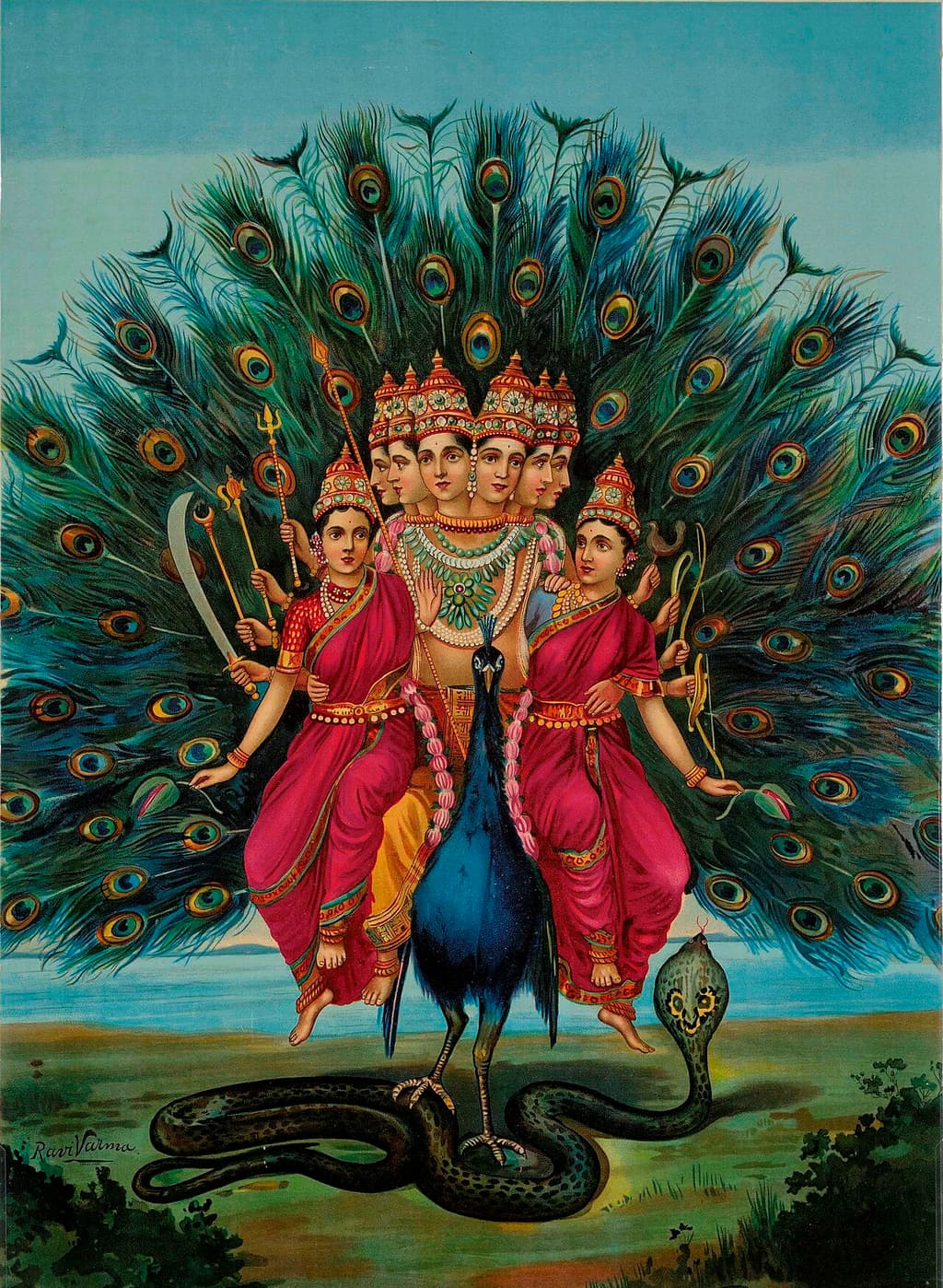
Two things are true at once about this god. In most of north India he is a minor figure with few temples, remembered mainly as Ganesha's brother. In Tamil country, Sri Lanka, Malaysia, Singapore and Mauritius he is Murugan, and the devotion directed at him is as intense as anything in the religious world — hook-swinging, spear-piercing, month-long walking pilgrimages, hillside temples with queues measured in hours. The same deity, two entirely different magnitudes, and the reasons are historical rather than theological.
Born to solve a military problem
The Sanskrit account, told fullest in the Skanda Purana and given its finest literary form in Kalidasa's Kumarasambhava, begins with a crisis. The demon Taraka holds a boon that only a son of Shiva can kill him, and Shiva is deep in ascetic withdrawal with no interest in producing one. The gods engineer his marriage to Parvati; the resulting seed is too potent to be carried, is taken up by Agni, passed to the Ganges, and deposited in a bed of sara reeds — hence Saravanabhava, "born in the reed thicket", one of his commonest names. Six Krittika women, the Pleiades, nurse the child, and he grows six heads to drink from all of them at once. Kartikeya means "son of the Krittikas".
He is made general of the divine army almost immediately and kills Taraka. Tamil tradition gives him a different principal enemy, Surapadma, who on defeat is split by the vel into a peacock and a rooster — and rather than being destroyed, becomes the god's mount and his banner. That resolution, in which the adversary is absorbed into the victor's iconography rather than annihilated, is characteristic of the Tamil material and has no real equivalent in the northern story.
The spear, and what he carries
His weapon is the vel, a broad-bladed spear given to him by his mother, and in many Tamil shrines the vel alone stands as the object of worship without any anthropomorphic image. He is Velan, the one with the spear. The peacock beneath him is usually shown with a serpent in its claws. He is depicted either as a beautiful young man — Kumara, the youth, Subrahmanya — or with six faces and twelve arms as Shanmukha.
His marital status splits by region, and the split is doctrinally load-bearing. Northern and Bengali tradition generally treats him as celibate. Tamil tradition gives him two wives: Deivanai, daughter of Indra, whom he marries formally, and Valli, a hill girl of the Kurava community whom he courts in the forest, with Ganesha helping by appearing as an elephant to frighten her towards him. The two marriages are read as the arranged and the chosen, or as the Sanskritic and the indigenous, and the presence of both is the clearest sign in his iconography that a Vedic-descended war god has merged with a Tamil hill deity.
Murugan is older than Skanda in Tamil
The oldest Tamil literature knows a god of the hills called Cheyon or Murugan, associated with the kurinji landscape, with youth and beauty and with ecstatic possession-dancing led by a priest called the velan. The Tirumurugatruppadai, a poem of the late Sangam era, is a guide directing a devotee from shrine to shrine and is one of the earliest sustained Tamil devotional works. The identification of that god with the Sanskrit Skanda happened over centuries and was never total: what Tamil devotion does with him — the possession, the vow-taking, the physical austerities — comes from the older stratum.
The Arupadai Veedu, six war camps, are the canonical pilgrimage temples: Palani, Tiruchendur on the sea, Swamimalai, Thiruparankundram, Pazhamudircholai and Thiruthani. Palani's hilltop image is famously made not of stone but of a hardened amalgam of medicinal materials whose composition is traditionally attributed to the siddha Bogar and has never been fully analysed.
Thaipusam, kavadi, and the physical vow
The festival of Thaipusam, in January or February, is the most visible expression of his cult. Devotees carry kavadi — ornamented arched burdens on the shoulders — and many take vows involving piercing of the cheeks, tongue and back with small spears and hooks, walking long distances in trance-like states with the support of drummers and family. It is done in fulfilment of a promise made when something was asked for, and the participants generally report no pain and no scarring.
At Batu Caves outside Kuala Lumpur the festival draws well over a million people up 272 steps past a 42-metre gilded statue of the god raised in 2006. Singapore's Thaipusam procession, Mauritius's Cavadee and the temples of Tamil Jaffna keep the same observance. Kataragama in southern Sri Lanka is stranger and more remarkable still: the shrine there is frequented by Hindus, Buddhists, Muslims at an adjacent mosque, and the indigenous Vedda community, and its deity has different names and different theologies for each.
Bengal keeps him separately again, as a handsome young man worshipped in his own right at Kartik Purnima and installed beside Durga during her autumn festival, with a specific local association: he is asked for sons.
A god who is also an argument about Tamil identity
Murugan is called Tamil Kadavul, the god of the Tamils, and that title has been in political use for over a century. The Tamil revival movements of the twentieth century made him a symbol of a religious tradition claimed as indigenous rather than imported from the Sanskrit north, and large-scale Murugan conferences and campaigns in the 2020s have kept that framing in the news. Devotion and cultural politics have run together here for a long time, and this page reports the association rather than adjudicating it.
Modern presence is mostly regional and mostly enormous: temple television channels, an entire genre of Tamil devotional song, the vel as a sticker on lorries and phone cases, and his name in dozens of forms — Murugan, Kumar, Skanda, Guha — as some of the commonest given names in south India and the Tamil diaspora.
Questions that follow from the six faces
Why did he fade in the north?
He clearly did not always lack standing there: Kushan coins depict Skanda under several names, Gupta-era inscriptions and temples honour him, and a Gupta emperor took the name Kumaragupta after him. His decline in the north over the following centuries coincides with the rise of Ganesha as the auspicious son and with the consolidation of Vaishnava and Shakta devotion. Some scholars also point to an association with childhood disease — the older Skanda literature includes grahas, seizing spirits that attack infants, and a god connected with that danger may simply have become one people preferred not to invite.
Is he the same as the elder or the younger brother?
Neither answer is universal: south Indian tradition typically makes Murugan the elder and Ganesha the younger, north Indian tradition reverses it, and both cite Puranic support. The circling-the-world contest that Ganesha wins by walking around his parents is usually told with the loser storming off in humiliation — and in Tamil versions that departure is why Murugan lives on a hill at Palani, alone, in the form of an ascetic wearing only a loincloth.
What is the connection to the Pleiades?
The Krittikas who nurse him are the star cluster, and the lunar month of Kartika is named from the same asterism. The link puts him in a small class of Indian deities with a direct calendrical and astronomical anchor, and the timing of his festivals in the Tamil months of Thai and Kartikai follows from it rather than from narrative convenience.
Why does the vel get worshipped without an image?
Because in the older Tamil stratum the god was present in the object and in the possessed body of the velan priest rather than in a sculpted form, and that mode of worship never disappeared. A spear planted in the ground at a hill shrine is not a symbol standing in for a deity who is elsewhere; the theology being enacted is that he is there.