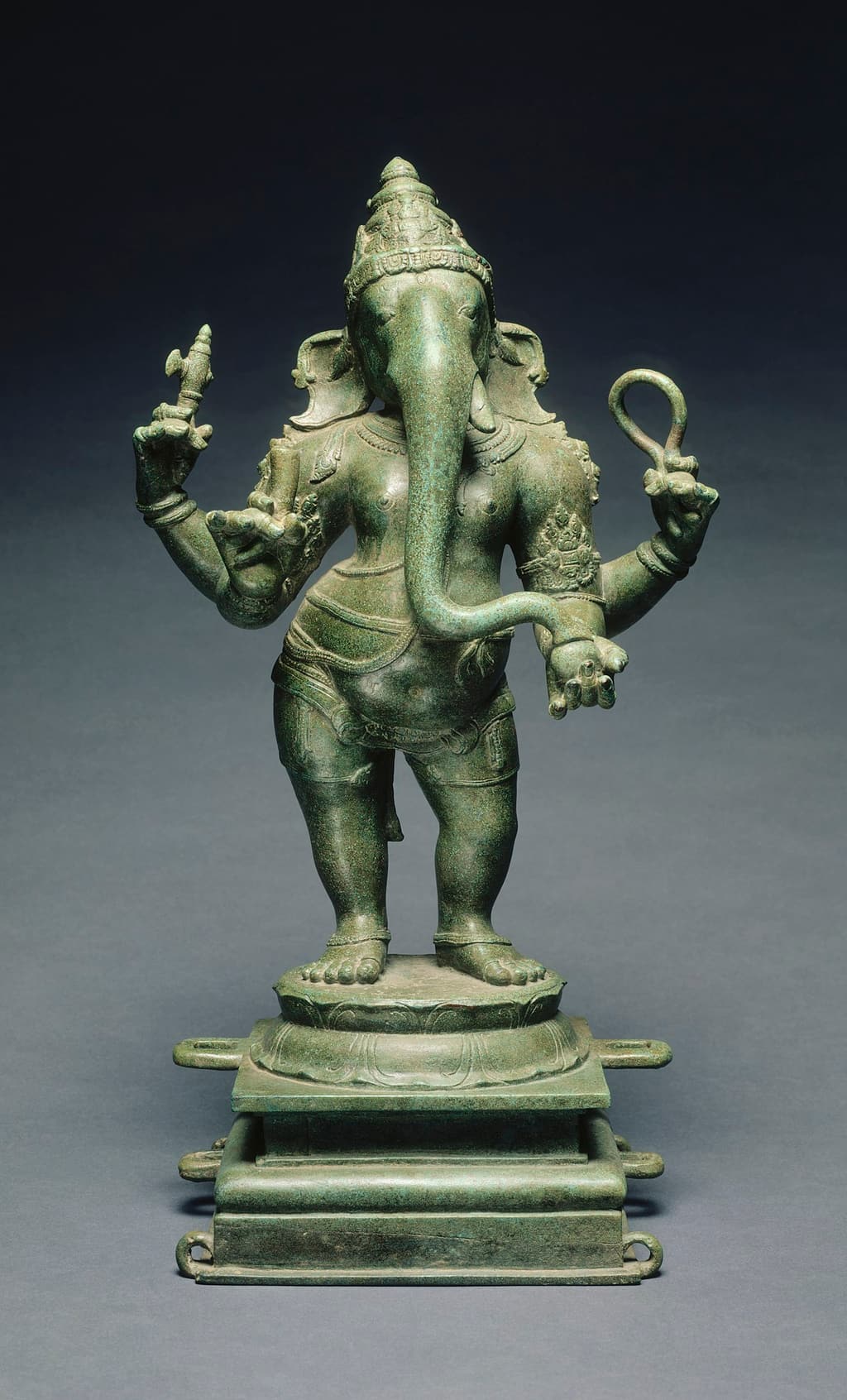
Before a wedding, before a business opens, before a book begins, before another god is invoked — Ganesha first. That precedence is the most concrete fact about him, more concrete than any of his stories, and it is why he is probably the most widely depicted deity in India regardless of which tradition a household belongs to. A Shaiva shrine and a Vaishnava shrine will disagree about almost everything and will both have him at the door.
He is worshipped daily across India, Nepal, Sri Lanka, Southeast Asia and the diaspora. The material below is the narrative and art-historical record, not a survey of that practice.
He is not in the Vedas, and the near-miss is instructive
Devotees sometimes point to Rigveda 2.23.1, which addresses a ganapati, lord of hosts. In context that verse is praising Brihaspati, the priest of the gods, and the word is a title rather than a name. What the older ritual literature does have is vinayakas: a set of troublesome spirits in the Manava Grihyasutra who possess people and obstruct undertakings, and who have to be propitiated with offerings at a crossroads. The elephant-headed remover of obstacles who emerges in sculpture around the fourth and fifth centuries CE inherits that name and, importantly, that job description in both directions. He is Vighnaharta, obstacle-remover, and Vighnakarta, obstacle-placer. The obstacles are his to give as well as to take away, which is a far older and stranger idea than the cheerful sweets-and-good-luck version suggests.
Several incompatible accounts of the head
The tradition has not agreed on how he acquired an elephant's head, and the disagreement is not a matter of minor variants. These are separate stories with separate morals.
- The Shiva Purana's version, the best known: Parvati forms a boy from the substance of her own body while bathing and posts him at the door with instructions to let nobody in. Shiva arrives, is refused entry to his own house by a child he has never seen, and beheads him. Parvati's grief is such that the head of the first north-facing creature found — an elephant — is fetched and fitted. The point of the story is that the god's origin is entirely maternal, and Shaiva and Shakta readers take rather different things from that.
- The Brahma Vaivarta Purana's version: the child is born normally and beautiful, and the gods come to bless him. Shani, the planet Saturn, whose gaze destroys what it falls on, tries to look away; pressed to look, he incinerates the head, and an elephant's is supplied. Here nobody is at fault and the culprit is a planetary force with a known and feared property.
- Other Puranic passages have him born from Shiva's laughter, or created specifically to obstruct the wicked, or given the head as a deliberate deformity to prevent vanity.
The broken tusk has two competing explanations as well. In one, he loses it in a fight with Parashurama, whose axe he declines to dodge because it was his own father's gift. In the other, more attractive one, Vyasa needs a scribe who can keep up while he dictates the Mahabharata; Ganesha accepts on condition the dictation never pauses, Vyasa counters that he must understand each verse before writing it, and when the pen fails Ganesha snaps off a tusk and carries on. The greatest poem in Sanskrit is thus written by a god using part of his own body, under a contract, with each party trying to outmanoeuvre the other.
Mouse, modak, and the rest of the iconography
His mount is a mouse or rat, and the disproportion is the meaning: the vast is carried by the negligible, or desire and pilfering appetite are ridden rather than killed. He is usually shown with a bowl of modak, steamed sweet dumplings, and is unembarrassed about eating them. One hand holds a noose to pull devotees closer, another an elephant goad to prod them along; a broken tusk is held like a stylus. The trunk curling left or right is a real distinction in temple practice, the right-curled Siddhi Vinayaka being considered more potent and more demanding to serve properly.
He is the elder or younger brother of Kartikeya depending on the region — north Indian and south Indian sources reverse the order — and the two are set against each other in a famous contest to circle the world, which Ganesha wins by walking around his parents and declaring that they are the world. His two consorts Siddhi and Buddhi, accomplishment and intelligence, are largely allegorical; in most of south India he is a celibate. The family diagram marks the sibling-order disagreement rather than picking a side.
Ganesh Chaturthi and a political decision
The ten-day festival in late summer is now the most visible Hindu festival in western India: household and neighbourhood images installed, worshipped, and then carried in procession for immersion in river or sea. The domestic version is old. The mass public version is datable and deliberate. In 1893 Bal Gangadhar Tilak promoted large communal Ganesh pandals in Pune and Bombay, in part because colonial restrictions on political assembly did not extend to religious gatherings. The festival became an organising structure for the nationalist movement, and its scale today descends directly from that decision.
The immersion has since become an environmental problem of its own. Plaster-of-Paris images with lead and chromium paints do not dissolve and do not stop being toxic; Indian pollution authorities have pushed clay images and artificial immersion tanks for two decades, with genuine but uneven success.
Siddhivinayak in Mumbai is the best-known temple. The eight Ashtavinayak shrines around Pune form a fixed pilgrimage circuit to self-manifested images, each with its own local legend. In Tamil Nadu the Ucchi Pillayar temple sits on the rock at Tiruchirappalli, and the Pillaiyar of the roadside shrine is ubiquitous.
The god who travelled furthest
Ganesha moved along trade routes better than almost any Indian deity.
- In Japan he is Kangiten or Shōten, in esoteric Buddhism, most often in a dual form of two embracing elephant-headed figures — an image kept largely hidden from public view and served with oil offerings.
- In Thailand he is Phra Phikanet, patron of arts and commerce, whose head is the emblem of the Fine Arts Department; shrines to him stand outside shopping centres in Bangkok and draw non-Hindu worshippers.
- In Indonesia, a magnificent Javanese Ganesha appeared on the 20,000-rupiah note issued in 1998, and stone images survive across Java and Bali.
- Tibetan and Chinese Buddhism carried him too, sometimes as a protector and sometimes as a subdued obstacle-demon, depending on the lineage.
Milk, sneakers and a very online god
In September 1995 images of Ganesha across India and then in temples worldwide were reported to be drinking spoonfuls of milk; the phenomenon lasted about a day, drew enormous crowds, and was attributed by physicists to capillary action and surface tension on stone and metal. Whatever the mechanism, it remains one of the best-documented mass religious events of the late twentieth century.
Less happily, his image has repeatedly been printed on shoes, swimwear, beer bottles and lavatory seats by Western manufacturers, each time followed by a campaign and a withdrawal. The pattern is consistent enough to be predictable: a god who reads as decorative and friendly is treated as a graphic. Alongside that, Amar Chitra Katha's comics and a steady output of Indian animated features have kept his stories in circulation for children, and his name in its several forms is a common given name across India.
Questions that come up around the elephant head
Is he a Hindu god or a Buddhist and Jain one too?
All three, with different jobs. Jain texts include him among worshipped figures and Jain temples in Rajasthan and Gujarat have Ganesha images. Buddhist tantra took him in both as Vinayaka the obstacle and as a deity of removal. The transmission is one of the clearest cases of a figure moving between Indian religions rather than being confined to one.
Why does the writing story matter so much to students?
Because he is invoked at the start of manuscripts, which is why so many Sanskrit texts open with a salutation to him and why the mark shri ganeshaya namah heads account books and school exercise books. In Maharashtra and Karnataka a child's first written letters are still often traced during his festival. The scribal role is not decorative — it is where the phrase "to do the ganesh" as a synonym for making a beginning comes from in several Indian languages.
What is the significance of his single tusk in Buddhist and philosophical readings?
Commentators gloss Ekadanta as the one who has passed beyond duality: the pair reduced to one. It is a later interpretive layer sitting on top of narratives that explain the tusk as an accident or a sacrifice, and both readings circulate simultaneously in devotional literature without anyone treating that as a contradiction.
Are the incompatible birth stories a problem for worshippers?
Generally not, and the reason is worth understanding. The Puranas are sectarian compilations that grew over centuries, and each records the version its community told; a devotee typically knows one story well, knows others exist, and does not expect the corpus to behave like a single-authored scripture. Treating variance as error is a habit imported from traditions built around one book.