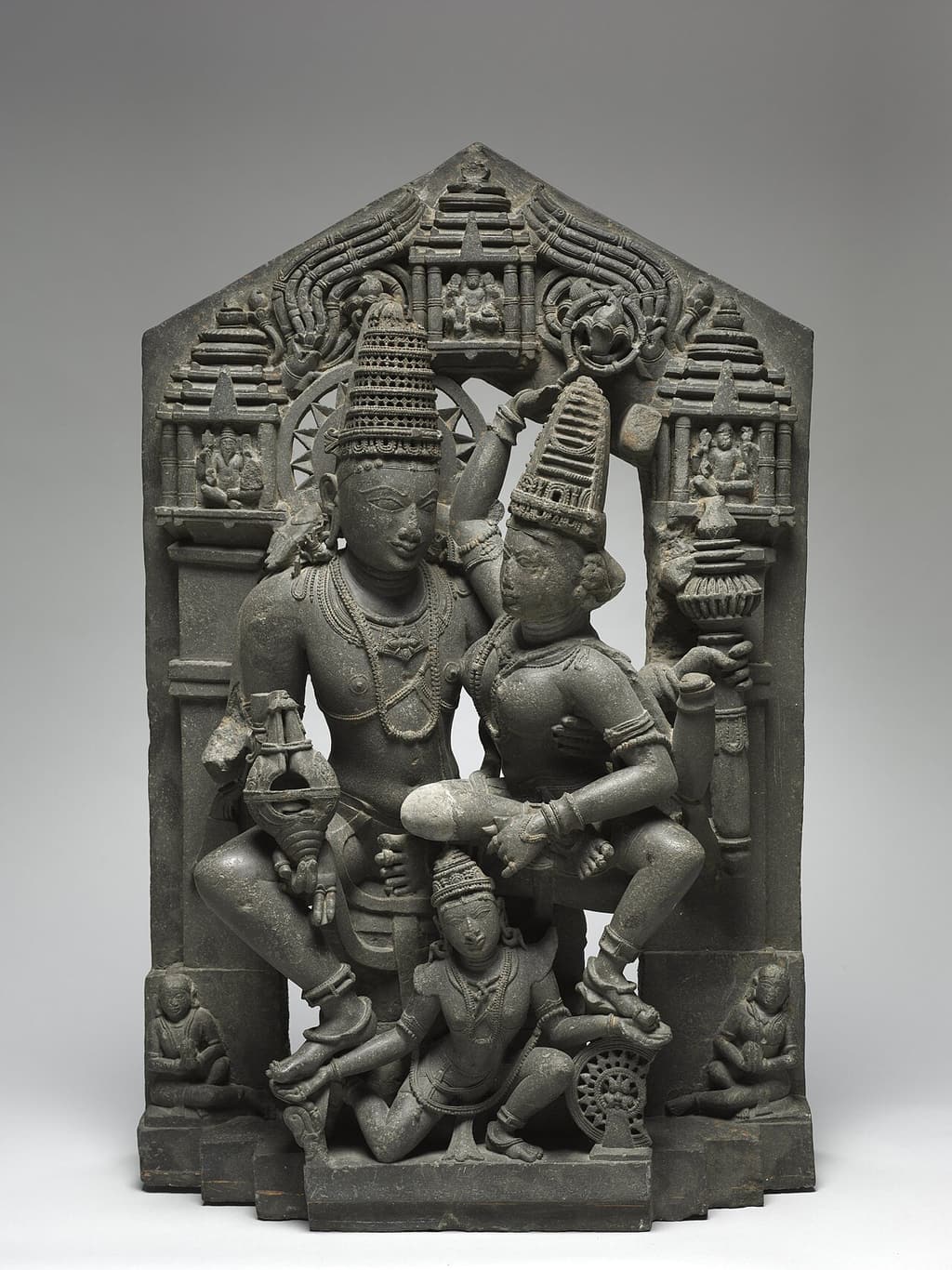
The best-documented promotion in the history of religion belongs to Vishnu. In the Rigveda he is a minor figure with about five hymns to his name, remembered for one trick: he covers the whole universe in three strides. Two thousand years later he is, for a large share of the world's Hindus, the thing that exists — the sustainer inside whom the universe is a passing dream, who has come down into the world nine times already and will come once more. Nobody edited the older text to help. Both layers are still read.
Vaishnavism is a living tradition with an enormous present-day following, and what follows treats the classical corpus as literature and history without implying that its subject belongs to the past.
Three strides, and a god who begins as a favour
The Vedic Vishnu is a helper. He is Indra's ally in the fight against Vritra, and his own signature act, the trivikrama, is described in Rigveda 1.154 and elsewhere: he paces out the earth, the air and the sky in three steps, the third of which lands somewhere no bird can follow. The hymns give him the epithet Urukrama, wide-striding. There is no preservation, no discus, no ocean of milk, no Lakshmi, and no avatars.
What happens next happens outside the Vedic hymns, in at least three streams that later merge:
- Narayana, a cosmic figure of the Brahmanas and of parts of the Mahabharata, associated with the primeval waters, from whose name the whole later theology of a god resting on the cosmic ocean grows.
- Vasudeva-Krishna, worshipped by the Bhagavata movement in western India, and attested epigraphically far earlier than most people expect: the Heliodorus pillar at Besnagar, erected around 113 BCE by a Greek ambassador from Taxila who calls himself a Bhagavata and dedicates a Garuda column to Vasudeva, the god of gods.
- The three-strider himself, who supplies the cosmic scale.
By the time of the Vishnu Purana these are one god with one theology, and the Vedic stride is retold as the Vamana avatar — the dwarf who asks the demon king Bali for three paces of ground and then takes the universe.
The ten descents, which are not ten in every book
An avatara is a "descent": the god entering the world in a bounded form when order has collapsed. The Bhagavad Gita gives the doctrine its most quoted statement, that whenever righteousness declines he takes birth again. The standard list of ten runs Matsya the fish, Kurma the tortoise, Varaha the boar, Narasimha the man-lion, Vamana the dwarf, Parashurama the axe-wielding brahmin, Rama, Krishna, the Buddha, and Kalki, who has not come yet and arrives on a white horse.
The list is not stable and pretending otherwise misrepresents the sources. The Bhagavata Purana opens by counting twenty-two descents and then says they are innumerable, and it treats Krishna not as one avatar among ten but as the source of all of them. Several traditions substitute Balarama for the Buddha; Gaudiya Vaishnavas do so as a matter of doctrine. The Buddha's inclusion at all is a piece of theological diplomacy that reads very differently depending on which Purana you open: some present it as gracious absorption, at least one as a deliberate deception to mislead the wicked. Jayadeva's twelfth-century Gita Govinda fixed the ten in poetry and in sculpture, which is why the ten feel canonical.
What he holds, what he rides, where he sleeps
Vishnu is normally four-armed and carries the Sudarshana discus, the Panchajanya conch, the Kaumodaki mace and a lotus — force, sound, authority and creation, with the discus important enough to have acquired its own temples and its own personified form. On his chest is the shrivatsa curl and the Kaustubha jewel. He rides Garuda, and between world-cycles he lies asleep on the coils of the serpent Shesha on the ocean of milk, with Lakshmi at his feet and a lotus rising from his navel carrying Brahma. That composition — Anantashayana — is one of the great subjects of Indian art, carved at Deogarh in the sixth century and at Angkor a thousand kilometres and six hundred years away.
His paradise is Vaikuntha. His thousand names, the Vishnu Sahasranama, sit inside the Mahabharata itself and are recited daily in millions of households.
The temples are not museums
- Tirumala–Tirupati in Andhra Pradesh, where he is Venkateswara, receives tens of millions of pilgrims a year and is among the wealthiest religious institutions on earth. Head-shaving as an offering is the visible custom there.
- Srirangam near Tiruchirappalli, where he reclines as Ranganatha, is the largest functioning Hindu temple complex in the world by enclosed area, seven concentric walls with a living town inside them.
- Badrinath in the Himalaya closes under snow for six months each year, and its reopening date is announced ritually.
- Puri in Odisha honours him as Jagannath in a form so unlike standard iconography — a wide-eyed wooden figure with stump arms, renewed periodically in a ceremony that buries the old body — that its non-Sanskritic origins are widely accepted.
- Angkor Wat was built in the twelfth century by Suryavarman II as a Vishnu temple, before Cambodia's shift to Buddhism, and its west-facing orientation and churning-of-the-ocean reliefs are Vaishnava statements in stone.
Ekadashi, the eleventh day of each lunar fortnight, is kept as a fast by Vaishnavas; the four monsoon months of Chaturmasya are counted as his sleep, which is why weddings are avoided in them.
Ramanuja, Madhva, and the Tamil poets who came first
The philosophical Vaishnavism most people encounter is south Indian and medieval. Before it came the twelve Alvars, Tamil poet-saints of roughly the sixth to ninth centuries whose four thousand verses, the Nalayira Divya Prabandham, are sung in temples as scripture and which include Andal, a woman who addresses the god as a lover and is worshipped in her own right. The 108 shrines they praise are the Divya Desams, and the pilgrimage map of Sri Vaishnavism is essentially their itinerary.
Ramanuja (traditionally 1017–1137) built the vishishtadvaita system on that devotional base: the world and souls are real and are the body of God, against Shankara's non-dualism. Madhva in the thirteenth century went further and argued for outright difference between soul and God. These are not footnotes; they are the reason "Hinduism" cannot be given one doctrine of the divine.
Who is supreme, honestly
A Vaishnava text will tell you Vishnu is the ultimate reality and Shiva a great deity subordinate to him. A Shaiva text reverses it exactly, and the Devi Mahatmya puts the Goddess above both. These are not confusions to be resolved by averaging; they are the positions of distinct traditions with their own scriptures, and each Purana argues its own side, sometimes by retelling the same episode with the winner swapped. The tradition overview sets out how that sectarian layering works across the corpus.
Reading him in the last hundred years
Vishnu himself is oddly under-served by pop culture compared with his own avatars — the Ramanand Sagar television Ramayan and B. R. Chopra's Mahabharat made Rama and Krishna household images in the late 1980s in a way the source god never quite matched. The most-quoted line in the West nominally about Vishnu is not about him at all: Robert Oppenheimer's "Now I am become Death" comes from chapter eleven of the Gita, spoken by Krishna revealing his universal form, and the choice of that verse to describe a weapon test is a piece of Western reading the tradition itself would find strange. Amar Chitra Katha's comics, running since 1967, gave two generations of Indian children the avatar sequence in a fixed visual order. More recently the 2024 Telugu film Kalki 2898 AD built a science-fiction franchise on the tenth, unarrived avatar — a story that has to be set in the future because the text leaves it there.
Questions the avatar doctrine raises
Does an avatar know he is God?
The texts disagree deliberately. Rama in Valmiki's telling behaves largely as a man, and the divinity is asserted by the frame rather than by him; later Ramayanas including Tulsidas's make it explicit throughout. Krishna in the Gita states it outright and then shows it. Vaishnava theologians turned this into a distinction between full descents and partial ones, which is a systematised answer to a genuine unevenness in the stories.
Why is the fish avatar first?
Because the sequence begins with a flood. Matsya warns Manu, the first man, tows his boat to safety and preserves the Vedas — the Indian version of a story attested from Mesopotamia westward, and one that a comparison of flood narratives can set beside its neighbours. Some modern readers claim the ten-avatar order encodes evolution, from fish to amphibian to mammal to man; that reading dates from the nineteenth century, not from the Puranas.
What is the shaligram on a Vaishnava household shrine?
A fossil-bearing ammonite stone from the Gandaki river in Nepal, worshipped as Vishnu himself without any carving. It is one of the few objects in Hindu practice held to require no consecration, and its trade and export are now regulated by Nepal.
Is Vaikuntha a place you go after death?
In the mainstream Sri Vaishnava account it is a state of unending nearness to God rather than a location with weather, though the Puranas describe it lavishly as a city of gold on a lotus lake. The important doctrinal point is that arrival there ends rebirth, which is not true of the ordinary heavens the Puranas fill with pleasure-seeking souls who eventually fall out again.