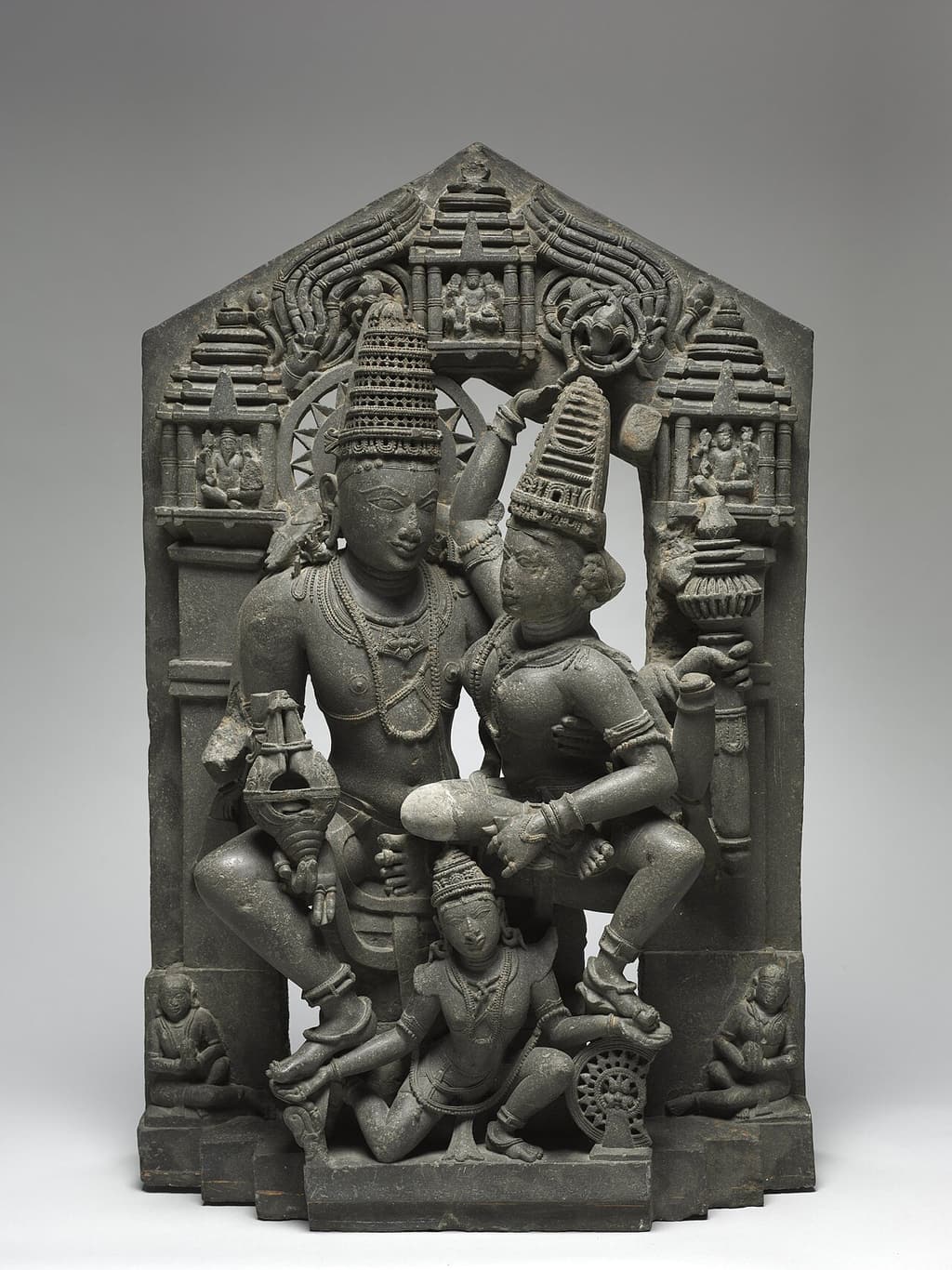
The story of how Garuda came to carry Vishnu is, unusually, a negotiation between equals. He has just fought his way into heaven, defeated the assembled gods, and taken the pot of amrita — and he has not drunk any of it, because he needs it as a ransom and stealing it for himself was never the plan. Vishnu, impressed by the restraint, offers him a boon; Garuda asks to be immortal without drinking, and to rank above him. Vishnu grants both, then asks a boon in return, and takes the eagle for his mount and his banner. Nobody in the exchange is commanded.
A bet, a slavery, and a bird born angry
The Adi Parva of the Mahabharata sets it up. The sage Kashyapa's wives Vinata and Kadru wager on the colour of the tail of Uchchaihshravas, the horse of the gods, produced by the churning of the ocean. Kadru, mother of the serpents, says black; Vinata says white; the loser becomes the winner's slave. Kadru instructs her naga sons to cling to the tail and darken it. Some refuse and are cursed for it, but enough comply, and Vinata loses.
Her second egg hatches into Garuda, already enormous, whose radiance is so great that the gods mistake him for Agni and praise him until he agrees to reduce it. Told that his mother's release requires the nectar of immortality, he goes to fetch it. On the way, hungry, he is directed by his father to eat a fighting elephant and tortoise gripped in each other's death-lock — and, finding no branch strong enough to perch on with them, breaks one, on which the tiny Valakhilya sages are hanging upside down in austerity.
The nectar is guarded by a wall of flame, a rotating wheel of blades, and two serpents whose gaze kills. He puts the fire out with river water carried in his beak, shrinks to pass the wheel, throws dust in the snakes' eyes and goes through.
Why snakes are his food, and why their tongues are forked
Indra catches him in flight and his thunderbolt does no more than dislodge a feather. They come to terms instead: Garuda will deliver the pot as agreed, freeing his mother, but Indra may retrieve it afterwards, and Garuda receives the serpents as his food in compensation. He sets the pot down on sharp darbha grass and tells the nagas to purify themselves before drinking. While they are gone Indra takes it back, and the snakes, returning, lick the grass where it stood — which splits their tongues, and is the reason they are forked.
That enmity is the fixed fact about him. In temple sculpture across South and Southeast Asia he is shown with a serpent in his talons or his beak, and the Garuda mantras and the garudi tradition of snakebite healing invoke him directly, with practitioners in parts of India still called by his name.
The bird at the temple door
In a Vishnu temple, the pillar directly in front of the sanctum is the Garuda stambha, and the image on it faces the deity rather than the visitor: he is the first devotee, permanently attending. During festivals the god is carried out on a Garuda vahana, and Garuda seva at Tirupati draws crowds that require crowd control on the scale of a stadium.
He is also, oddly, a death-rite figure. The Garuda Purana takes its name from being narrated to him by Vishnu, and its later sections on the fate of the soul are recited during the mourning period in many Hindu households, which means the name most associated with funerals in north India belongs to a bird.
His brother is Aruna, the dawn, charioteer of Surya, hatched prematurely and therefore incomplete below the waist — a consequence of the same impatient mother.
A national emblem in three countries
Garuda travelled with Indian religion into Southeast Asia and stayed after the religion changed.
- Indonesia takes him as its national symbol: the Garuda Pancasila, whose feathers are numbered for the date of independence, and whose state airline carries the name. The 121-metre Garuda Wisnu Kencana statue completed in Bali in 2018 is among the tallest sculptures anywhere.
- Thailand uses the Khrut as the royal emblem, and a garuda plaque displayed on a business signifies a royal warrant — a mythological bird functioning as a trademark register.
- Mongolia's capital Ulaanbaatar carries the Khangarid on its arms, a Buddhist descendant of the same figure.
- Buddhism treats garudas as a whole class of beings perpetually at war with the nagas, and Tibetan tradition merges the figure with the indigenous Khyung.
The Nepali royal army's Garuda regiments, Indian air force squadron insignia and a special-forces unit all borrow him, which is a natural fit for a creature whose defining act is a raid.
Points that come up about the eagle of Vishnu
What kind of bird is he, exactly?
The texts describe a composite: an eagle's wings and beak with a man's torso, arms and legs, sometimes with a bird's head and sometimes a human one with a beaked nose. The identification with a specific species is a modern preoccupation; the brahminy kite, whose reddish-brown body and white head are conspicuous over Indian coasts, is the bird most often pointed to in popular explanation and is regarded as auspicious for that reason, particularly in Tamil Nadu.
Is he related to Jatayu and Sampati?
They are usually given as sons of Aruna, which makes them his nephews rather than his sons, though the genealogies vary. The vulture Jatayu who dies trying to stop Ravana's chariot in the Ramayana belongs to the same family of noble birds and does the same kind of thing — a self-sacrificing intervention against a stronger opponent — which suggests the type mattered more than the pedigree.
Why does he outrank Vishnu in the boon?
Because he asked, and because the story is interested in the fact that he asked. The usual gloss is that the banner is carried above the god, so the position is literal rather than a claim to superiority. Sri Vaishnava commentary treats the whole episode as a lesson about service freely undertaken: a servant who was compelled would be worth less, which is why the text is careful that Garuda never drinks the nectar he could have.
Does he appear in Vedic literature?
Not by that name. A great solar bird called Suparna or Shyena appears in the Rigveda, notably as the falcon who brings soma down from heaven — a theft of a divine drink by a bird, which is structurally the same story and is the likeliest ancestor of the Mahabharata narrative. The comparison of divine birds across traditions places that motif in a wider frame.