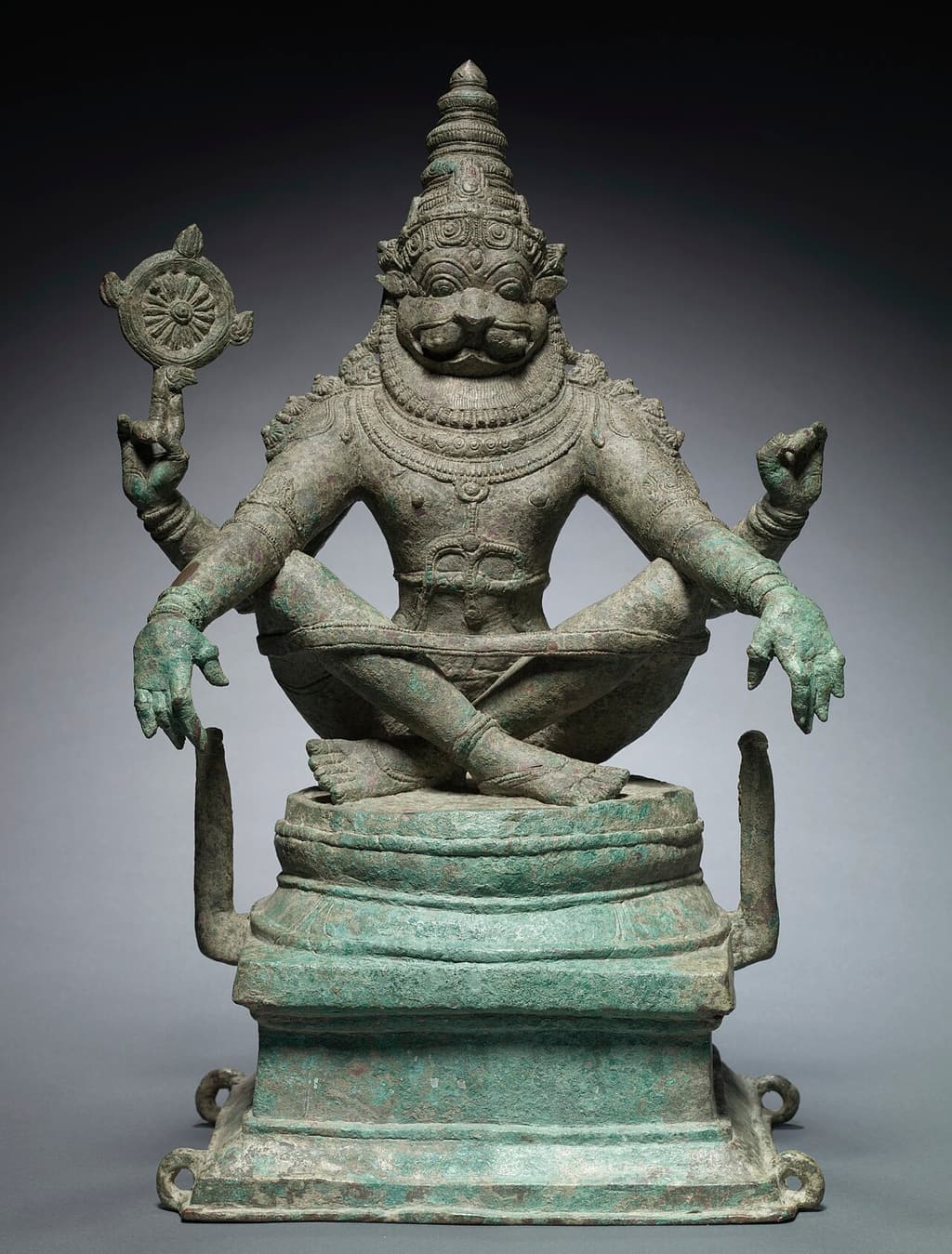
The finest piece of legal reasoning in Indian mythology is executed by something with claws. Hiranyakashipu had asked Brahma for a boon closing every avenue he could think of: that he not be killed by man or animal, by god or demon, indoors or outdoors, by day or by night, on the earth or in the sky, by any weapon animate or inanimate. Brahma granted it. What emerges from the pillar at dusk is neither man nor lion, sets him on its thighs on a threshold, and opens him with its claws. Every clause is honoured and the man dies anyway.
The son who would not stop praying
The narrative comes in full in the seventh book of the Bhagavata Purana, with versions in the Vishnu and Narasimha Puranas. Hiranyakashipu's hatred of Vishnu is personal — his brother Hiranyaksha was killed by Vishnu in the boar incarnation — and he has extracted his boon in order to make himself the only object of worship in the world. His own son Prahlada is a devotee from birth.
What follows is a catalogue of attempted filicide told with unusual coldness: the boy is poisoned, thrown from a height, trampled by elephants, bound and cast into the sea, and burnt on a pyre in the lap of his aunt Holika, who is immune to fire and is destroyed while he is untouched. Between attempts he goes back to his lessons and turns his tutors' curriculum into theology.
The climax is a question and a dare. Is your god in this pillar, his father asks, and strikes it. He is.
What the image is doing
The iconography is unusually specific because the conditions of the boon are unusually specific, and sculptors know they are illustrating a proof. Narasimha sits on the doorstep — neither in nor out. The victim lies across his lap — neither on ground nor in air. The light is dusk — neither day nor night. The claws are neither animate weapon nor inanimate. The head is a lion's, the body a man's.
Three main types recur in temple sculpture:
- Ugra or Sthauna Narasimha, the wrathful killing form, mane flared, entrails in his hands. This is the type that requires cooling rites.
- Yoga Narasimha, seated in meditation with a yoga strap around his knees — the same being at rest, and a favourite of Vijayanagara sculptors.
- Lakshmi Narasimha, with the goddess on his knee, which is the form used domestically because it is safe to keep at home.
Hampi's monolithic Ugra Narasimha, carved in 1528 under Krishnadevaraya, still sits where it was cut, damaged, enormous and unmistakably angry; the figure of Lakshmi who was seated on his knee has been broken away, and only her hand remains on his back.
The temples where he has to be calmed
His cult is strongest in Andhra Pradesh, Telangana and Karnataka, and it has a distinctive feature: much of the ritual is about managing his heat.
- Ahobilam in the Nallamala hills is the mythic site of the killing and comprises nine separate Narasimha shrines scattered across steep terrain, a pilgrimage that takes days on foot. The Ahobila Mutt, a Sri Vaishnava monastic lineage, has been headquartered there since the fourteenth century.
- Simhachalam near Visakhapatnam keeps the image entirely encased in sandalwood paste all year, and uncovers it for a single day at Chandanotsavam in spring, when very large crowds come to see the actual form. The stated reason is that the deity is too hot to be left exposed.
- Yadadri in Telangana, cut into a hillside cave, has been rebuilt at great expense in the last decade.
- Melkote, Namakkal and a long list of others carry major images, and the Narasimha Kavacha, an armour-hymn, is recited for protection.
Narasimha Jayanti falls in April or May and is kept with a fast broken at dusk, matching the hour of the appearance. The festival of Holi connects to the same story from the other end: the bonfire on the eve, Holika Dahan, commemorates the aunt who burned instead of the boy, and the following day's colours are the survival celebrated.
Why he matters theologically
Narasimha is the avatar that Vaishnava devotion reaches for when the point being made is protection rather than teaching. The doctrinal claim built on him is that God's response to a devotee in danger is immediate, unbounded by form, and not required to be dignified — he arrives as a monster because a monster is what the situation needs. Sri Vaishnava commentators dwell on the fact that he appears without being asked, since Prahlada never demanded rescue.
The Prahlada story also carries an implicit social argument that later devotional movements used heavily: the boy is a daitya, born on the wrong side of the cosmic divide entirely, and his devotion counts for more than his ancestry. Bhakti poets across several centuries returned to that point.
Later life
He is standard in Amar Chitra Katha's avatar sequence and in the mythological television serials, where the pillar-splitting is a reliable set piece. Sculptural Narasimhas from Hampi and Ahobilam are among the most photographed images of Indian art, which means that a great many people who could not name him have seen him. He appears in Javanese and Cambodian temple relief, and in Nepal his image guards palace entrances — an appropriate posting for a deity whose defining act took place in a doorway. His name is used for children, particularly in the Telugu-speaking regions, in forms such as Narasimha, Simha and Nrisimha, and one Indian prime minister carried it.
Questions the boon leaves open
Why does Brahma grant a boon like that in the first place?
Because in the Puranic system austerity generates a claim that cannot be refused, and Brahma is the god who must appear when the heat becomes intolerable. He is not choosing to arm a tyrant; he is paying out on a contract. This makes him the standard supplier of the crises the other gods then have to resolve, and it is a structural feature of Puranic plotting rather than a lapse of divine judgement.
Is Narasimha worshipped as more than an avatar anywhere?
Yes. In parts of south India and in Nepal he functions as a principal deity with independent temples, festivals and initiatory mantras, and some Sri Vaishnava and tantric traditions treat the Narasimha mantra as a complete practice rather than an ancillary one. The distinction between a form of Vishnu and a deity in his own right is not sharply drawn in practice, and the tradition overview explains why that fluidity is normal rather than confused.
Who calms him after the killing?
The accounts differ, which is itself informative. In some, Prahlada's praise alone settles him. In others the gods send Lakshmi. A distinctively Shaiva version has Shiva take the form of Sharabha, a composite of lion, bird and man, to subdue him — a sectarian riposte that Vaishnava texts reject vigorously, and one of the clearest examples on this site of two traditions telling the same episode with the winner reversed.
Is the man-lion related to other hybrid guardians?
Composite lion-human figures recur widely, and the temptation to link Narasimha with sphinxes and with Mesopotamian lion-men is old. The honest position is that lion-hybrid guardians are a near-universal solution to the problem of representing controlled ferocity, and that no transmission has been demonstrated in this case. What is specific to Narasimha is that his hybridity is not decorative — it is the mechanism by which a contract is defeated.