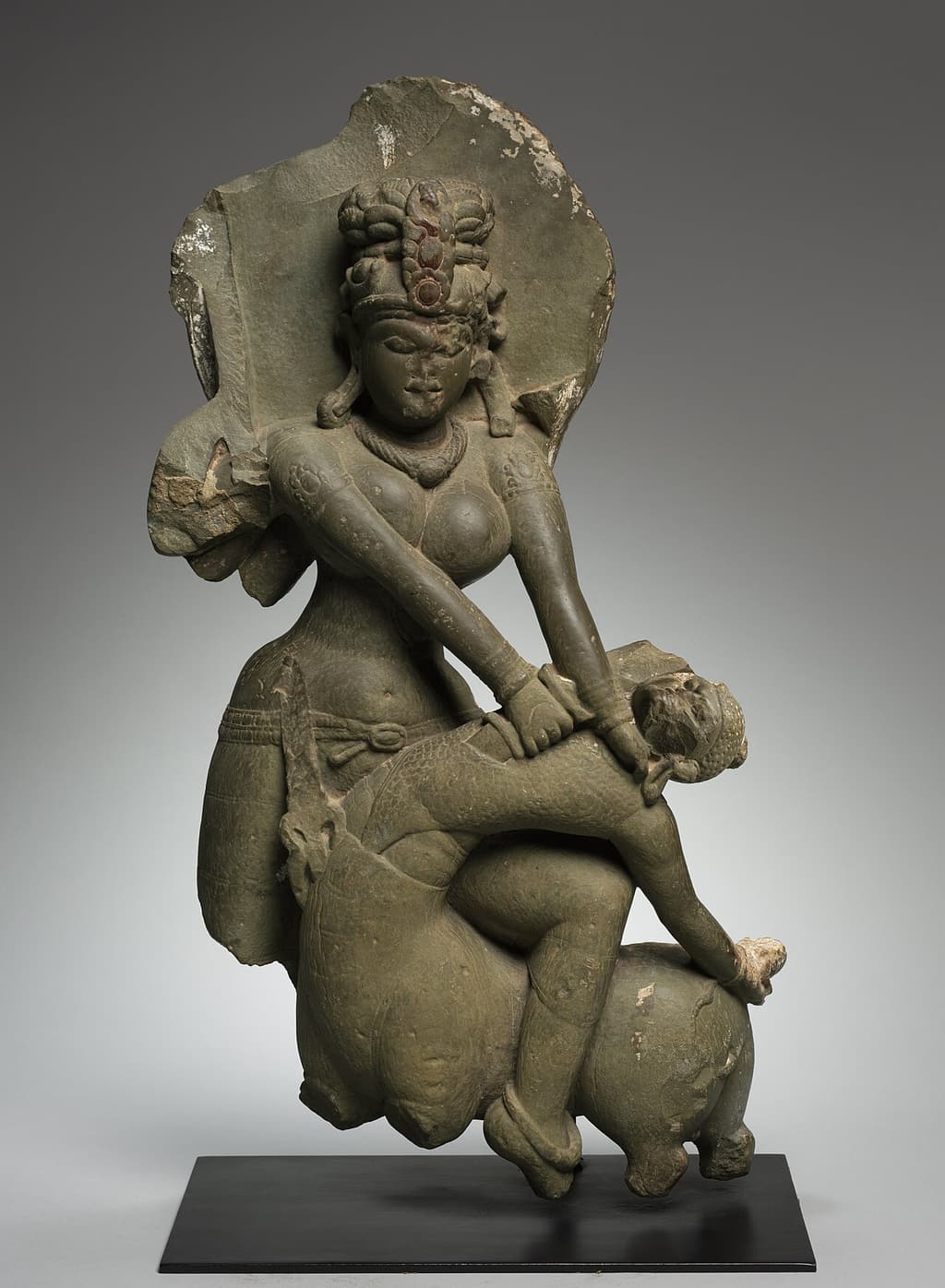
Around the fifth or sixth century CE, seven hundred verses were inserted into the Markandeya Purana that changed the shape of Indian religion. The Devi Mahatmya — also called the Durga Saptashati or simply Chandi — is the first Sanskrit text in which a goddess is not a consort, not an attribute of a god, and not a local power to be honoured on the way past, but the ground of the universe from which the male gods derive their capacity to act. Everything that follows in Shakta theology is commentary on it, and it is recited in full, aloud, every autumn by very large numbers of people.
The text, and its three battles
The Devi Mahatmya is structured as three episodes told to a deposed king and a defrauded merchant by a forest sage, and its argument is built into that framing: both men have been ruined by attachment, and the goddess is presented as the power that both binds and releases.
- In the first, the goddess is Mahamaya, the sleep in which Vishnu lies on the cosmic ocean. She withdraws from him so he can wake and deal with two demons, which establishes at the outset that a great god's action is her doing.
- In the second, the buffalo demon Mahishasura has driven the gods out of heaven under a boon that no man and no god can kill him. Their combined anger streams out of them as light and consolidates into a woman: Shiva's energy forms her face, Vishnu's her arms, Yama's her hair, and each god arms her with a duplicate of his own weapon. She laughs, and the sound cracks the sky. Mahisha shifts shape through buffalo, lion, man and elephant as she fights him, and she pins the buffalo with her foot and spears him as he emerges from its neck. That instant — Mahishasuramardini, the crushing of the buffalo demon — is the single most reproduced image in Indian sculpture after the dancing Shiva.
- In the third, against Shumbha and Nishumbha, she multiplies. The Matrikas, mother goddesses, come out of the male gods to fight beside her, and Kali emerges from her own forehead. The demon Raktabija, from each drop of whose blood a duplicate springs, is defeated only when Kali drinks the blood before it can land. Asked at the climax why she needs helpers, the goddess absorbs them all back into herself and states that there is only ever one of her.
Where she came from, which is a real question
The scholarly position that Durga was originally a non-Vedic goddess absorbed into the Sanskrit tradition rests on evidence that is not decorative. She has no Vedic ancestry worth the name. Her associations in early literature are with the Vindhya hills, with forest peoples, with wine and with flesh offerings — she is called Vindhyavasini, dweller in the Vindhyas — and buffalo sacrifice, still performed at some of her temples, is entirely outside Vedic norms. Her lion or tiger mount and her independence from any husband both mark her out from the consort goddesses. The counter-argument, that she develops from within the tradition out of Vedic figures like Ambika and Ratri and the Vac hymn, is seriously made and not absurd. What is not defensible is treating either account as settled.
There is a further complication that is not academic at all. Among some Asur, Santal and other Adivasi communities in Jharkhand and neighbouring states, Mahishasura is remembered as an ancestral king killed by treachery, and his death is mourned rather than celebrated. Observances on that basis have been held since at least the early 2010s and became the subject of a parliamentary row in 2016. Whatever one makes of the historical claims, the existence of communities who read the central myth from the losing side is a fact about it.
Ten arms and the meaning of borrowed weapons
She is normally shown with eight, ten or eighteen arms, each holding a weapon given by a specific deity: the trident from Shiva, the discus from Vishnu, the thunderbolt from Indra, the bow from Vayu, the noose from Varuna, the spear from Agni. The theological content of that arrangement is precise. She is not equipped by the gods as a subordinate would be; the text says their powers left them and became her, which is why they are spectators for the rest of the fight. Her calm face above a violent body is a deliberate convention — the sculptors of the Mahishasuramardini panels at Mamallapuram and Ellora keep the expression serene while the composition is all diagonal force.
Her name means the unassailable, or the fort, or the one difficult to approach, and Durgatinashini, destroyer of distress, is a common expansion of it.
Durga Puja, and what a festival can become
The autumn festival in Bengal, Assam, Odisha and Tripura is now among the largest religious events anywhere, and it has an unusual character: for five days the goddess is treated as a married daughter visiting her parents' home with her children — Ganesha, Kartikeya, Lakshmi and Saraswati are installed with her — and the emotional register of the last day is a family seeing a daughter off, not a triumph over a demon.
Practical features worth knowing:
- The images are unfired clay on straw and bamboo armatures, made in workshop districts of which Kumartuli in north Kolkata is the most famous, and destroyed by immersion at the end. The craft is annual by design; nothing is kept.
- Custom requires that the clay mixture include soil from a courtesan's doorway, a rule whose usual explanation is that the goddess accepts what society excludes.
- Mahalaya, the dawn a week before, is marked in Bengali households by a radio recitation of the Mahishasuramardini programme first broadcast in 1931 and voiced by Birendra Krishna Bhadra — a piece of twentieth-century broadcasting that has become effectively liturgical.
- Community pandals compete on design, and contemporary Kolkata pandals routinely address politics, migration and environmental themes in installation form.
- UNESCO inscribed Kolkata's Durga Puja on its Intangible Cultural Heritage list in 2021.
Elsewhere the same nine nights of Navaratri look different: Gujarat dances garba, Mysore stages a state procession dating to the Vijayanagara period, and north India performs the Ramayana in the streets and burns Ravana on the tenth day. The calendar is shared and the story is not.
Vaishno Devi in the Trikuta hills of Jammu, where the goddess is worshipped as three natural rock formations at the end of a steep climb, receives millions of pilgrims a year and is one of the busiest shrines in India.
After the colonial period
Bankim Chandra Chatterjee's novel Anandamath (1882) put the hymn Vande Mataram into circulation, fusing the goddess with the land itself, and the image of Bharat Mata that followed drew directly on Durga's iconography; the nationalist movement's use of her is one of the clearest cases anywhere of a deity becoming a political image, and the consequences of that fusion are still being argued about in India. Devotional and mythological cinema has returned to her repeatedly since the silent era. Her iconography is also, increasingly, the one Indian goddess image that global advertising and fashion reach for when it wants "strength", usually with the buffalo demon and the theology quietly removed.
Questions the Devi Mahatmya prompts
Why does the text keep changing her name mid-battle?
Because it is doing theology through nomenclature. Chandika, Ambika, Kaushiki, Bhadrakali and Durga are used of the same figure within a few verses, and the effect is to gather goddesses who were worshipped separately into one identity without denying any of them. The Devi Mahatmya is, among other things, an act of consolidation, and its own concluding hymns name still more forms to be absorbed.
Is she recited or read?
Recited, and the manner matters. The Saptashati is chanted in a prescribed order with ancillary sections before and after, and there is a whole apparatus of ritual "armour" verses treated as protective in themselves. Many households employ a priest for the full recitation during Navaratri rather than reading it privately, which makes it closer in function to the Vedic hymns than to a narrative Purana.
What is Kumari Puja?
The worship of a pre-pubescent girl as the living goddess, performed on one day of the festival at Belur Math and elsewhere, and instituted in that setting by Vivekananda in 1901. Related practices exist across South Asia, most elaborately in Nepal, where a Kumari is selected and maintained as a state institution. The custom draws both reverence and criticism, the latter concerned with the girls' welfare and education.
Does anyone still sacrifice animals to her?
Yes, at particular temples — Kamakhya in Assam and Kalighat in Kolkata among them — and it remains legally and socially contested, with several Indian states restricting it and periodic litigation over the practice. It is a live disagreement inside Hinduism about what the goddess wants, not a survival that everybody quietly tolerates.