There is no such thing as the Ramayana. There is a Sanskrit poem attributed to Valmiki; a Tamil poem by Kamban that is not a translation of it; an Awadhi poem by Tulsidas in which the hero is unambiguously God; Jain versions in which a different character kills the villain; Thai, Khmer, Javanese, Malay and Lao versions with their own casts; and a large body of women's songs in which the heroine gets to say what she thinks. Any retelling has to choose, and the honest thing is to say at each turn which one it is choosing.
What follows takes Valmiki as its spine, because it is the oldest continuous version we have, and marks the places where the others go somewhere else.
Ayodhya
Dasharatha, king of Ayodhya, had three queens and no sons, and performed a sacrifice for offspring. The share of sacred food that came out of it was divided among the queens, and four boys were born: Rama to Kausalya, Bharata to Kaikeyi, and the twins Lakshmana and Shatrughna to Sumitra. Lakshmana attached himself to Rama from infancy and never detached.
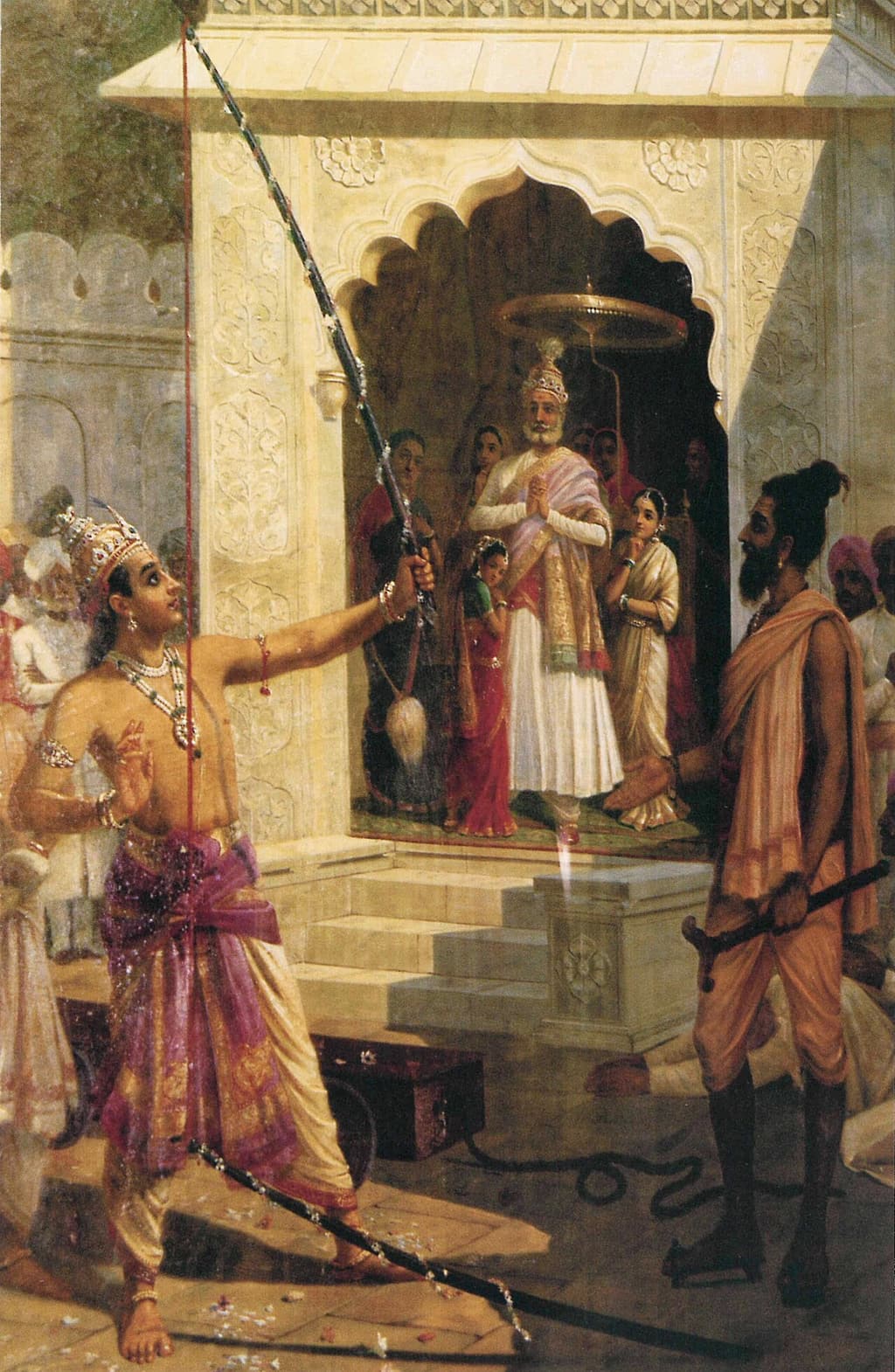
The sage Vishvamitra came asking for the eldest boy to guard a sacrifice from demons, and got both elder brothers; on that journey Rama killed the demoness Tataka and freed Ahalya from the stone into which she had been cursed. At Mithila, King Janaka had an enormous bow of Shiva's and a standing offer: whoever could string it could marry his daughter. Rama broke it, and married Sita.
(The first book, the Bala Kanda, and the last are widely held by textual scholars to be later additions to Valmiki's poem. The bow, Ahalya and the childhood miracles are therefore not part of the oldest layer.)
Dasharatha announced Rama's consecration as heir. Kaikeyi, worked on by her maid Manthara, remembered two boons the king had once promised her and cashed them: her own son Bharata to be installed, and Rama exiled to the forest for fourteen years. Dasharatha, bound by his word, could not refuse and did not survive it. Rama went without argument — the obedience is the point of the character — with Sita and Lakshmana. Bharata, who had been away, came home to a dead father, a throne he had not asked for and a mother he could not forgive; he went to the forest, failed to talk Rama into returning, took his brother's sandals back and set them on the throne, and governed for fourteen years as a regent for a pair of shoes.
The forest, and the abduction
Years pass in the forest hermitages. At Panchavati, Ravana's sister Shurpanakha finds Rama attractive, is deflected by him and then by Lakshmana, loses her temper and goes for Sita — and Lakshmana cuts off her nose and ears. Her brothers Khara and Dushana come with an army and are destroyed, and word reaches Lanka.
Ravana, who is not a brute but a scholar, a devotee of Shiva and the most learned character in the poem, does not attack. He arranges a distraction. His uncle Maricha takes the form of a golden deer; Sita wants it; Rama follows it and kills it, and it dies calling out in Rama's voice for Lakshmana. Sita, hearing it, tells Lakshmana to go, and — in Valmiki — says something so cruel to make him leave that the scene is uncomfortable to read. He goes. Ravana arrives as a wandering ascetic asking for alms, and takes her.
(The famous line drawn on the ground by Lakshmana, which Sita must not cross, is not in Valmiki. It enters through later retellings and is now so embedded in North Indian tradition that "Lakshman rekha" is ordinary Hindi for a boundary one must not step over.)
The old vulture Jatayu attacks the flying chariot and is cut down; Rama finds him dying and performs his funeral rites. Sita drops her jewellery in a bundle as she is carried south.
(The Adhyatma Ramayana and the Kurma Purana — and following them Tulsidas — remove the abduction's sting entirely: Rama secretly instructs Sita to enter the fire and leave an illusory double in her place, so that what Ravana carries off is a shadow. The real Sita is restored from the fire at the end, which turns the fire ordeal into a reunion rather than a test. This is one of the most consequential variants in the whole tradition, and it exists precisely because later devotional communities could not bear the alternative.)
Kishkindha
The brothers search south and reach the monkey kingdom, where Hanuman meets them disguised as a mendicant and takes them to Sugriva, who has been driven out by his brother Vali. Rama undertakes to kill Vali; Sugriva undertakes to find Sita.
Rama shoots Vali from concealment during a duel, and Vali dies asking him how a prince who has done nothing but keep his word shoots an opponent from behind a tree in a fight he was not part of. Rama's answers — that a king may punish, that Vali took his brother's wife, that hunting rules permit shooting from cover — have satisfied almost nobody for two thousand years. Commentators from the medieval period onward have kept returning to it, and it remains the sharpest ethical problem in the poem.
Sundara Kanda
The fifth book belongs to Hanuman, and it is the one most often recited on its own: a great many Hindus read the Sundara Kanda as a devotional practice without reading the rest.
He leaps the ocean, enters Lanka at night, searches the palaces, and finds Sita in a grove of ashoka trees, guarded by demonesses, refusing Ravana and counting down her own patience. He gives her Rama's ring; she gives him her hair-jewel. He then lets himself be captured on purpose, is brought before Ravana, argues with him, has his tail set alight as a punishment — and uses it to set the city on fire before leaping home.
The war
The armies cross on a causeway built into the sea. Ravana's brother Vibhishana, who has told him to give Sita back and been thrown out for it, comes over to Rama's side. What follows is a long, formal, extremely detailed war: Indrajit fighting invisible from the sky and binding the brothers in serpent-arrows; Lakshmana felled and revived by a healing herb that Hanuman, unable to identify it, fetches by carrying the entire mountain; the vast sleeping Kumbhakarna woken and killed.
Rama kills Ravana with a weapon given him by the sage Agastya, after Agastya teaches him a hymn to the sun that is still recited daily by many people. Vibhishana is crowned in Lanka.
(In the Jain tradition — Vimalasuri's Prakrit Paumacariya and its successors — this ending is impossible, because a man of Rama's spiritual standing does not kill. Lakshmana kills Ravana and takes the karmic consequence; Ravana himself is a noble Vidyadhara king and a Jain layman brought down by one flaw. Rama ends the story as a monk who attains liberation.)
The endings, which do not agree
Valmiki then has Rama receive Sita coldly and say that he fought for his own honour, not for her, and that he cannot take back a woman who has lived in another man's house. She asks Lakshmana to build a pyre, walks into it, and is carried out of it unburnt by Agni himself, who certifies her. The gods appear and tell Rama what he is.
They fly home on the aerial chariot Pushpaka, and Ayodhya lights lamps to bring them in. Rama is crowned, and Ram Rajya — the reign in which the rains come on time and no one grieves — begins.
Then the seventh book, the Uttara Kanda, does something the rest of the poem does not prepare you for. Gossip circulates in the city about a queen who lived in Lanka. Rama, whose entire character is the subordination of himself to duty, banishes his wife — pregnant — to the forest, without telling her why. She is taken in at Valmiki's hermitage and bears twins, Lava and Kusha, who grow up learning to recite their father's story from its author. Years later they sing it at Rama's horse sacrifice; he recognises them and offers to take Sita back if she will swear publicly, once more, to her purity. She calls on the earth to receive her if she has been faithful, and the earth opens, and her mother takes her, and she is gone.
The Uttara Kanda is generally regarded as a later addition. Kamban's Tamil Iramavataram ends with the coronation. Tulsidas's Ramcharitmanas ends with Ram Rajya and a discourse. Most performed and televised versions end before the banishment, or soften it. The tradition has been quietly editing this ending for a very long time, and it has never quite succeeded, because the banishment is also the thing that generations of women's retellings have found most worth talking about.
The versions, listed plainly
- Valmiki, Sanskrit, in seven books, with a critical edition prepared at Baroda between 1960 and 1975 from hundreds of manuscripts. The oldest continuous text; date debated, with the core usually placed in the last centuries BCE.
- Kamban, Iramavataram, Tamil, twelfth century. Independent, magnificent, and notably generous to Ravana.
- Tulsidas, Ramcharitmanas, Awadhi, 1574 onward. The most influential text in North India by a distance, recited daily in millions of households; theologically it is a bhakti poem in which Rama is the supreme reality, not a prince who turns out to be divine.
- Adhyatma Ramayana, Sanskrit, source of the shadow-Sita and a strongly Advaitic reading.
- Adbhuta Ramayana, in which Sita is Ravana's own daughter and she — not Rama — kills a thousand-headed Ravana, in a form indistinguishable from Kali.
- Jain versions, from Vimalasuri onward, described above.
- Southeast Asia: the Thai Ramakien, given its standard form under Rama I in 1797, in which Hanuman is a womaniser and a leading man; the Khmer Reamker; the Old Javanese Kakawin Ramayana and the Balinese and Javanese wayang repertoire; the Malay Hikayat Seri Rama. In these traditions the story is not a Hindu scripture but a national literature.
- Women's oral Ramayanas, in Telugu, Bengali, Marathi and elsewhere: songs sung at weddings and at grinding stones, from Sita's or Kausalya's or Shurpanakha's position, frequently sceptical of Rama and frequently very funny.
A. K. Ramanujan's essay "Three Hundred Rāmāyaṇas" is the standard introduction to this plurality; it was removed from a Delhi University history syllabus in 2011 after protest and litigation, which made the point about the stakes of the argument more forcefully than the essay had.
Questions readers ask
Is Diwali the celebration of Rama's return?
In much of North India, yes, and the lamps of Ayodhya are the explanation given. But Diwali is not a single festival with a single charter: in parts of the south and west it is tied to Krishna's defeat of Narakasura, in many communities principally to Lakshmi and the new commercial year, and for Jains it commemorates Mahavira's liberation. A festival this large has accumulated several stories rather than descending from one.
Is Ravana treated as simply evil?
Not by the tradition as a whole. He is a Brahmin by descent, a master of the Vedas, a formidable ascetic and a musician; several southern and Sri Lankan traditions treat him with open respect, and there are places in India where he is worshipped and where his effigy is not burnt. Kamban's Ravana is grand and tragic. Even Valmiki gives him a real argument and a magnificent death. What condemns him in the text is one thing: he takes a woman who does not consent.
What about Ayodhya today?
The site in Ayodhya identified by many Hindus as Rama's birthplace, and occupied until 1992 by the Babri Masjid, has been the focus of one of the most contentious disputes in modern India. The demolition of the mosque in December 1992, the Supreme Court judgment of November 2019 awarding the site for a temple and allotting land elsewhere for a mosque, and the temple's consecration in January 2024 are matters of public record. What they mean is contested along political, religious and historical lines, and is not something to be settled in a paragraph about a poem.
Where should someone start?
For the whole story in English, Robert Goldman's multi-volume Princeton translation of the critical edition is the scholarly standard; R. K. Narayan's short prose version, based on Kamban, is the most readable introduction. For the version most Indians actually live with, it is Tulsidas — and the closest most non-readers will get is Ramanand Sagar's television Ramayan of 1987–88, which drew audiences estimated in the tens of millions per episode and fixed the visual look of these characters for a generation. Ramlila, the outdoor autumn performance cycle staged in thousands of North Indian towns, is on UNESCO's intangible heritage list and remains the way most people encounter the story in person.
The two routes named above
One is the complete scholarly text and one is the short way in; the section above explains which job each of them does.
- The Rāmāyaṇa of Vālmīki, translated by Robert Goldman
The scholarly standard: the multi-volume Princeton translation of the critical edition, for the whole story in English.
- R. K. Narayan, The Ramayana
The short prose version based on Kamban rather than Valmiki — named above as the most readable introduction there is.
As an Amazon Associate we earn from qualifying purchases made through these links, at no extra cost to you.