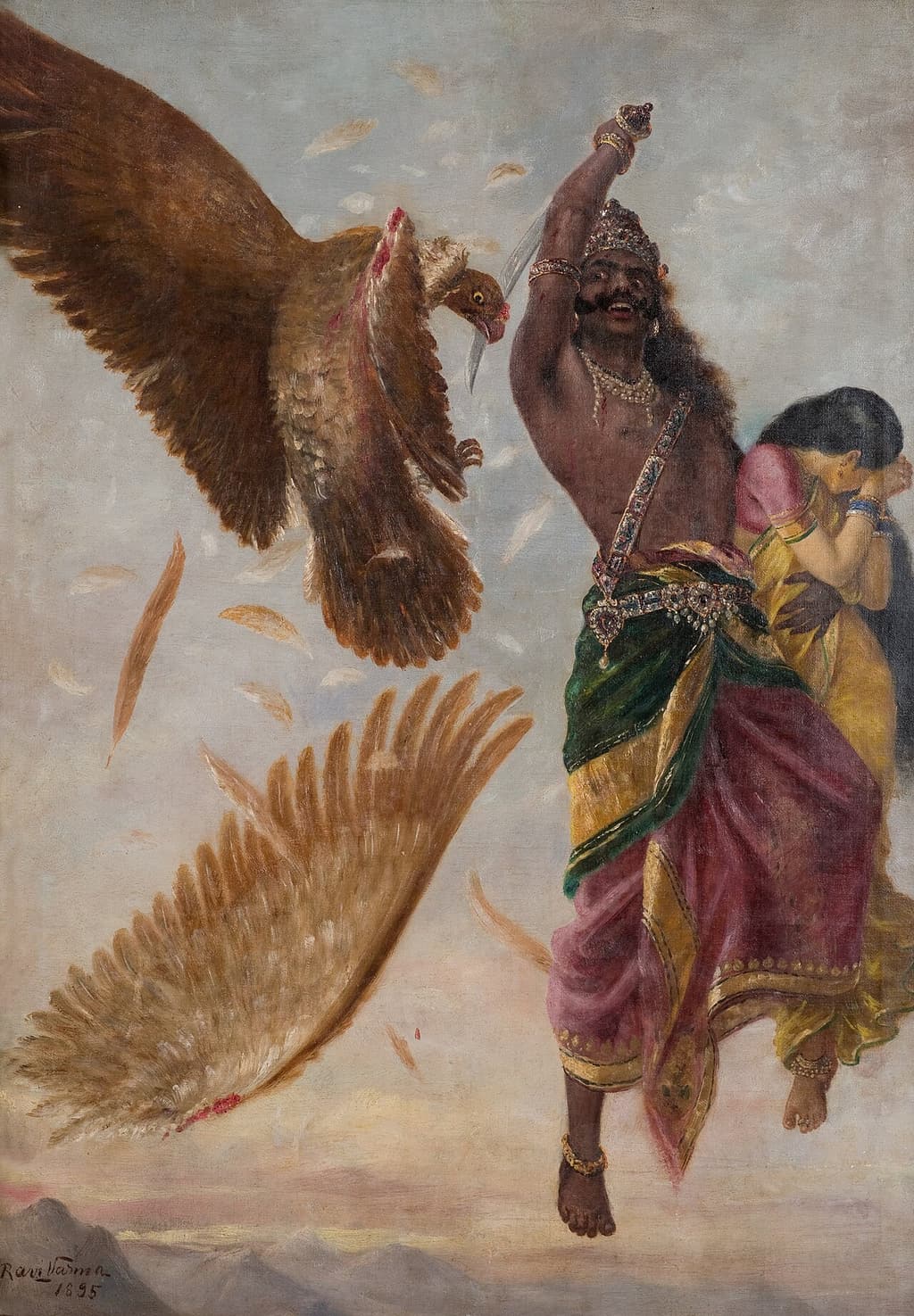
She is not born. King Janaka of Mithila is ploughing a field as part of a rite when the blade turns up a child in the furrow, and he raises her as his daughter. At the end of her story she asks the earth to take her back, and it opens and does. Between those two moments Sita is abducted, besieged, recovered, doubted, examined by fire, exiled while pregnant and asked to prove herself a second time — and the second time she declines. The refusal is the last thing she does, and a great deal of Indian literature has been written about it.
Sita is worshipped alongside Rama in millions of households, and in Mithila and parts of Nepal she is the senior figure of the pair. The account below follows the texts and the regional traditions that argue with them.
A furrow with a Vedic ancestor
Her name means furrow, and it is not a coincidence dressed up as etymology. A goddess Sita, the furrow personified, is invoked in a short Rigvedic passage and in the domestic ritual manuals as a power addressed at ploughing, asked for full grain and a good harvest. Whether the epic heroine grew from that agricultural figure or merely inherited her name is not settled, but the resonances run right through the story: a woman found in tilled earth, married to a king whose reign is measured by whether rain arrives, and reclaimed by the ground at the end. Her epithets are all about origin — Janaki, daughter of Janaka; Vaidehi, the woman of Videha; Maithili, of Mithila.
Mithila matters. It is a real cultural region straddling northern Bihar and the Nepali Tarai, with its own language, its own script and a painting tradition that has carried her story on household walls for centuries. Her father Janaka is remembered in the Upanishads as a philosopher-king who hosted debates and held his own in them, which places her in an intellectual household rather than a merely royal one.
Choosing exile, which nobody asked her to do
The decision that shapes the plot is hers and it is an argument she wins. When Rama is sentenced to fourteen years in the forest he tells her to stay in the palace. She rejects every reason he gives, points out that the wives of the old stories went, tells him a forest with him is a city and a city without him is a wilderness, and accuses him at last of behaving like an actor playing a man. He gives way. The Ramayana is very careful to have her refuse comfort before it has anything happen to her.
Her abduction turns on two further choices. It is Sita who insists Rama chase the golden deer, and Sita who drives Lakshmana away from the hut with an accusation so unjust that she is still apologising for it books later. The poem gives its heroine the initiating error, which is not the treatment of a woman conceived as passive.
In Lanka she spends her captivity under the ashoka trees refusing Ravana in language that gets steadily less polite. Valmiki supplies an explanation for why he never forces her: a curse laid on him by Nalakubara means that touching an unwilling woman would kill him. The captivity is therefore a siege of the will, twelve months of alternating flattery and threat, and she survives it by contempt.
Fire, exile, earth
The two ordeals are the most contested episodes in the whole tradition, and it is worth being exact about what they are. The first, immediately after the war, is a public repudiation: Rama declares that he fought to avenge an insult to his house, and Sita, rather than plead, has a fire built and enters it. Agni delivers her back untouched. The second, years later in the Uttara Kanda, follows a subject's gossip; she is sent to a hermitage while pregnant, raises Lava and Kusha there, and when finally offered the chance to swear her purity before the court, calls instead on her mother the earth.
Traditions have handled this in three distinct ways, and none of them is simply acceptance.
- Substitution. The Adhyatma Ramayana and Tulsidas's Ramcharitmanas have Sita place an illusory double in the hut before the abduction; the real Sita spends the war hidden in fire, and the ordeal merely returns her. The problem is dissolved by making the whole captivity happen to someone else.
- Revision. Bhavabhuti's eighth-century Sanskrit play Uttararamacharita stages the exile as a tragedy of Rama's own making and engineers a reunion. Regional retellings simply end earlier, at the return to Ayodhya, leaving the Uttara Kanda out.
- Reproach. This is the largest category and the least often quoted. Women's oral Ramayanas in Telugu, Marathi, Maithili and Bengali retell the story as a household narrative — her pregnancy cravings, her sisters-in-law, her anger — and are frankly critical of her husband. Chandrabati, a sixteenth-century Bengali woman poet, wrote a Ramayana centred on Sita in which Rama's conduct is the problem to be explained.
The Adbhuta Ramayana, a late and startling text, goes furthest: it introduces a second, thousand-headed Ravana whom Rama cannot defeat, and has Sita take the form of Kali and kill him herself while her husband lies unconscious on the field.
Where she is worshipped in her own right
Her temples are far fewer than Rama's, because she is normally worshipped with him — the standard north Indian shrine sets Rama, Sita, Lakshmana and Hanuman together, and the invocation "Sita-Ram" is used as a greeting across the Hindi belt. But Mithila keeps her separately and seriously. The Janaki Mandir at Janakpur in Nepal, completed in 1910 in an ornate Mughal-influenced style, is her principal temple, and Vivaha Panchami there each winter re-enacts her marriage with a procession that draws pilgrims from both sides of the border. Sitamarhi in Bihar claims the field where she was found. Sita Navami in spring marks her appearance.
Among Ramanandi ascetics there is a devotional mode called sakhi bhava, in which a male renunciant adopts the persona of one of Sita's female companions in Ayodhya, serving the divine couple as a member of her household. It is one of the more striking things Indian devotion does with gender, and it exists because she, not her husband, is the figure whose intimates the practitioner wants to be.
Modern retellings, mostly by women
Sita has become the figure through whom modern Indian writers argue about marriage, consent and the cost of ideal conduct. Volga's Telugu story collection The Liberation of Sita (translated 2016) has her meet Shurpanakha, Ahalya and Urmila and learn something from each. Sita's Ramayana (2011), a graphic novel by Samhita Arni with Patua scroll artist Moyna Chitrakar, retells the war from inside the ashoka grove. Amish Tripathi's Sita: Warrior of Mithila (2017) made her a trained fighter and a candidate for rule. Television has been more conservative: the 1987 Doordarshan Ramayan played the ordeals straight and made its Sita, Dipika Chikhlia, a household icon of forbearance for a generation.
Against all of this sits the ordinary use of her name in Indian speech, where "she is a real Sita" can be a compliment about patience or, increasingly, a criticism of a standard nobody should be held to. Sita and its variants remain common given names.
Questions readers bring to the ashoka grove
Is Sita considered an avatar?
Yes — Vaishnava theology identifies her with Lakshmi, descending with Vishnu whenever he does, so that Rama and Sita are the same pair as Vishnu and Sri. That identification does real work: it means her separation from Rama is a cosmic anomaly rather than a domestic misfortune, and it underwrites her independent worship in the Ramanandi and Sri Vaishnava streams. The family diagram marks avatar links as descents rather than births for exactly this reason.
Why does she have no mother in the story?
Because the earth is her mother, and the poem means it structurally rather than sentimentally. Janaka's queen appears rarely; the parent invoked at the climax is Bhumi, the ground itself, who is elsewhere a goddess rescued by Vishnu in his boar incarnation. Sita's whole arc runs from soil to soil, and the absence of a human mother is what makes the last scene available.
What happened to Lava and Kusha?
They are raised by Valmiki, taught the poem about their own father, and sing it to him at a horse sacrifice without either side knowing the relationship — the epic's most elegant piece of construction, since it makes the Ramayana a text that exists inside itself. Traditional genealogies have them found cities and continue the solar line, and Lahore's name is popularly derived from Lava, though the etymology is folk rather than established.
Do any communities decline to celebrate her rescue?
The picture is more complicated than celebration or refusal. In parts of Mithila the story is told as a daughter's departure and the emotional weight falls on her leaving home, not on the war; some Dravidian-movement readings in Tamil Nadu treat the whole plot as an account of northern conquest and are unsympathetic to Rama throughout; and several Adivasi and folk traditions keep Ravana as a figure of respect while still telling her story with sympathy. Those positions are set out further in the tradition overview.