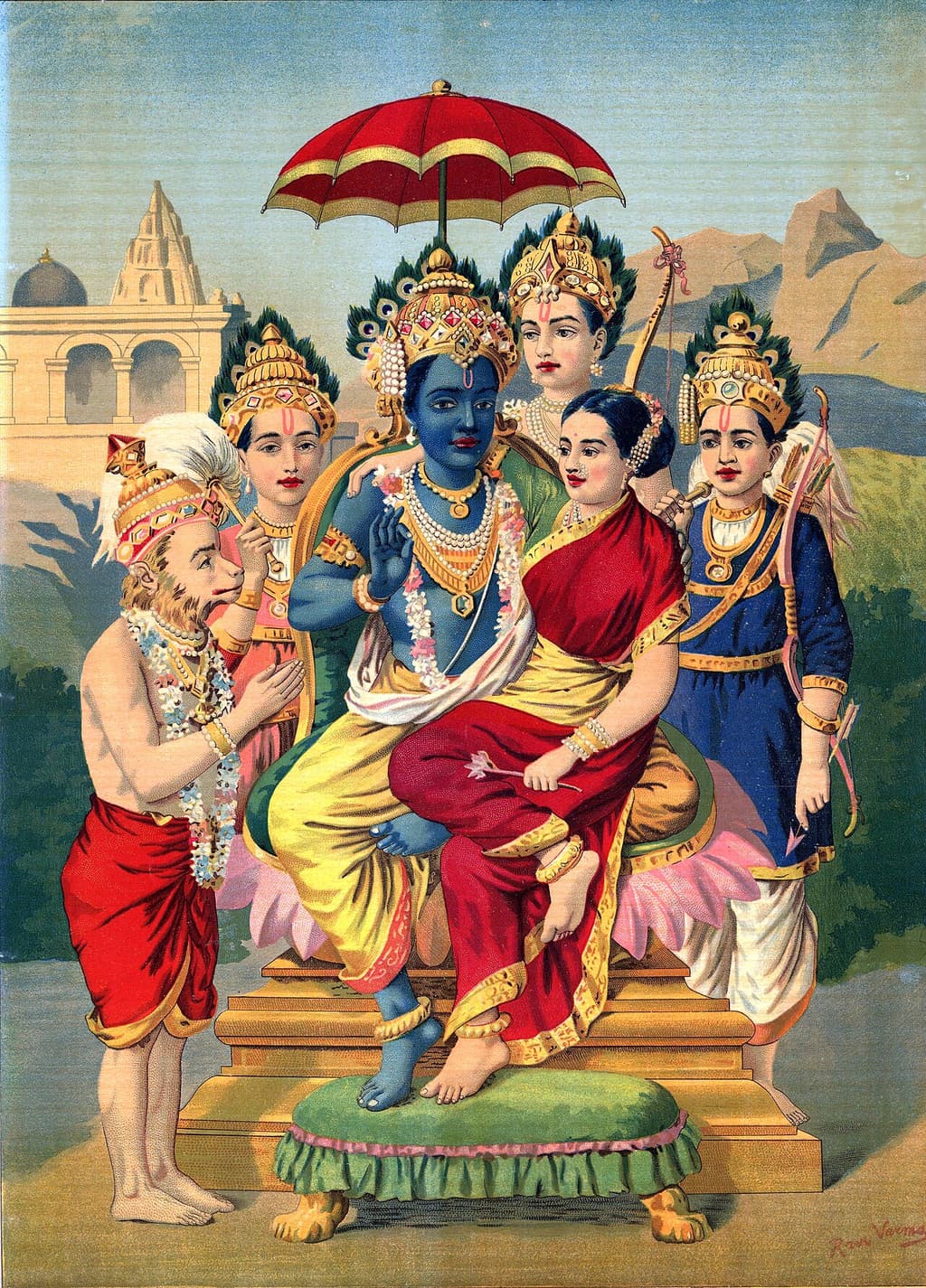
The most important thing Hanuman ever does is remember what he can do. Standing on the southern shore with an ocean between him and Lanka, he does not know he can cross it; a curse laid on him in childhood has left him unable to recall his own strength until someone tells him. Jambavan the bear tells him. He grows, and jumps. Devotional commentary treats this as the whole doctrine of the figure — capability is present and dormant, and it takes another's word to release it — and it is the reason his worshippers are not principally asking for a favour but for the reminder.
He is one of the most actively worshipped deities in India today, with roadside shrines in numbers no census has ever seriously attempted.
Wind, jaw, and a broken sun
He is the son of Vayu, the wind, by Anjana, an apsara living on earth under a curse, with the monkey king Kesari as his earthly father — hence Anjaneya, Maruti, Pavanaputra, all meaning some version of that parentage. As an infant he mistakes the rising sun for fruit and leaps for it. Indra strikes him with the vajra to stop him and breaks his jaw, and the Sanskrit hanu, jaw, is the traditional etymology of his name. Vayu, furious, withdraws breath from the world until the gods come to terms and load the child with boons and invulnerabilities. Sages, tired of a boy with unlimited power and no judgement, then add the forgetting.
That the story of a monkey seizing the sun exists at all connects him, at a distance nobody has satisfactorily measured, to a much wider Asian family of solar-theft narratives.
The fifth book of the Ramayana is his
Valmiki's Sundara Kanda — the "beautiful book" — is the section named for the episode in which Hanuman crosses to Lanka alone. He shrinks to the size of a cat to search the city at night, finds Sita under the ashoka trees, gives her Rama's ring, and offers to carry her out; she refuses, on the grounds that her rescue is her husband's to accomplish. He then lets himself be captured in order to see Ravana, is sentenced to have his tail set alight, and burns the city with it before dousing the tail in the sea.
Later, when Lakshmana falls in battle, he is sent for a healing herb on a Himalayan peak, cannot identify it, and brings back the entire mountain. The image of him airborne with a hill in one hand is second only to the flying leap in popularity.
His signature gesture comes after the war. Given a pearl necklace, he bites the pearls open looking for Rama inside them, and when mocked tears open his own chest to show Rama and Sita seated in his heart. It is a literalism that the tradition finds neither absurd nor grotesque, because the point is that his devotion is physical rather than sentimental.
An immortal with a second job in the other epic
Hanuman is a chiranjivi, one of the deathless, and the belief is not abstract: he is held to be present wherever the Ramayana is recited, which is why an empty seat is sometimes kept at a recitation. That immortality lets him appear in the Mahabharata, generations later. He lies as an old monkey across a forest path and asks Bhima — his own half-brother, also a son of Vayu — to move his tail aside. Bhima, the strongest man alive, cannot lift it, and the scene deflates him in a way nothing else in the epic manages. Hanuman later agrees to sit on Arjuna's banner during the war, which is why the Pandava chariot flies a monkey standard.
What is recited, and where
The Hanuman Chalisa, forty verses in Awadhi by Tulsidas, is by any reasonable measure among the most-recited devotional poems on earth — daily in millions of households, at wrestling grounds, on long-distance buses, and increasingly as streamed audio with view counts in the billions. The Sundara Kanda is read in full as a remedy in periods of difficulty. Tuesday and Saturday are his days, Saturday because he is held to shield devotees from the affliction of Shani, the slow-moving planetary deity whose transits Indian astrology treats with great caution.
The images are coated in orange sindoor and oil, an offering explained by a story in which Sita applies vermilion to her parting and Hanuman covers his whole body with it, reasoning that more must be better. Major centres include Hanuman Garhi in Ayodhya, Sankat Mochan in Varanasi (founded, by tradition, by Tulsidas himself at the spot where he saw him), Salasar and Mehandipur Balaji in Rajasthan, and Namakkal in Tamil Nadu with its eighteen-foot standing image. He is the patron of akharas, the traditional wrestling gymnasia, where celibacy, diet and discipline are held together under his name.
Less widely known outside scholarly circles is his reputation as a grammarian and musician — Sanskrit tradition credits him with mastery of the vyakarana and there is a lost work, the Hanuman Nataka, attributed to him. The strong monkey is also the learned one.
The Sun Wukong question
Whether the monkey hero of the sixteenth-century Chinese Journey to the West descends from Hanuman has been argued since Hu Shih proposed it in the 1920s and Lu Xun rejected it in favour of an indigenous Chinese water-demon ancestry. The case for transmission rests on Buddhist textual routes carrying Ramayana material into China and Central Asia; the case against rests on the strength of local precedents and on how different the two characters are in temperament — Hanuman's defining quality is service, Wukong's is insubordination. There is no consensus, and anyone who states one confidently is overselling.
Southeast Asia complicates the picture further. In the Thai Ramakien Hanuman is a celebrated seducer with wives and children, which is not a corruption of the Indian figure so much as evidence that the Indian emphasis on his celibacy is itself one tradition's choice.
From comic panels to protest flags
The 2005 Indian animated feature Hanuman was a commercial breakthrough for the country's animation industry and produced a run of sequels; the 2024 Telugu film HanuMan built a superhero franchise on a devotee borrowing his powers. Amar Chitra Katha has kept the Sundara Kanda in comic form for half a century. In 2018 a Kerala designer's digital illustration of a scowling, saffron-tinted Hanuman spread across vehicle decals and phone screens and was rapidly adopted as a political emblem, to the discomfort of its own artist — a case of an image escaping its maker within weeks. Western pop culture has largely left him alone, which given its record with Indian deities is arguably the best available outcome. His name and its variants remain in wide use as given names in South Asia.
Things worth knowing that the stories skip past
Is he a god, or a devotee who got promoted?
Theologically he is both, and Vaishnava traditions worry at the distinction. He is a bhakta whose status is entirely derived from his object of devotion, and simultaneously an object of independent worship with his own temples, mantras and festivals. Some Shaiva sources go further and call him an incarnation of Shiva — a claim Tulsidas endorses in passing, and one that neatly reconciles two sectarian loyalties in a single figure.
Why are monkeys tolerated around his temples even when they are a nuisance?
Because feeding them is a devotional act, and this has real municipal consequences: urban macaque populations around major Hanuman shrines in Delhi, Jaipur and Vrindavan are sustained by offerings, and repeated attempts to relocate them have run into the fact that the animals are, in local understanding, guests of the deity rather than pests.
Does the Ramayana explain how a monkey army can build a stone causeway?
It explains it as engineering with a divine assist: the bears and monkeys are led by Nala, credited as an architect, and the stones float because of a boon. Later devotional retellings added the detail, absent in Valmiki, that stones inscribed with Rama's name float of themselves — an addition that says something about the growth of name-recitation as a practice in the medieval period.
What is his relationship to the vanara kingdom's politics?
He is Sugriva's minister, not his warrior, and his first appearance in the poem is as a diplomat sent to establish who the two armed strangers in the forest are. Valmiki gives him an explicitly polished, grammatically careful speech, and Rama's response is to remark on how well he speaks. The character is introduced as a negotiator before he is ever introduced as strong.