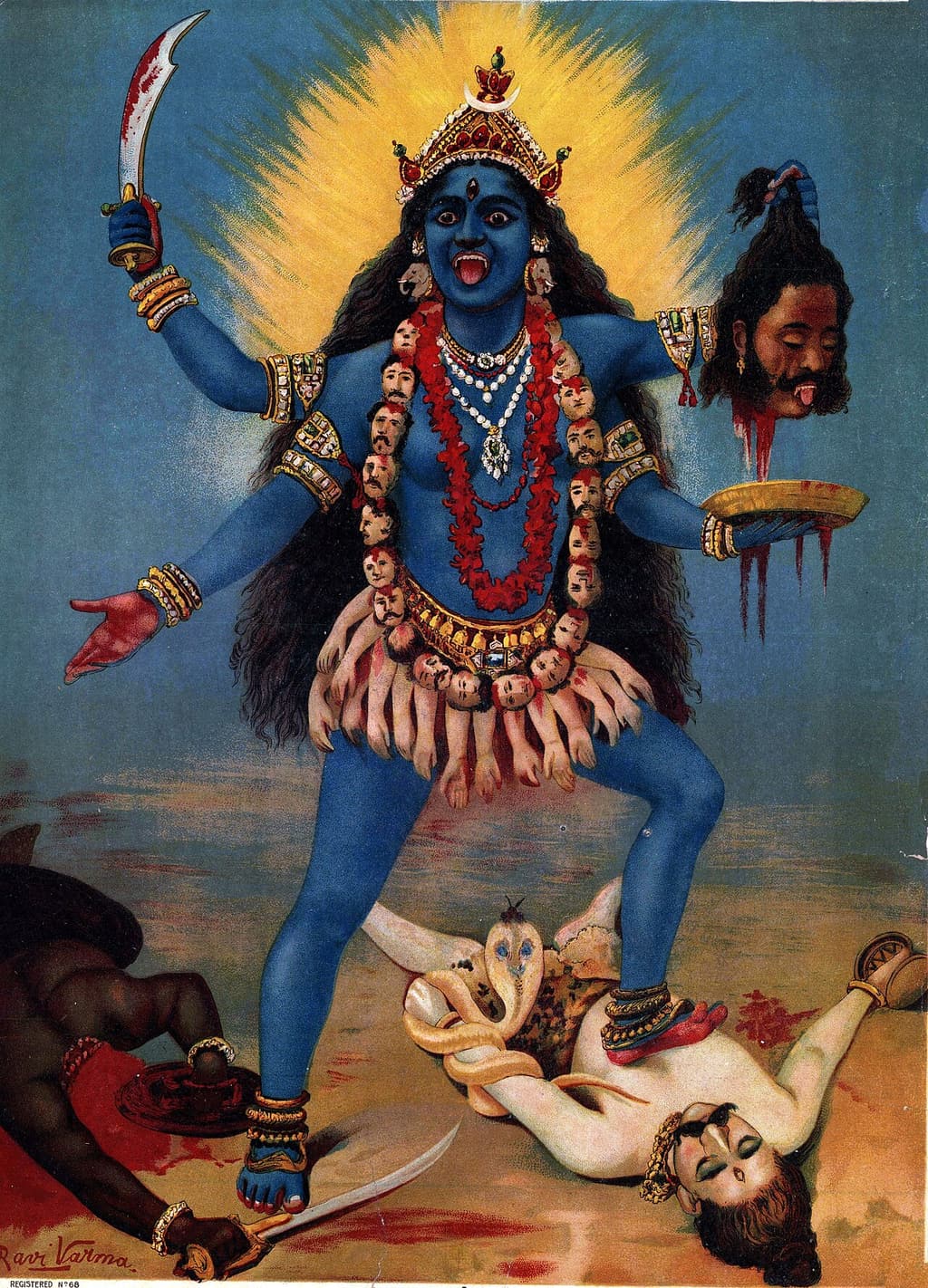
Ramprasad Sen, an eighteenth-century Bengali clerk and poet, wrote hundreds of songs to the goddess with the severed head and the skull garland, and their tone is that of a son complaining to his mother. He accuses her of neglect. He tells her he knows her tricks. He asks why she gave him a mind if she meant to torment it, and then says he will not let go of her feet. Nothing in that literature is frightened, and it is by some distance the largest body of writing about Kali that exists. Almost none of it has reached the West, which received instead an image of bloodthirst assembled by colonial officials and completed by Hollywood.
Out of Durga's forehead
Her earliest substantial appearance is in the seventh chapter of the Devi Mahatmya. Facing the demon generals Chanda and Munda, the goddess's face blackens with anger and Kali steps out of her brow: emaciated, wide-mouthed, wearing a tiger skin and a garland of heads, carrying a staff topped with a skull. She swallows the demon armies whole, decapitates the two generals and hands the heads over, receiving the name Chamunda for it. Shortly afterwards she solves the tactical problem of Raktabija — every drop of whose spilled blood becomes another warrior — by spreading her tongue across the battlefield and drinking the blood before it can reach the ground.
The other famous episode has no such tidy source and reaches its familiar shape through Bengali and Tantric literature. Kali, unstoppable after victory, dances until the world begins to break under her. Shiva lies down in her path. She treads on him, realises what she has done, and the tongue that in the battle scene was a device for drinking blood becomes, in the standard Bengali gloss, an expression of embarrassment. Tantric commentators reject that reading firmly: for them the extended tongue is appetite and the corpse-like Shiva is inert consciousness beneath active power, and the domestic explanation is a later softening. Both readings are in print, and a Kalighat pilgrim and a Tantric practitioner will give you different ones.
Reading the image without flinching
Every element has an assigned meaning, and the assignments are not euphemisms.
- The garland of severed heads is conventionally fifty or fifty-two, matched to the letters of the Sanskrit alphabet: language itself, worn as a trophy, since what she destroys includes the categories thinking is done in.
- The skirt of arms is the accumulated deeds of the world, hung on her because action's consequences belong to her.
- The severed head and the sword in her left hands are ego and the cutting of it; the right hands make the gestures of fearlessness and of granting, which is the part reproductions usually crop.
- Her nakedness is glossed as being beyond covering — she is digambara, clothed in the directions.
- Her name is grammatical before it is frightening. Kālī is the feminine of kāla, time, and also of black. She is time, which eats everything, and the tradition means both senses at once.
The philosophical claim underneath is that what terrifies is not other than what saves, and that a religion which offers only the benign face has hidden half the world from its adherents.
Bengal, and the mother
Kali's transformation into an object of tender devotion is a datable historical development, largely of eighteenth- and nineteenth-century Bengal. Ramprasad and Kamalakanta wrote the shyama sangeet repertoire that is still sung. Ramakrishna Paramahamsa, priest at the Dakshineswar temple outside Calcutta from the 1850s, described a relationship with the image there in terms of ordinary intimacy — arguing with her, refusing to eat until she responded — and his conversations, recorded verbatim by a disciple, are among the most detailed first-person accounts of devotional experience in any language. His student Vivekananda, who initially found the goddess repellent, ended up writing a poem about her that begins with everything being darkness.
Her principal seats are Kalighat in south Kolkata, from which the city's name most likely derives; Dakshineswar on the Hooghly; Tarapith in Birbhum, associated with the wild ascetic Bamakhepa and with cremation-ground practice; and Kamakhya in Assam. Kali Puja falls on the new-moon night of Kartik, the same night as Diwali elsewhere in India — so that while much of the country is lighting lamps for Lakshmi, Bengal is holding a nocturnal worship of the goddess of dissolution. That divergence on a single date is one of the sharper illustrations of how regionally various this tradition is.
Tantra, and what it actually involves
Kali is central to Shakta Tantra, where she heads the Dasha Mahavidya, the ten wisdom goddesses, and where practice can include meditation in cremation grounds, ritual use of substances ordinary orthodoxy forbids, and mantra work under a teacher. Two things are worth stating plainly. First, the "left-hand" practices that fascinate outsiders are a minority current within a much larger body of ritual, meditative and philosophical material. Second, the wholesale merger of the word "Tantra" with sexuality in Western usage happened in the twentieth century and has very little to do with the texts, which are overwhelmingly concerned with mantra, cosmology and ritual procedure.
How the West got her wrong, and kept getting her wrong
The colonial construction of Kali is documentable step by step. British administrators in the 1830s, above all W. H. Sleeman, built the campaign against "Thuggee" around the claim of an organised hereditary cult of stranglers devoted to Kali or Bhavani; later historians have shown the evidence to have been produced largely through the interrogation of approvers under a system that rewarded confession, and the existence of a coherent Kali-worshipping criminal fraternity is now heavily doubted. Missionary writing then made her the emblem of everything a reforming empire claimed to be there to correct. Sati, human sacrifice and cannibalism were attached to her name in Victorian print with a persistence that survived the collapse of the underlying claims.
Indiana Jones and the Temple of Doom (1984) took that inheritance, invented a blood cult chanting her name, and was refused a filming permit and then banned outright in India. It remains the single most widely seen depiction of a Hindu deity in the English-speaking world, and it is a fabrication end to end. Since the 1970s a second and gentler Western appropriation has run alongside it, in feminist and neo-pagan spirituality, where she becomes an icon of unrestrained female power — better intentioned, still detached from the Bengali material, and generally uninterested in the fact that her devotees call her mother. A 2022 documentary poster by a Canada-based Indian filmmaker showing Kali smoking drew criminal complaints in several Indian states, a reminder that the sensitivities are not only about outsiders. Her name is a fairly common given name in India, which surprises people who know her only from film.
What people ask once they get past the iconography
Is Kali a goddess of death?
Not in the sense of presiding over the dead — that office belongs to Yama. She is destruction as a cosmic function, which in Indian thought is a precondition of renewal rather than an ending, and her association with cremation grounds is about the place where illusions about permanence fail, not about the management of souls. A devotee asking her for protection is not making an unusual request.
Why is she worshipped at night?
Kali Puja is performed after midnight on a moonless night, and the timing is doctrinal rather than atmospheric: she is invoked in the absence of light because she is what remains when everything visible is withdrawn. The practical consequence is that the festival in Bengal has an entirely different rhythm from the daytime family gatherings of Durga Puja three weeks earlier.
Does she have any relationship to the Kali Yuga?
None etymologically, and the confusion is widespread. The present degenerate age is kali with a short first vowel, from a word for the losing throw of a die, and is unrelated to kālī with a long one. The two are distinct terms that collapse together in English transliteration and are then joined into a false theology of an age ruled by the goddess.
Are Durga and Kali the same?
In Shakta doctrine, yes — Durga and Kali and Parvati are the one Devi in different modes, and the Devi Mahatmya has Kali issue from Durga's own body to make the point. In lived practice they are approached quite differently, with different festivals, different offerings and different emotional registers, and the family diagram uses a dedicated "form of" link rather than pretending either that they are separate deities or that the distinction does not matter.