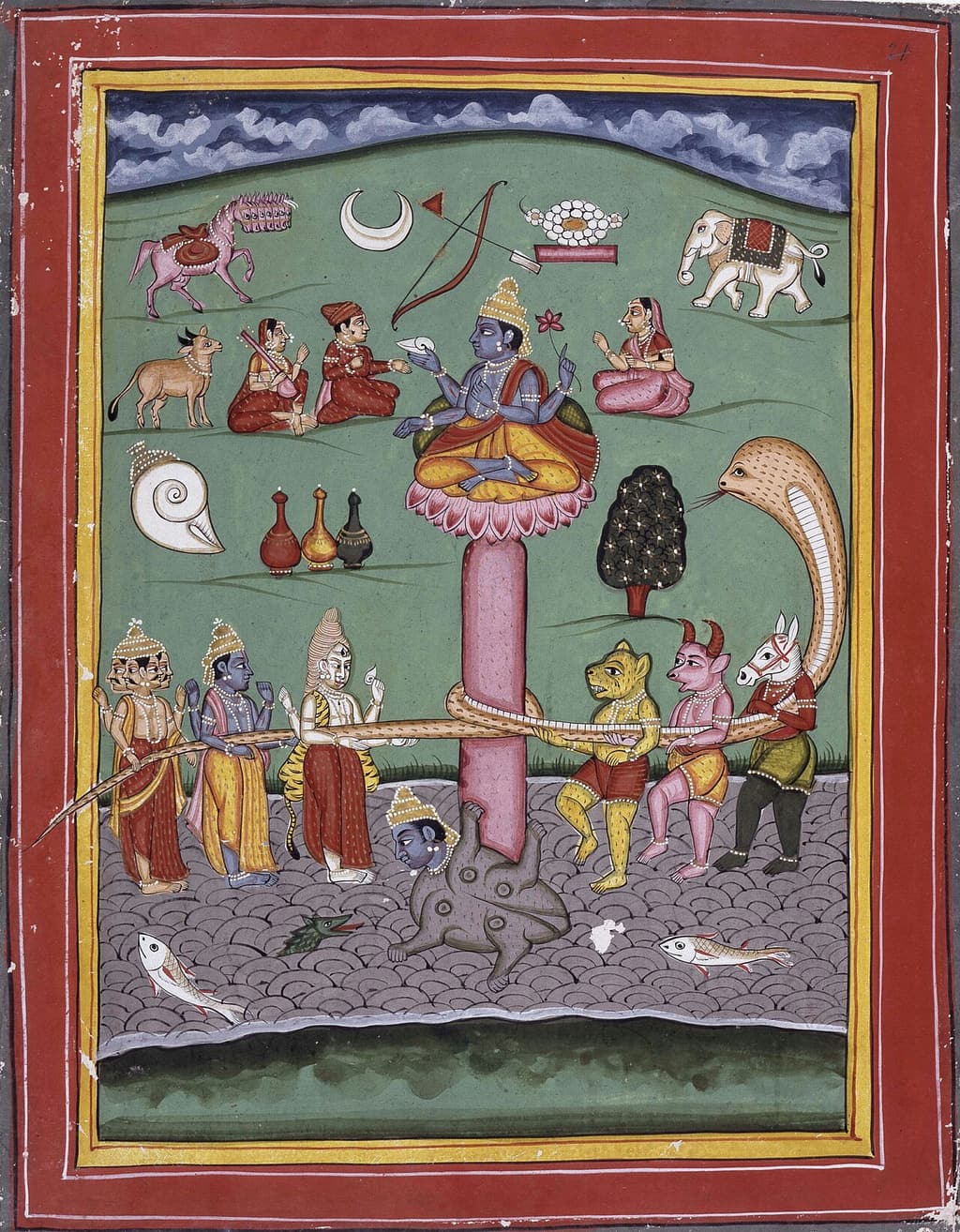
The governing image is a kitchen one. To get butter you put curd in a pot, wrap a rope around a stick, and pull the ends alternately until the fat separates and rises. Now make the pot an ocean of milk, the stick a mountain, the rope the king of serpents, and the two people pulling the gods and the anti-gods — who are at war and who have to do this together, because neither can churn alone. Everything that follows comes out of taking that metaphor entirely seriously.
Why the gods needed help
The Mahabharata opens the episode almost without motive: the immortals want the nectar of immortality, and they take advice on how to get it. The Puranas supply a cause, and it is a story about arrogance.
The sage Durvasa, whose temper is a fixed feature of Sanskrit narrative, gave Indra a garland. Indra, riding in state on Airavata, took it and draped it over the elephant's head; the elephant took it off and trod on it. Durvasa cursed him, and the terms of the curse are precise: the three worlds would lose śrī — fortune, prosperity, the quality that makes a kingdom flourish. The goddess who is that quality withdrew into the sea. The gods began losing, and kept losing, and eventually went to Vishnu.
His advice was not to fight harder. It was to make terms with the asuras, promise them a share of what came out of it, and churn the ocean of milk for the amṛta, the nectar that ends death — and, he added privately, to see to it that they did not get any.
Setting up the churn
Mount Mandara was pulled up to be the churning staff. Vasuki, the great serpent, agreed to be the rope and was wound around the mountain. Then the mountain, having no base, sank into the seabed — and Vishnu took the form of an enormous tortoise and went down under it, so that the whole apparatus turned on the back of a living animal. In the Mahabharata this is simply the king of tortoises; the identification of the tortoise as Kurma, an incarnation of Vishnu and a fixed member of the ten-avatar list, is a Puranic development, and the difference is a good small illustration of how the avatar scheme was assembled over centuries out of material that did not originally require it.
The two sides took ends. The devas took the tail; the asuras insisted on the head, on the reasonable-sounding grounds that the head end is the honourable one. Several tellings make this Vishnu's manipulation — he suggests the tail is beneath the asuras' dignity, knowing exactly what is coming. What came was Vasuki's breath, and over the long labour of the churning the asuras at the front were scorched, blackened and half-blinded by the smoke and heat pouring out of the serpent's mouths, while the gods at the tail worked in the cool.
Then they pulled, and the sea turned, and things began to come up.
Poison first
The first thing the ocean gave up was not a treasure. It was halāhala, a black venom of such concentration that it began killing the world simply by existing, and both sides dropped the rope and ran.
Shiva drank it. There was nobody else who could, and the way the texts describe it is not heroic but medical — an antidote administered by the only body capable of containing it. And as he swallowed, Parvati put her hands around his throat and held it there, so that the poison never reached the rest of him and never reached the world. It stayed in his neck and turned it blue, and Nīlakaṇṭha, the blue-throated one, is one of the commonest names by which he is worshipped today. When a devotee at a Shiva temple says that name, this is the incident being invoked: the god who took the worst thing in existence into his own body and kept it there.
It is worth pausing on the structure. The first product of a joint venture between enemies is a poison neither of them can handle, and it is dealt with by a third party who has no stake in the nectar at all. Shiva does not take a share of the amrita and does not ask for one.
What the ocean gave up
After the poison, the treasures. The lists differ between texts — the Mahabharata, the Vishnu Purana, the Bhagavata Purana and the Ramayana do not agree on the count or the order, and the traditional figure of fourteen jewels is a later tidying. What recurs across them:
- Surabhi or Kamadhenu, the cow who yields whatever is asked of her, taken by the sages for their sacrifices
- Uchchaihshravas, a white horse, seven-headed in some accounts
- Airavata, the white elephant, who becomes Indra's mount
- the Kaustubha gem, which Vishnu wears on his chest
- the Parijata, a flowering tree of heaven
- the Apsaras, who belonged, the texts say, to nobody
- Varuni, the goddess of strong drink — accepted by one side and refused by the other, in an episode the Ramayana uses to play on the two groups' names
- the moon, which Shiva takes into his hair
- and Lakshmi herself, rising on a lotus, who looks over the whole assembly of gods, sages and asuras and puts her garland on Vishnu. That choice is the moment the curse is undone, and it is the founding image of the entire Śrīvaiṣṇava understanding of the divine couple.
Last of all came Dhanvantari, walking up out of the sea holding a pot — the physician of the gods, patron of Ayurveda, and still worshipped as such, with a day of the Diwali sequence named for him. In the pot was the nectar.
Mohini, and the head that would not die
The asuras seized the pot at once and ran with it, and immediately began fighting each other over who would drink first.
Then a woman arrived. The texts do not stint on describing her, and the asuras, in the middle of an armed dispute among themselves, agreed to let her arbitrate: she would hold the pot, they would sit in two rows, and she would serve. Mohini — Vishnu, in the only female form he takes — sat the gods in one line and the asuras in another, and worked her way steadily along the wrong line first.
One asura noticed. Rahu slipped into the gods' row in disguise and got a mouthful. The sun and the moon, sitting on either side, recognised him and said so, and Vishnu's discus took his head off — but the nectar had already passed his throat, so the head could not die. Head and body both live: Rahu and Ketu. They pursue the two who informed on them across the sky for ever, and when they catch them they swallow them, and the sun or moon reappears through the severed neck.
That is an eclipse. It is also, in Indian astrology, a precise and technical piece of doctrine rather than a decorative one: Rahu and Ketu are the two lunar nodes, the points where the moon's path crosses the sun's, they are counted among the nine grahas of a birth chart, and they are the only two that are not physical bodies. A myth about a decapitation encodes the geometry that actually causes eclipses.
The asuras, realising what had happened, fought and lost, and the gods drank.
Which text says what
- The Mahabharata, in the Adi Parva, has the earliest extended version. It is brisk, it has no Durvasa and no curse, its tortoise is not an avatar, and it treats the churning largely as the prelude to a war.
- The Bhagavata Purana, book 8, is the fullest and the most devotional; it supplies the curse, expands the poison episode, and gives Mohini a long and famous description.
- The Vishnu Purana gives the curse in a similar form and emphasises Lakshmi's emergence.
- The Ramayana tells it compactly in the Bala Kanda, in a version with its own list of what came up.
Two further threads are worth naming honestly. The southern tradition in which Shiva later sees Mohini and their union produces the deity worshipped at Sabarimala as Ayyappa is a genuine and living part of the material, carried in Puranic and regional sources. And the widespread modern account that the Kumbh Mela is held at Haridwar, Prayagraj, Nashik and Ujjain because drops of the nectar fell at those four places is not found in the Mahabharata and appears to be a comparatively late explanation attached to a much older set of river festivals. The festival is enormous and ancient; that particular charter for it is not.
Questions this story raises
Are the asuras demons?
Not usefully translated that way. They are the elder half-brothers of the devas by the same father, they perform the same austerities, they win boons from the same gods, and several of them are exemplary devotees — Prahlada, whose devotion to Vishnu his father tries to kill him for, is an asura. What separates the two groups in the churning is not virtue but who ends up drinking. Reading the story as good against evil flattens the thing that makes it interesting: the entire enterprise only works because both sides pull.
What does the ocean of milk mean?
The kṣīrasāgara is one of the seven concentric oceans of Puranic cosmography, and it is where Vishnu reclines on the serpent Shesha between world-cycles. Commentators have read the churning allegorically for a very long time — the mountain as the spine, the rope as the breath, the poison as the first hard product of spiritual effort, the nectar as the goal — and these readings are part of the living interpretive tradition rather than modern impositions. They coexist comfortably with the narrative reading; nothing in the tradition requires you to choose.
Where is the best place to see it depicted?
The south wing of the east gallery at Angkor Wat carries a bas-relief of the churning roughly fifty metres long, with ranks of asuras hauling on the serpent's head and devas on its tail and the tortoise beneath — twelfth-century Khmer work, and probably the single greatest narrative relief of any Indian myth anywhere. The causeways into Angkor Thom repeat the motif in the round, with rows of stone figures gripping a nāga balustrade. A modern full-scale sculpture of the scene stands in the departures hall at Bangkok's Suvarnabhumi Airport, which is a fair indication of how thoroughly this story belongs to Southeast Asia as well as to India.
Why is Dhanvantari still worshipped?
Because Ayurveda is a functioning medical tradition with a professional establishment, and he is its patron. Dhanteras, the first day of the Diwali sequence, is observed as his day; the Indian government has designated it National Ayurveda Day; and hospitals, colleges and practitioners across the country keep his image. He is one of the clearer cases of a figure who steps out of a cosmological narrative and into an occupational cult that is entirely current.