Sumer, Akkad, Babylonia and Assyria
Mesopotamian mythology
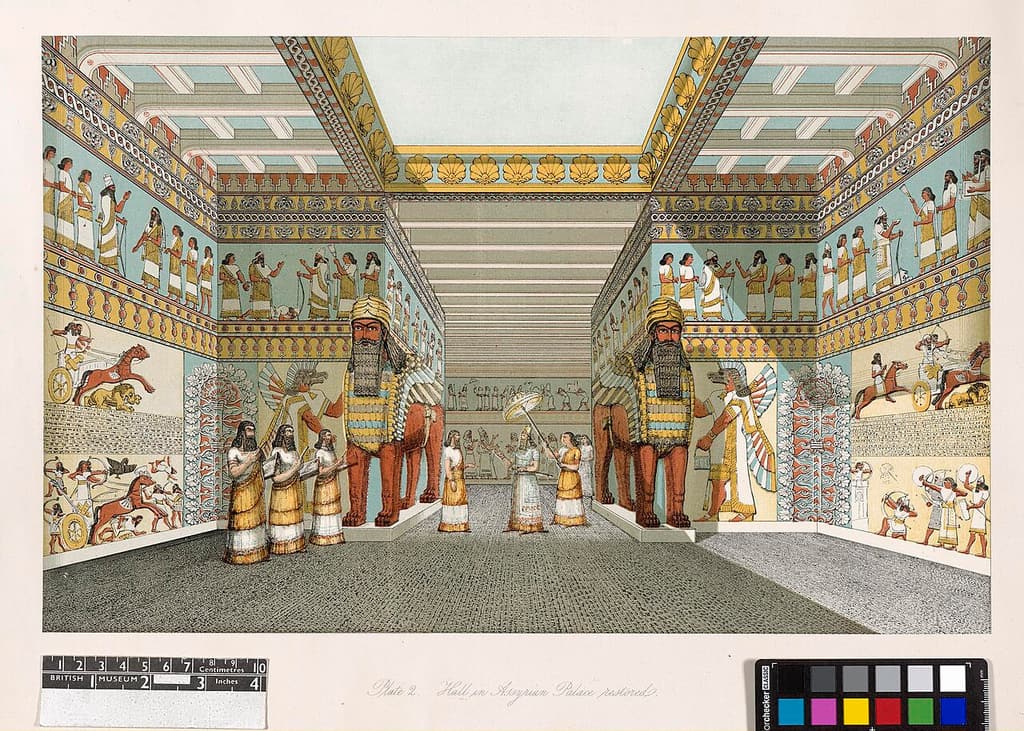
This is the oldest mythology on this site by a wide margin, and the only one that had to be dug up and decoded before anyone could read it. When George Smith, a former banknote engraver working at the British Museum, recognised a flood story on a broken tablet in 1872 and reportedly began undressing in his excitement, he was reading a text that no living person had understood for roughly two thousand years.
Everything here comes from clay. Cuneiform was pressed into wet tablets with a reed stylus, and the tablets survive in enormous numbers precisely because they were baked hard when the buildings holding them burned down. The single richest source is the library assembled at Nineveh by the Assyrian king Ashurbanipal in the seventh century BCE — a deliberate collection of the older literature of the region, recovered in fragments from a destruction layer.
Four peoples, one continuous tradition
"Mesopotamian" covers three thousand years and several languages, and the material is genuinely continuous while the names change.
- Sumerian is the oldest written layer, from around 2900 BCE, in a language unrelated to anything known. The great goddess is Inanna; the sky is An, the air-god Enlil, the wise god of fresh water Enki.
- Akkadian, a Semitic language, becomes dominant from about 2300 BCE and inherits the same gods under new names: Inanna becomes Ishtar, Enki becomes Ea, Utu the sun becomes Shamash.
- Babylonian and Assyrian literature continues in Akkadian, with each empire promoting its own city god — Marduk of Babylon, Ashur of Assyria — to the head of a pantheon that otherwise stays recognisable.
Because the same story often survives in a Sumerian version and a later Akkadian one with different names and a different emphasis, pages here name the language and period of the version they follow. That is not pedantry: the Sumerian Descent of Inanna and the Akkadian Descent of Ishtar differ in ways that change what the story is about.
The texts
- The Epic of Gilgamesh — the great one. A Sumerian cycle of separate Gilgamesh poems was reworked into a unified Akkadian epic, and the version most people read is the "standard" eleven-tablet edition attributed to the scribe Sîn-lēqi-unninni, with a twelfth tablet appended that contradicts the rest. A king humbled by friendship, wrecked by his friend's death, and sent chasing an immortality he does not get. Tablet XI contains the flood.
- Enuma Elish — the Babylonian creation epic, recited at the New Year festival. The sea Tiamat and the fresh water Apsu mingle; the younger gods are noisy; Apsu is killed; Tiamat makes war and is destroyed by Marduk, who splits her body to make sky and earth. It is a creation myth that is also a piece of political argument for Babylon's supremacy.
- Atrahasis — the flood story in its fullest form, with the reason attached: humans were made to do the gods' labour, they multiplied and became too loud, and the gods sent plague, drought and finally a flood to reduce them.
- The Descent of Inanna / Ishtar — the goddess passes through seven gates into the underworld, surrendering a garment or ornament at each, and hangs dead on a hook until rescued, at the cost of a substitute.
- Hymns, laments and omen texts — including the temple hymns attributed to Enheduanna, high priestess at Ur and daughter of Sargon, who is the earliest author in world literature whose name is attached to her own work.
Gods, cities and the economics of religion
Mesopotamian religion is organised by city. Each major city had a god who owned it: Enlil at Nippur, Inanna at Uruk, Enki at Eridu, Nanna the moon at Ur, Marduk at Babylon, Shamash at Sippar and Larsa. The temple was not merely a shrine but a household and an economic institution, holding land, employing labour, storing grain and lending it. The ziggurat was a platform for the god's house, not a temple people entered.
The deity was present in the cult statue, and the statue's care was the central rite — fed twice daily, clothed, taken out in procession. When a city was defeated, its god's statue was carried off, and the return of a statue could be worth more politically than territory. The Marduk Prophecy is essentially a god explaining his own abduction.
The most important thing to grasp about the relationship is that humanity exists to work. Atrahasis states it flatly: the lesser gods rebelled against digging the canals, so people were made from clay mixed with the blood of a slaughtered god to take over the labour. There is no promise in this literature that the gods are on your side.
The afterlife nobody wanted
The Mesopotamian underworld, the "land of no return", is a house of dust where the dead eat clay and are clothed like birds in feathers. It applies to everyone regardless of conduct — there is no judgement, no reward, no separation of good from bad. What the dead need is the offerings of the living, and a person with no descendants to pour water for them is in the worst state of all.
Gilgamesh's entire second half is a refusal to accept this, and the epic's answer, delivered by the flood survivor Utnapishtim, is that there is no way around it. That bleakness is the tradition's distinctive note, and it makes the comparison with the Egyptian afterlife — where the dead are judged, and can succeed — one of the sharpest contrasts on this site.
Divination, demons and the everyday religion
The literary myths are a small part of what was written on clay. Far more tablets concern divination: the liver of a sacrificed sheep read in minute detail, the behaviour of oil dropped on water, the shape of a malformed birth, the movements of the planets — all recorded as omen lists pairing a sign with an outcome, built up over centuries into reference works. The gods were understood to write their intentions into the world, and reading them was a technical profession with a training and a literature.
Alongside that ran an enormous body of exorcism and healing texts. Illness and misfortune were often the work of named demons or angry ghosts, addressed by an ashipu with incantations, substitute figurines and rituals. Lamashtu, who kills infants and unborn children, was warded off with amulets showing the demon Pazuzu, whose horrifying face was employed as a protection. This — not epic poetry — is what most Mesopotamians would have recognised as religion in practice.
What this tradition passed on
The Mesopotamian flood narrative and the biblical one are related, and the relationship is not a matter of speculation: the sequence of the vessel, the surviving family, the animals, the birds released to find land, and the sacrifice afterward is shared, and the Mesopotamian versions are older. Precisely how the transmission happened is debated; that there is a connection is not. The flood myths compared page works through what is shared and what genuinely is not.
Other inheritances are quieter and larger: the division of the circle into 360 degrees and the hour into sixty minutes comes from Babylonian sexagesimal mathematics; systematic astronomy and the zodiac's origins are Mesopotamian; and the demon Lamashtu, who threatens mothers and newborns, stands somewhere behind a long European tradition of child-stealing night-figures.
What is missing, and why
Reading this material means reading around holes. Tablets break, and the breaks fall mid-line. Square brackets in a translation mark a modern restoration; ellipses mark text that is simply gone. New fragments are still being identified, and in 2015 a newly-acquired tablet added twenty lines to the Cedar Forest episode of Gilgamesh, changing how that scene reads. Any statement about Mesopotamian myth is provisional in a way that statements about Homer are not.
Names, and why they keep changing
A single deity in this tradition may appear under a Sumerian name, an Akkadian one, and a title used instead of either. Inanna and Ishtar are the same goddess; Enki and Ea likewise; Utu and Shamash; Nanna and Sin. Marduk is frequently called Bel, "lord", and Ashur is both a god and a city. Scholarly transliteration adds diacritics that popular writing drops, so Sîn, Sin and Suen are one moon god. This site gives the form appropriate to the version being described, with the equivalents in the panel, and says which language a story is being told in — because a claim about "the Babylonian Inanna" is already confused before it gets to its verb.
Where to start
Read Gilgamesh — Andrew George's translation, which marks the gaps honestly rather than smoothing them, and which prints the older Babylonian fragments alongside the standard version so you can watch the poem being edited across a thousand years. Then Enuma Elish, which is short, and which repays being read as propaganda as well as cosmology. Then Enheduanna's hymn to Inanna, for the shock of hearing a named individual's voice, complaining about her own exile, from the twenty-third century BCE.
The Mesopotamian family tree sets out the god-lists as the Sumerian and Akkadian sources give them, including the cases where a god's parentage changes when a new city took the top position. The figures written up so far follow below, grouped by the kind of being each one is.
gods
- Anuthe sky, supreme authority, the granting of kingship
- Enlilwind, the tablet of destinies, kingship on earth
- Enkifresh water, wisdom, craft
- Inannalove, war, Venus
- MardukBabylon's supremacy, order from chaos, the fifty names
- Ereshkigalthe land of no return, the dead, grief
- Nergalplague, war, the underworld
- Ninhursagbirth, the foothills, the shaping of humanity
- Nannathe moon, the calendar, cattle
- Ututhe sun, justice, oaths
- Dumuzidshepherding, the dying god, the annual return
- Ninurtafarming, war, the defeat of Asag
- Nabuwriting, scribes, the tablet of destinies
- Adadstorms, rain, destructive weather
- Namtarfate as death sentence, disease, the underworld's vizier
primordials
heros
creatures
- Humbabathe cedar forest, the terrifying face, divine appointment
- Lilitunight, wind demons, danger to mothers and infants
- Pazuzuthe west wind, fever, protection against Lamashtu
- Lamashtudanger in childbirth, infant death, fever
- Anzuthe theft of the tablet of destinies, the storm bird
- the Bull of Heavendrought, divine punishment, the constellation Taurus