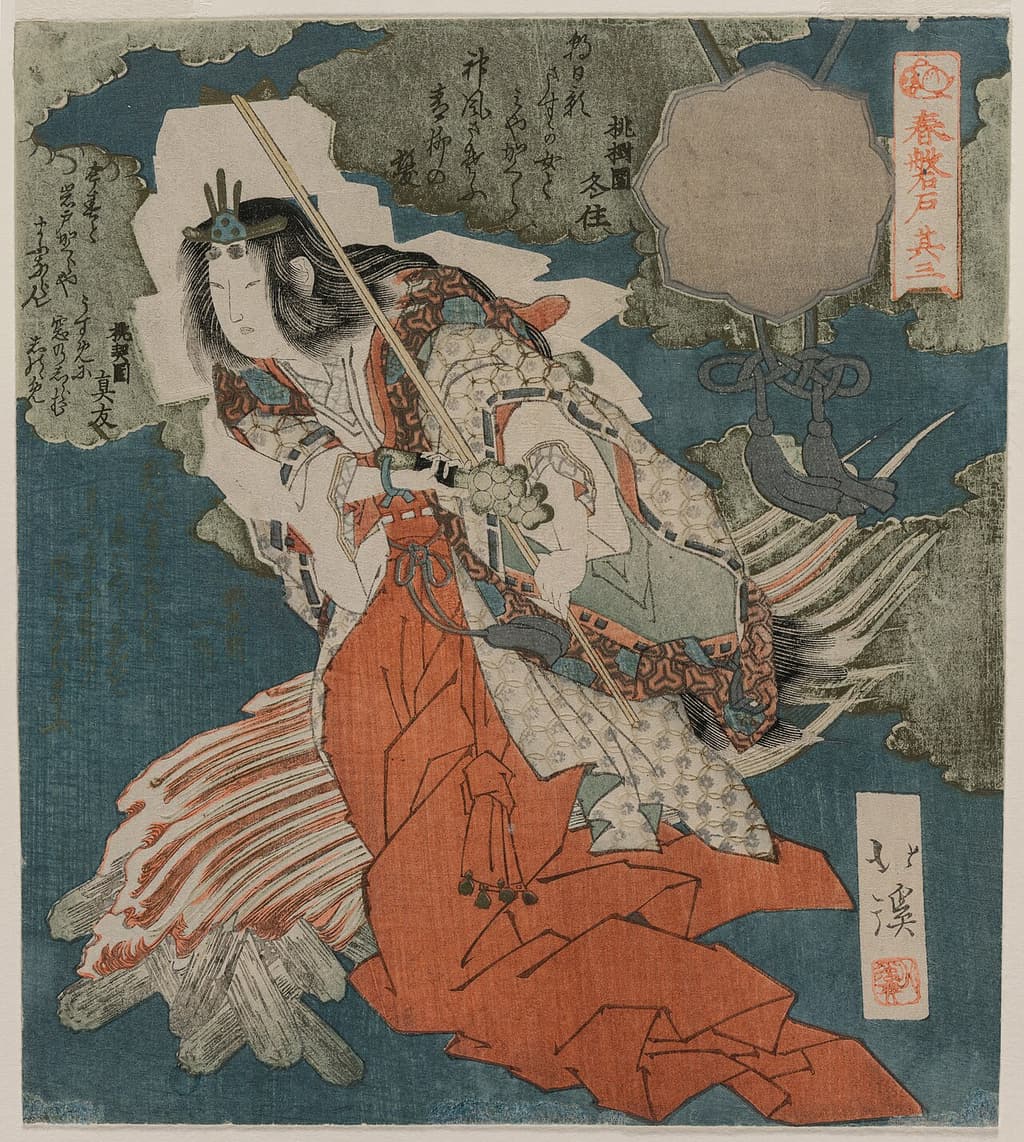
The sun goes out, and the response is a committee. That is genuinely how the most famous episode in Japanese mythology proceeds: the eight hundred myriad deities convene in a dry riverbed, take advice from a specialist, commission equipment, run a divination, and stage a performance. Nobody threatens anybody. The problem is solved by procedure, craft and a joke.
What Susanoo did
The trouble starts with a contest neither party quite wins. Susanoo, on his way to say goodbye to his sister before being expelled to the land of his mother, comes up to the high plain of heaven so violently that the mountains shake, and Amaterasu meets him armed — hair bound up into male-style loops, a quiver of a thousand arrows on her back, stamping the ground until her legs sink into it. He protests that his intentions are clean, and they test it by an oath-rite, each chewing and crushing something belonging to the other and breathing out deities. He declares the result proves his innocence, and then behaves in a way that suggests otherwise.
His offences are agricultural before they are anything else, and that is the point. He breaks down the divisions between his sister's rice paddies so the water runs out; he fills in the irrigation channels; and he defecates in the hall where the first fruits of the harvest are ritually tasted. Amaterasu covers for him each time, in a series of increasingly strained excuses — the ridges were wasteful, the mess was vomit, he had been drinking.
Then he takes a piebald colt of heaven, flays it backwards from the tail, and throws the carcass down through a hole in the roof of the sacred weaving hall, where garments for the gods are being made. A weaving woman inside starts, is driven against her shuttle in the genitals, and dies. This is the line the story will not excuse. It contaminates a sacred workshop with death and with the wrong kind of blood, and it kills a woman at her loom, which in this text is very close to killing the sun's own function.
Amaterasu went into the rock cave of heaven, pulled the stone door shut behind her, and stayed there.
Total dark
The high plain of heaven went dark and the reed-plain country below went dark, and it stayed dark. The text says that from then on there was continual night; that the voices of the myriad deities filled the world like summer flies; and that every kind of calamity arose at once. Nothing grows without the sun, and nothing is safe: the darkness is not merely inconvenient, it is a state in which the malign things that ordinarily keep out of the light have nothing to keep out of.
The plan
The deities assembled in the bed of the Peaceful River of Heaven and put the question to Omoikane, whose name means something like the god who combines thoughts and whose entire function is the solving of problems. What he designed was not a rescue. It was a lure, made of four components, and every one of them survives in Japanese ritual practice.
- The long-crying birds of the eternal night — roosters — were gathered and made to crow, which is the sound the world makes when the sun is about to appear whether it wants to or not.
- Iron was quarried from the heavenly mountain of Kagu, and the smith Amatsumara and the deity Ishikoridome were set to make a mirror; Tamanoya strung a long rope of curved magatama beads.
- Ame-no-Koyane and Futodama performed a divination, roasting the shoulder blade of a stag over a fire of hahaka wood and reading the cracks. Then they pulled up a sakaki tree, roots and all, from Mount Kagu, hung the bead-rope on its upper branches, the mirror on its middle branches, and streamers of white and blue cloth on its lower ones. Futodama held the tree out as a great offering while Koyane chanted the liturgy.
- Ame-no-Tajikarao, the deity of hand-strength, took up position beside the door where he could not be seen.
Then Ame-no-Uzume did the thing everybody remembers.
The dance
She bound her sleeves back with a cord of vine from Mount Kagu, tied a headband of club moss, took bundles of bamboo leaves in her hands, turned a wooden tub upside down in front of the cave and stamped on it until it boomed. And then the deity came into her — the text says she became divinely possessed — and she pulled the cords of her dress down below her navel and bared her breasts.
The eight hundred myriad deities laughed until the plain of heaven shook.
Inside, Amaterasu heard something she could not account for. She pushed the stone door open a crack and said, into the noise: I thought that with my withdrawal heaven and earth would be dark, so why is Uzume dancing, and why are all of you laughing?
Uzume answered: because there is a deity here greater than you, and we are delighted.
And while she spoke, Koyane and Futodama brought the mirror forward and held it up to the gap in the door.
Amaterasu leaned out to look at the being in the mirror, further and further, still not understanding — and Tajikarao took her by the hand and hauled her out into the open. Futodama immediately stretched a plaited rope of rice straw across the entrance behind her and told her she might not go back beyond it. The world was light again.
That rope is the shimenawa, and it hangs today across shrine gates and around sacred trees and stones all over Japan, marking off what may not be re-entered.
Susanoo was fined a thousand tables of restitution offerings, had his beard cut off and his finger- and toenails pulled out, and was expelled from heaven — which is how he arrives, filthy and disgraced, on the riverbank in Izumo where he meets a weeping family with one daughter left.
The two chronicles do not tell it the same way
The Kojiki of 712 CE gives the version above. The Nihon Shoki of 720 gives a main narrative and then a series of alternative accounts introduced with the formula "in one writing it is said" — and the variants matter. In the Shoki tradition, the woman injured at the loom is in some versions Amaterasu herself, wounded by the shuttle, and in others her younger sister Wakahirume; the Kojiki keeps the goddess unhurt and kills an anonymous weaving maiden instead.
The Shoki also has a small, revealing note about the mirror: the first casting came out imperfect and became the sacred object of one shrine, and the second attempt is the one that became the imperial regalia. That is a chronicle acknowledging that two shrines both claimed to hold the mirror and resolving the dispute by giving each a mirror, which tells you a good deal about what these books were for.
Why the story is shaped like this
Look at who does what. Koyane recites the liturgy; Futodama holds the offerings; Uzume dances in trance; Ishikoridome casts the mirror; Tamanoya strings the beads. Each of these is the ancestor of a real hereditary priestly lineage at the eighth-century court — the Nakatomi, the Imbe, the Sarume, the mirror-makers and the bead-makers — and each is shown performing, in the crisis at the origin of the world, exactly the ritual duty their descendants performed at court. The episode is a charter. It is not primarily an explanation of why the sun rises; it is an argument about who is entitled to conduct the ceremonies of the state, and the answer is: the people whose ancestors got the sun out of the cave.
That also explains why the whole sequence is so specific about equipment. The sakaki branch hung with mirror, beads and cloth is a real offering-tree, the tamagushi; scapulimancy was a real court divination technique; the roosters, the drumming, the trance dance and the laughter are the recognisable ingredients of kagura, the shrine dance still performed today. The best-known cycle, the all-night yokagura of Takachiho in Miyazaki, dramatises this very episode, and Takachiho's Ama-no-Iwato Shrine faces a cave across a gorge and maintains an upstream riverbed cave, Amano-Yasukawara, as the place where the deities held their meeting.
Where scholars genuinely disagree
- Was Amaterasu always female, and always the sun? A line of argument going back to Tsuda Sōkichi in the early twentieth century holds that the figure behind her may originally have been a female ritualist who served a male solar deity, with the two collapsing into one during the formation of the imperial cult — and some scholars have connected the fixing of her femininity to the reign of the empress Jitō, in whose lifetime the chronicles were compiled. This is a minority position and it is not demonstrable, but it is not fringe either, and the sheer political convenience of a sun goddess ancestress for a reigning empress is hard to ignore.
- Is it about an eclipse? People have tried repeatedly to match the episode to a datable total solar eclipse over Japan. There is no way to test the claim, the chronicles give no date, and a story about the sun disappearing does not require a specific eclipse to explain it. The winter-solstice reading — a sun that weakens, is ritually coaxed back and returns — fits the ritual context better and is likewise unprovable.
- Is the parallel with Central and Southeast Asian sun-hiding tales a real relationship? Comparable stories exist across a wide area, and the argument for transmission versus independent invention has not been settled.
Questions people bring to this episode
What actually happened to the mirror?
The Yata-no-Kagami is one of the Three Sacred Treasures of the imperial house, and the tradition holds it at the Inner Shrine at Ise, wrapped and boxed, unseen. No modern person is known to have looked at it, no photograph exists, and no examination has been permitted; a replica is kept in the palace. The claim that it is the mirror from this story is a matter of continuous ritual assertion, not of evidence, and both sides of that sentence are true.
Why is the answer to a cosmic emergency a striptease?
Because in this ritual logic, laughter is generative. The Japanese word used for the noise of the assembled gods is connected to the flowering and opening of things, and Uzume's exposure belongs to a well-attested category of ritual obscenity meant to provoke vitality — she performs an almost identical routine later at the frontier of heaven, dealing with the giant Sarutahiko, where nakedness again functions as a form of authority rather than of vulnerability. Reading the scene as titillation misses that the audience is eight hundred million deities and the intended effect is agricultural.
Does the cave still exist as a place you can visit?
Several sites claim it. The Takachiho gorge in Miyazaki is the best-known and has the strongest institutional presence, but Ama-no-Iwato claimants exist elsewhere, including in Mie and Tokushima, and the Kojiki gives no geography for heaven at all — heaven, in the text, is simply above. Visiting the Miyazaki site is a pilgrimage to a tradition about the story, which is a slightly different thing from visiting its setting.
Has the episode survived into modern popular culture intact?
Better than most. The cave sequence has been staged in film, in Noh-derived dance, in manga and in games — Ōkami builds an entire art style around the returning sun — and the imagery of the mirror and the rope is instantly legible to Japanese audiences without explanation. The one thing that travels badly is the name: when a fire technique in a globally popular manga is called Amaterasu, it is borrowing a word, not a story, and readers who meet the goddess that way are usually surprised to find that her defining act is refusing to come out of a room.