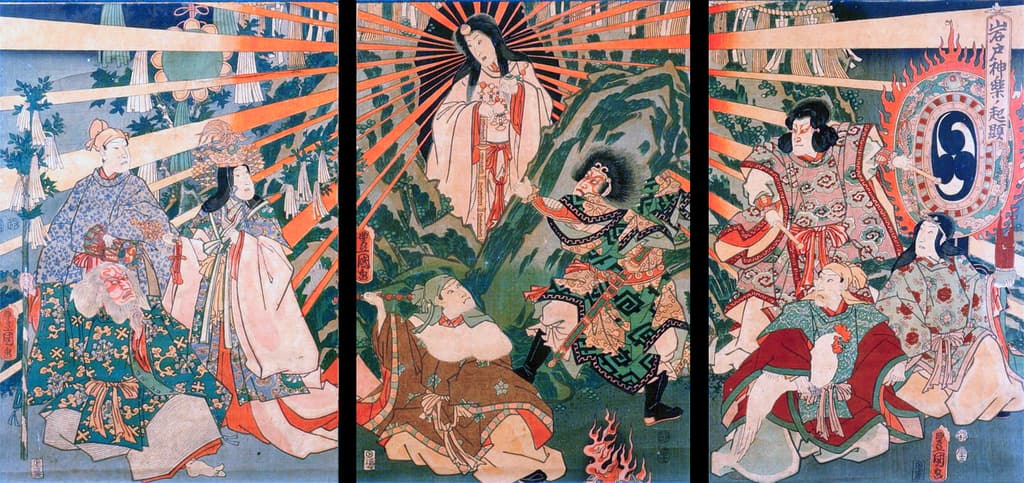
On the first day of 1946, Emperor Hirohito issued a rescript stating that the bond between throne and people did not depend on the notion that the emperor was a living deity descended from the gods. That sentence was necessary because, for the preceding seventy-odd years, Japanese schoolchildren had been taught the opposite as fact, and the fact in question was a genealogy that began with Amaterasu-Ōmikami, the kami of the sun.
No other figure on this site has been quite so load-bearing for quite so long. She is a mythological character, a shrine, a bloodline argument and, since the 1990s, a video-game protagonist, and the interesting thing is how little the earliest texts do to make her impressive.
Born from an eye, and given the higher plain
The Kojiki (712) has her produced when Izanagi, filthy from the land of the dead, washes his left eye in a river mouth in Himuka. His right eye yields Tsukuyomi and his nose yields Susanoo; the Kojiki calls these three the "three noble children" and says Izanagi rejoiced, took off his necklace and handed the upper heavens to his daughter.
The Nihon Shoki (720) is less settled about it. Its main narrative has Izanagi and Izanami produce her deliberately, as a couple, because the child was so radiant that they decided the earth was too small for her and sent her up the pillar of heaven; only in the alternative accounts, the passages introduced with the formula that one book says otherwise, does the washing version appear. The compilers were willing to print both. That habit makes the Japanese chronicles unusually easy to read honestly, and it is the reason no page here can give you a single authoritative version of her birth.
Her older name, Ōhirume, means something like "great sun woman" and is probably the earlier title — a description of a function rather than a personal name. Amaterasu is itself a verb: ama-terasu, "shining in heaven".
The quarrel, the pledge, and eight children who were nobody's
When Susanoo comes up to heaven to announce his exile, she assumes invasion, ties her hair into male bunches, straps on quivers holding a thousand and five hundred arrows and stamps her legs into the hard ground up to the thighs. This is not a passive light-giving figure; the text goes out of its way to arm her.
They settle it by an ordeal. Each takes something belonging to the other, chews it, and spits out a mist from which children emerge. From his ten-span sword come three goddesses — the Munakata deities, still enshrined on the islands and coast of northern Kyushu. From her string of curved magatama beads come five male kami. Susanoo claims victory on the grounds that his produce was female and therefore gentle, proving his intentions pure; the pledge's terms are stated after the result, which is why commentators have argued about who actually won for a thousand years.
The genealogical payoff is that the five males are reckoned hers, because the beads were hers, and the eldest line runs from Ame-no-Oshihomimi to his son Ninigi, the grandson sent down to rule. The whole imperial claim hangs on a rule about whose object produced whom.
The cave: a strike, not a disappearance
What drives her into the rock cave is not a sulk. Susanoo breaks the ridges between her paddy fields, blocks the irrigation channels, fouls the building in which the year's first rice is consumed, and finally skins a piebald colt tail-first and drops the carcass through the roof of the workshop where the gods' garments are woven, killing one of the weavers outright. The Nihon Shoki keeps one variant in which it is Amaterasu herself who is injured. The offences are agricultural and ritual — precisely the crimes listed as "heavenly offences" in the great purification prayer preserved in the tenth-century Engishiki.
She withdraws, and the world goes dark, and the eight hundred myriad kami hold council in the dry bed of the river of heaven. Their solution is a piece of theatre: cocks made to crow, a mirror forged by Ishikoridome, magatama strung by Tamanoya, both hung with cloth streamers on a five-hundred-branched sakaki tree, a prayer intoned by Ame-no-Koyane, and Ame-no-Uzume dancing on an overturned tub until her dress falls open and the assembled gods laugh so hard that heaven shakes.
Curiosity is what defeats her. She slides the rock door open a finger's width to ask what could possibly be funny while the world is dark; Uzume says a deity greater than you has arrived; the mirror is pushed forward; and as she leans out to look at what she takes for a rival, Ame-no-Tajikarao grabs her wrist and hauls her out. A straw rope is stretched behind her so she cannot go back in. The shimenawa hung across every shrine gate in Japan descends from that rope.
The point of the story is that light is restored by a joke and a mirror, not by force. It is worth holding onto when you meet the scene in adapted form, because that is nearly always the part that gets cut.
Ise, and the shrine that is always new
Her shrine is the Inner Shrine at Ise in Mie prefecture, and the Nihon Shoki explains how it got there: the imperial princess Yamatohime carried the sacred object from site to site looking for a permanent home until the deity told her she wished to dwell in Ise, where the waves of the eternal land return. From then until the fourteenth century an unmarried imperial princess, the saiō, served there as the sun kami's representative.
Ise is torn down and rebuilt on an adjacent plot every twenty years, the deity moved across at night, the old timbers distributed to other shrines. The sixty-second rebuilding was completed in 2013. The buildings are always ancient and never old, which is a genuinely different idea of what preservation means, and it has kept alive a carpentry tradition that would otherwise have died with the technique.
What sits in the sanctuary is the mirror Yata-no-Kagami, which nobody has publicly seen. It is one of the three regalia; the sword lives at Atsuta; only the jewel is kept at the palace.
Ōkami, Naruto, and the sun in a wolf suit
Most readers under forty meet the name in fiction first, and the fiction varies wildly in fidelity. Capcom's Ōkami (2006) casts you as the sun goddess incarnated as a white wolf who restores colour to a monochrome world with a brush — a free invention, but built on a genuine premise, since restoring light after withdrawal is the character's actual job. Naruto attaches her name to a technique that produces black inextinguishable flames, which has nothing to do with anything in the chronicles beyond the sibling grouping with Susanoo and Tsukuyomi. The Persona and Megami Tensei series place her near the top of their divine hierarchies, which at least reflects the chronicles' own ranking.
The cave scene itself is the most-adapted piece of Japanese myth there is, from kagura performances at rural shrines to the plot skeleton of a great many anime arcs. What survives the journey is the darkness and the rescue. What tends not to survive is the ribald dance, which is the mechanism.
Was Amaterasu always a goddess?
Not obviously, and the question is live. A minority of scholars — following a line of argument from Tsuda Sōkichi onwards — read Ōhirume as the wife or medium of a male solar deity, later promoted when the imperial cult needed a female ancestor to match a ruling empress. The evidence is indirect: the name's structure, the saiō institution, and the reigns of Suiko and Jitō during the period the chronicles were compiled. It is a hypothesis, not a finding, and the texts as we have them are unambiguous that she is the deity herself.
Why is Ise so plain when the imperial shrine ought to be grand?
Because its architecture predates continental influence and was deliberately frozen. The style, shinmei-zukuri, uses unpainted Japanese cypress, a raised floor, a thatched roof and forked finials, and it looks like a granary because it descends from one. Buddhist temple architecture arriving from the sixth century brought vermilion paint, tile and curved roofs — which is why Inari's shrines are bright orange and Ise is the colour of wood. Ise's austerity is not modesty; it is a claim to be older than the alternative.
Is the Japanese imperial line really descended from her?
The claim is that it is, and the Japanese family tree sets out the chain the chronicles draw: Amaterasu to Oshihomimi to Ninigi to Hoori to Ugayafukiaezu to Jimmu, conventionally the first emperor. Historians treat the early emperors as legendary and the chronicles as eighth-century documents written to justify an eighth-century state. The present imperial house is genuinely very old by any comparative measure; its documented history and its mythological genealogy are two different things, and the tradition overview explains why the compilers needed both.