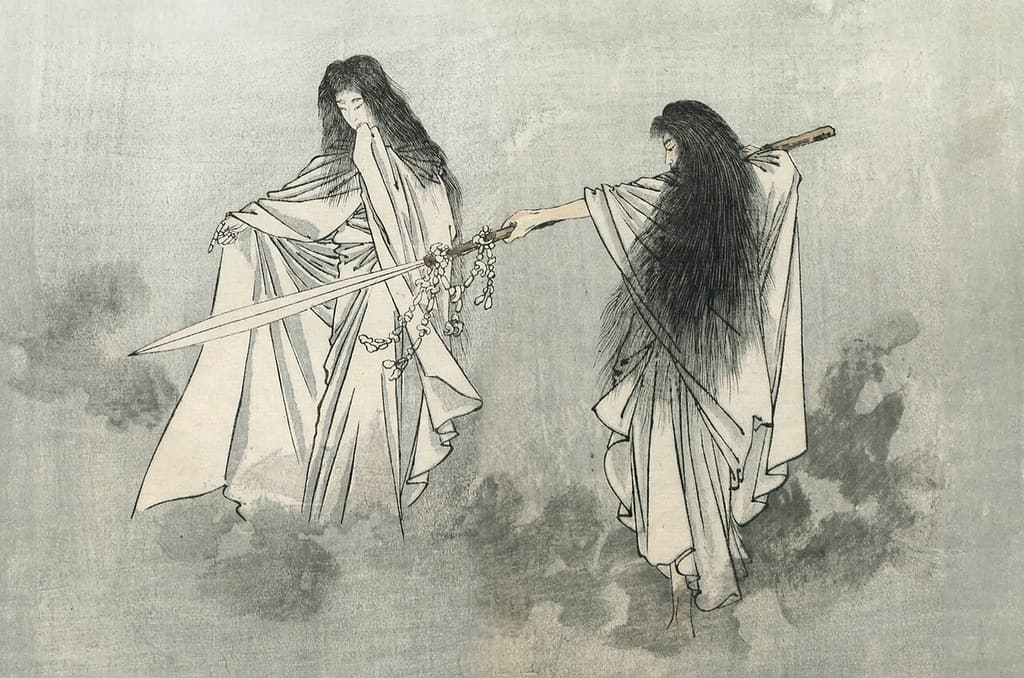
Almost everything distinctive about Shinto practice — the basin at the shrine entrance, the salt, the paper streamers waved over a new car, the sumo wrestler's rinsed mouth — can be traced back to one man taking a bath after a bad journey. The Kojiki gives that bath more narrative attention than it gives the creation of the world, and the three most important kami in the corpus are produced by it.
The spear, the island, and the wedding that had to be done twice
He is the seventh in a sequence of kami who come into being, and the first with anything to do. The heavenly kami hand him and his sister-consort Izanami a jewelled spear and instruct them to consolidate the drifting land. Standing on the floating bridge of heaven, they push the spear down into the brine, stir, and lift it; the salt that drips from the point piles up into an island called Onogoro, "self-curdling". They descend onto it.
There they erect a pillar and a hall, and circle the pillar in opposite directions to meet and marry. Izanami speaks first — what a delightful young man — and the child of that union is Hiruko, the leech-child, boneless, who is put into a reed boat and set adrift. Their second product, Awashima, is likewise not counted among their children.
They go back up and ask what went wrong. The heavenly kami perform divination and return the answer: the woman spoke first. They repeat the circuit with Izanagi speaking first, and it works. Out of this second attempt come the islands of Japan, one after another, in a fixed order beginning with Awaji and the four-faced island of Shikoku — and after the islands, a long procession of kami of wind, sea, rivers, mountains, trees and plains.
The rejected first child does not vanish from Japanese religion. By the medieval period Hiruko had been identified with Ebisu, a god of luck and fishermen, on the reasoning that a baby set adrift must have washed ashore somewhere.
Fire, and the first killing
The birth sequence ends catastrophically. Izanami bears Kagutsuchi, the kami of fire, and is burned so badly that she sickens and dies — though even dying she keeps producing deities, from her vomit, her urine and her excrement, among them kami of metal and clay and irrigation water, which is a compressed statement about what a furnace, a mine and a paddy field have in common.
Izanagi's response is to draw his ten-span sword, Ame-no-Ohabari, and behead his newborn son. The blood on the blade, the blood shaken from the hilt, and the pieces of the corpse each become further kami, including Takemikazuchi, the thunder-and-sword deity who later negotiates the surrender of the land at Izumo. This is the first killing in the corpus, and it is a father executing an infant for the crime of being born.
Yomi: the comb, the peaches and the boulder
He goes after her. Yomi is reached by walking, not by descent, and the door is a physical door. She meets him at it and says she will ask permission to leave, but he must not look at her. He waits, loses patience, snaps a tooth from the comb in his hair and lights it as a torch.
What he sees is maggots and roaring, and eight thunder deities seated on her head, chest, belly, genitals, hands and feet. He runs. She sends the hags of Yomi after him and he delays them by throwing down his headdress, which becomes grapes, and his comb, which becomes bamboo shoots — both of which they stop to eat. Then the eight thunders and fifteen hundred warriors of Yomi come, and he holds them off with his sword swung behind him, and finally with three peaches picked at the foot of the slope. He thanks the peaches and gives them a divine name and a job: to help people in distress.
At the pass he blocks the road with a boulder that a thousand men could not move, and they conduct their divorce across it. She promises to strangle a thousand of his people every day. He answers that he will cause fifteen hundred to be born. The world's birth rate exceeds its death rate by five hundred a day because of an argument at a doorway, and the Kojiki states this as an explanation, not a metaphor.
The bath at the river mouth
Reaching a plain by the sea in Himuka, in southern Kyushu, he says that he has been to a foul and polluted land and must cleanse himself, and he undresses. Every discarded item — staff, belt, bag, robe, trousers, headdress, bracelets — becomes a kami as it hits the ground. Testing the current, he judges the upper reach too swift and the lower too slack and washes in the middle. From the filth he rinses off come two kami of pollution and then, immediately, two kami of rectification, because in this system contamination and its correction are the same event seen twice.
Then he washes his face:
He calls these three his noble children, gives his necklace to Amaterasu with the plain of high heaven, gives the realm of night to Tsukuyomi and the seas to Susanoo, and the Nihon Shoki — which in its principal narrative has the couple produce the sun and moon deliberately, as parents, and relegates the whole Yomi episode to a variant — records the washing version only among its alternatives. Which account is primary is genuinely unsettled.
Where he goes afterwards, and the two places that claim him
The Kojiki says he retired to Taga in Ōmi province; Taga Taisha in Shiga is built on that line, and a proverbial couplet makes him Amaterasu's father in the same breath as making Taga her parent's home. The Nihon Shoki instead has him build a quiet palace on the island of Awaji, where Izanagi Jingū stands. The two shrines have coexisted with the discrepancy for a very long time; nobody has ever needed to resolve it, because a kami being present in two places is not a contradiction in this religion.
Persona, Ghibli, and the shape of the story
Persona 4 made the name globally familiar as the protagonist's initial persona, and Persona 3 and 5 extended the family across their casts, which is why a substantial share of English-speaking readers first encounter Izanagi as a masked figure with a spear rather than as a creator deity. Anime and games routinely pair Izanagi and Izanami as tragic lovers separated by death — which the sources do support, right up until the point where they stop being lovers and start being a demographic policy.
The Yomi sequence gets adapted constantly, and the elements that survive are the forbidden look and the flight. What tends to be dropped is what the story is actually for: it explains why you rinse your hands before approaching a shrine. The chase is the setup; the bath is the conclusion.
Is the forbidden look the same story as Orpheus?
The resemblance is real and the relationship is unproven. A living person entering the land of the dead to recover a spouse and losing them by looking is a story shape found in Greece, in Japan, and in a scatter of other traditions, and comparative folklorists have catalogued it for over a century. What differs is the moral: Orpheus loses Eurydice through a failure of trust, and the tale is about grief. Izanagi loses Izanami through a failure of ritual restraint, and the tale is about contamination — he does not mourn, he washes. Reading the Japanese episode as a version of the Greek one flattens exactly the thing that makes it Japanese. The comparison of underworlds sets the two side by side.
Why does he purify himself rather than grieve?
Because pollution in this system is a substance, not a state of mind. Death, blood and decay leave a residue called kegare that attaches to a person regardless of fault, obstructs contact with kami, and is removed by water, salt and time — not by repentance. That is why the sequence runs corpse, flight, undressing, river, and why what emerges from the water is not consolation but the sun. The tradition overview sets out how far this purity logic reaches into ordinary practice.
What is the jewelled spear, and does it still exist?
Ame-no-Nuboko is a mythological object with no claimant relic behind it, unlike the three regalia — no shrine displays it and no text says where it went. It appears in art constantly, most famously in Kobayashi Eitaku's late-nineteenth-century painting of the couple on the floating bridge, and a replica stands at Onokoro Island shrine on Awaji, which claims to be the island the brine made. The tools and treasures of this tradition that do survive as objects — mirror, sword, curved jewel — are the ones a dynasty needed to be able to hand over.