Roughly a third of all Shinto shrines in Japan are Inari shrines — the usual figure given is around thirty thousand, with tens of thousands more small unregistered ones on rooftops, in factory yards, beside rice paddies and at the back of department stores. No other kami comes close. And yet Inari does not appear in the Kojiki or the Nihon Shoki at all, has no birth story, no parents, no quarrel, and no fixed gender.
That combination — maximum worship, minimum mythology — makes Inari the best possible corrective to the idea that Japanese religion is a set of stories about named gods.
A shrine founded by an arrow and a rice cake
The origin is preserved in a surviving fragment of the Yamashiro no Kuni Fudoki, the provincial gazetteer for the region around Kyoto. A wealthy man of the immigrant Hata clan, Hata no Irogu, had so much rice that he used a rice cake for archery practice. The cake turned into a white bird and flew to the top of a mountain, where rice began to grow. He built a shrine there in remorse. The shrine is Fushimi Inari Taisha, on Mount Inari south-east of Kyoto, and its traditional founding date is 711.
The name is generally read as ina-nari, rice growing, or ina-ni, rice load — either way, a grain word rather than a personal name. The kami of the mountain is identified in shrine documents with Uka-no-Mitama, a deity of foodstuffs who does appear in the chronicles as a child of Susanoo, but the identification is a later tidying-up rather than an origin.
Male, female, or five at once
Ask what Inari looks like and the sources answer at least four ways, all of them current:
- An old man carrying two bundles of rice, which is the oldest attested image and the one preserved in the twelfth-century record of a vision at the shrine.
- A young woman with sheaves and a sickle, which is the commonest folk image and the reason English books usually say "goddess".
- Dakiniten, an armed female Buddhist deity riding a white fox, absorbed from Indian tantric material via Chinese Buddhism — the form worshipped at Toyokawa Inari, which despite the name is a Sōtō Zen temple and not a shrine at all.
- A collective. Fushimi enshrines five kami on the mountain, and many shrines treat Inari as a plural presence rather than an individual.
Nothing forces a choice, and the tradition has never made one. This is the single clearest case on this site of a deity that a Western category of "god" simply mis-describes, and any page that gave you a confident pronoun would be inventing.
Foxes, and what they are not
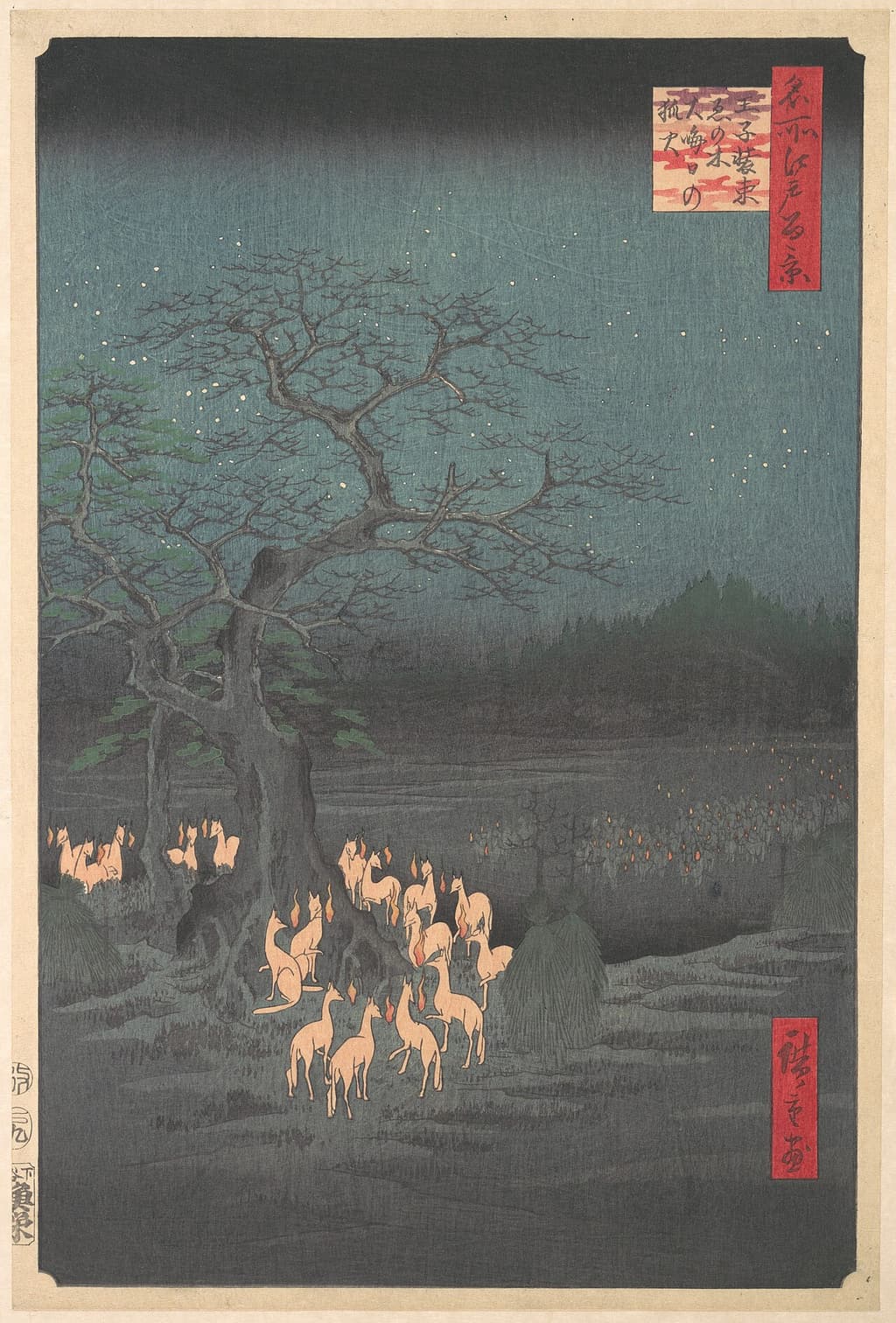
The paired stone foxes at an Inari shrine are not the deity. They are byakko, white messenger foxes, understood as attendants and go-betweens, and the distinction matters because it is constantly collapsed in English writing and in games. Each usually holds something in its mouth or under a paw: a granary key, a jewel, a scroll, or a sheaf of rice.
Their food offering is abura-age, deep-fried tofu, which is why a rice ball wrapped in sweetened fried tofu is called inarizushi and why a bowl of udon with a sheet of it on top is kitsune udon. Fried tofu on a menu in Osaka is a live piece of religion, and almost nobody eating it thinks of it that way.
The fox of folklore — the shapeshifter, the possessing spirit, the nine-tailed seductress — is a separate and largely later body of tradition that got entangled with the shrine fox because they are the same animal. Fushimi has spent centuries quietly distinguishing the two.
Why the gates are orange and why there are thousands of them
The tunnels of vermilion torii winding up Mount Inari are the most photographed religious site in Japan and among the most misunderstood. They are not ancient. Each gate is a donation, inscribed on the back with the donor's name and the date, and the practice of donating them took hold in the Edo period as merchants and businesses thanked the kami for a successful venture. Prices are published; small gates cost less than large ones; old gates rot and are replaced. The tunnel is a rolling ledger of Japanese commercial gratitude, several thousand entries deep.
Vermilion itself came into shrine architecture with continental Buddhist building and carries a protective association against decay — the pigment contains mercury sulphide and does in fact preserve wood. Ise, which predates that influence, is bare cypress. The colour is chronology, not taste.
From rice to venture capital
Inari's portfolio expanded with the economy. A kami of the grain harvest became, by the Edo period, a kami of prosperity generally, then of trade, then of manufacturing, and the sub-shrines maintained today by banks, breweries, department stores, film studios and technology firms are the direct continuation of that. Sake breweries are especially heavily represented, since sake is rice.
Swordsmiths brought a further layer: the tenth-century smith Sanjō Munechika was said to have forged a blade with the help of a fox spirit at the shrine's foot, a story dramatised in the Noh play Kokaji, and Inari accordingly picked up an association with metalwork that a pure agricultural deity would not have.
The busiest days are the Hatsuuma festival on the first horse-day of the second lunar month, marking the traditional date of the kami's descent onto the mountain, and the New Year period, when Fushimi receives millions of visitors in three days.
Memoirs, mountains and the tunnel shot
Arthur Golden's Memoirs of a Geisha and its 2005 film adaptation put the Fushimi gate tunnel in front of a global audience — the child running through the torii is that location — and international visitor numbers to the shrine have never gone back down. It now regularly tops rankings of Japan's most-visited sites among foreign tourists, which is a strange fate for a working mountain shrine with a two-hour circuit and thousands of small graveside-scale altars at the top that most visitors never reach.
Games and anime tend to fold Inari into the fox material: fox-eared characters, shrine maidens with tails, nine-tailed rivals. Naruto's fox is a demon, not a messenger; Inari, Konkon, Koi Iroha is one of the few franchises to build directly on the actual shrine relationship. The distinction between a kami of rice and the fox that carries its messages has almost entirely dissolved in fiction, and it is worth restoring, because the deity everyone assumes is a fox is not one.
Why does Inari have both Buddhist and Shinto shrines?
Because for most of the past thousand years there was no functional boundary. Fushimi's fortunes were bound up with Tōji, the great Shingon temple in Kyoto, from the ninth century, and Inari came to be venerated as a protector of that temple's construction; on the Buddhist side the deity was assimilated to Dakiniten. The 1868 separation edicts forced institutions to declare themselves one or the other, and the Inari network split messily — Fushimi and its branches became shrines, Toyokawa and its branches stayed temples, and both still call the deity Inari. It is the most instructive surviving example of a cult that the separation could not cleanly cut in half, and the tradition overview sets out how that separation was carried out.
What are the small stone altars all over the mountain?
They are otsuka, private mounds, each with a stone bearing a name for the deity chosen by the individual or group that erected it — thousands of them, in clusters, up the wooded slopes behind the main gate tunnels. They represent a devotional habit closer to a personal covenant than to congregational worship: a petitioner names their own Inari, erects a stone, and tends it. Many are maintained by families or small businesses across generations, and some are abandoned and moss-covered. The upper mountain is the part of Fushimi that photographs badly and explains the most.
Is it true you should never stop worshipping Inari once you start?
This is a genuine and widely held folk belief — that Inari's favour comes with obligation, and that a household or business which sets up a shrine and then neglects it invites reversal. Priests generally treat it as superstition rather than doctrine, and it has no textual basis; but it is repeated often enough, and taken seriously enough by shopkeepers, that it shapes real behaviour, and it explains why disused corporate shrines are formally decommissioned by a priest rather than simply removed. It also reflects something structurally true about this kami: a deity of increase is a deity whose withdrawal is legible as loss. For the wider symbolism of the gate itself, see gate and threshold symbols.