the Japanese archipelago
Japanese mythology
Japanese mythology reaches us through two books, both commissioned by the imperial court, both completed within eight years of each other, and both with an obvious political job to do. That job was to establish that the ruling family descended from the sun goddess. Everything else in the corpus sits around that argument.
Two chronicles, one agenda
The Kojiki ("Record of Ancient Matters", 712 CE) was compiled by Ō no Yasumaro from material said to have been memorised by a court reciter. It is written in an awkward hybrid script, using Chinese characters partly for sound and partly for meaning, and it reads as narrative: gods with personalities, quarrels, jokes and grief.
The Nihon Shoki (720 CE) covers the same ground in formal literary Chinese, the international scholarly language of the day, aimed at an audience including the Chinese and Korean courts. Its crucial feature for anyone studying myth is that it repeatedly gives variant versions side by side — "in one writing it is said…" — sometimes four or five for the same episode. It is the only ancient source on this site that does the work of a modern critical edition on its own account.
Beyond the two chronicles sit the Fudoki, regional gazetteers recording local legends and place-name origins from the provinces, and the Engishiki, a tenth-century compilation of court ritual that preserves the norito, the formal prayers actually spoken — which is where the practised religion rather than the narrated one becomes visible.
Kami are not gods in the usual sense
The word kami does not map onto "god". The eighteenth-century scholar Motoori Norinaga defined it as anything that inspires awe: deities of the chronicles, but also striking mountains, waterfalls, ancient trees, unusual stones, powerful ancestors, emperors, and things that are simply extraordinary. They are countless — the standard phrase is "eight million kami", meaning innumerable — and they are local first. The kami of a particular mountain is that mountain's kami, not a regional manager of mountains.
This has consequences for how the mythology behaves. There is no systematic pantheon with fixed offices, no single creator with authority over the rest, and no theology of good and evil kami. A kami's power can bless or blight depending on whether it is properly treated; a violent, wrathful aspect and a gentle, benign one can belong to the same deity, and the ritual vocabulary has terms for both.
Central to practice is purity rather than sin. Pollution comes from death, blood and decay, and it is removed by washing — the rinsing of hands and mouth at a shrine basin, the great purification rites, the salt thrown in a sumo ring. Misfortune more often means contamination than punishment.
The narrative arc
The chronicles run a continuous sequence from creation to the imperial line, and it is worth knowing the shape even before meeting the individual figures.
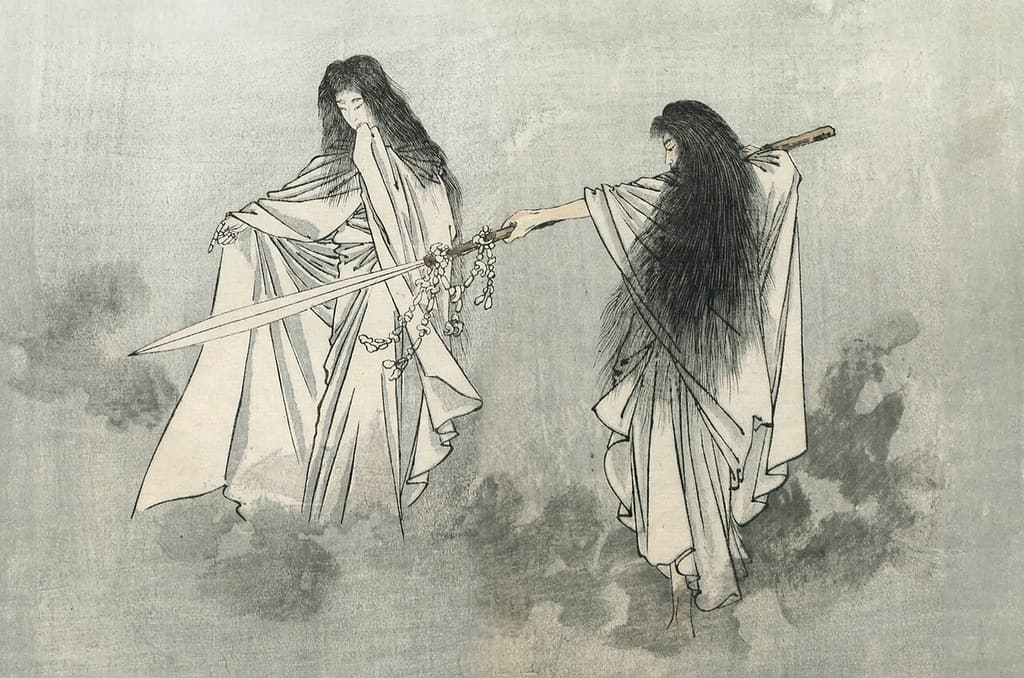
- Creation — a formless drift, the first generations of kami, then Izanagi and Izanami stirring the sea with a jewelled spear and creating the islands of Japan from the brine that drips off it. Japan is made first and specifically.
- Death enters — Izanami dies giving birth to fire, Izanagi follows her to the land of Yomi and breaks the prohibition on looking at her, and the two part as enemies at the boundary rock. Purification after that journey produces the three most important kami.
- The sibling conflict — the sun, the moon and the storm divide the world, and the storm god's outrages drive the sun goddess into a cave, taking the light with her. The other kami retrieve her with a party, a mirror and laughter loud enough to make her curious.
- The transfer of the land — negotiation and force by which the heavenly kami take control of the earthly realm from the kami of Izumo, who receive a great shrine in compensation. This is myth doing constitutional work between two real centres of power.
- The Izumo tales — a separate strand in which the storm god, exiled to earth, kills an eight-headed serpent to rescue a girl and finds a sword in its tail, and in which the hare of Inaba and the ordeals of Ōkuninushi are told. These stories belong to a rival regional centre and sit awkwardly inside the imperial frame.
- The descent — the sun goddess's grandson comes down to earth bearing mirror, sword and jewel, and his descendants become the emperors. The three objects remain the imperial regalia.
The shrine, and the two religions that share it
Shinto was not a named religion until it needed distinguishing from Buddhism, which arrived from Korea in the sixth century CE. What followed was not conflict but a thousand years of fusion: kami were interpreted as local manifestations of buddhas and bodhisattvas, temples and shrines shared sites and staff, and most Japanese people practised both without any sense of choosing. The forcible separation of the two in 1868, and the state-managed Shinto that followed until 1945, is a modern political event that has coloured how the ancient material is presented ever since — including in a great many English-language books.
What happens at a shrine is small-scale and physical: passing the torii gate, rinsing hands and mouth, an offering, two bows, two claps, a bow. Purification rites, seasonal festivals, prayers for a safe birth or a passed examination, and wooden plaques hung with requests. This is a religion of practice and place far more than of belief and text.
Reading the names
Japanese divine names are long, descriptive and full of honorific elements, which is why the same kami appears in different books under strikingly different forms. The sun goddess is Amaterasu in ordinary use and Amaterasu-Ōmikami in full, "great august kami who shines in heaven". The suffixes -no-mikoto and -no-kami are titles rather than parts of the name, roughly "august one" and "kami", and they attach and detach freely. Names may also be written with different characters between the two chronicles, since both were experimenting with how to write Japanese at all. This site uses the short recognisable form in the text and gives the full form and script in the panel.
The year, and where the myths surface
Most Japanese people meet this material not by reading but through the festival calendar. New Year brings the first shrine visit of the year, when tens of millions of people queue at shrines that are otherwise quiet. Setsubun in February drives out demons with thrown beans. The summer Obon festival welcomes ancestors home with lanterns and dancing and sends them off again on water — a Buddhist observance thoroughly fused with kami practice. Local shrine festivals carry the kami through the streets in a portable mikoshi, jolted deliberately, because the deity is understood to enjoy it. The chronicle myths supply the origin stories for a good many of these, and the shrines involved are frequently the ones the chronicles name.
Yōkai, yūrei and the later imagination
Alongside the chronicle material sits a vast body of later supernatural tradition, and this site keeps the two distinguished. Yōkai — the shape-shifting fox and tanuki, the water-dwelling kappa, the long-nosed tengu, the oni — are largely medieval and early modern, developed in tale collections like the Konjaku Monogatarishū, then catalogued, illustrated and effectively invented in quantity by Edo-period artists, above all Toriyama Sekien in the 1770s. Several creatures now presented as ancient folklore first appear in his printed books.
Yūrei, the vengeful dead of kabuki and of modern horror cinema, follow rules of their own: the white burial robe, the untied hair, the grievance that must be settled. When a page here calls something Edo-period, that is a real distinction, not a footnote.
Modern retellings
Japanese myth is unusual in that its most influential modern adaptations are made in Japan, by people inside the tradition. Studio Ghibli's Spirited Away uses genuine bathhouse-and-purification logic and real ideas about names and contracts. Princess Mononoke is built on kami of forest and mountain, and on the anger of a violated deity. Ōkami casts the player as the sun goddess in wolf form. Anime and games have carried names like Amaterasu, Susanoo and Izanagi worldwide attached to characters who often share nothing with the chronicles beyond the name, and pages here say which is which.
Where to start
Read the Kojiki — Gustav Heldt's translation is the readable modern one — as far as the descent of the imperial grandson; it is the whole mythological core and it is not long. Then dip into the Nihon Shoki's variant passages on the same episodes to see how much disagreement the compilers were willing to print. Then, for the later material, Lafcadio Hearn's ghost stories with the caveat that they are a nineteenth-century foreigner's retellings, or a modern annotated yōkai catalogue.
One caution about older English scholarship: books written between 1870 and 1945 frequently present the chronicles as national history and the emperor's divine descent as doctrine, because that is what the Japanese state was then teaching. Read them for their translations, not for their framing.
The Japanese family tree traces the line from the first kami through Izanagi and Izanami to Amaterasu and the imperial descent, and marks the points where the two chronicles order things differently. The figures written up so far follow.
gods
- Amaterasuthe sun, the imperial line, weaving
- Susanoostorms, the sea, exile
- Tsukuyomithe moon, night, the count of months
- Izanagicreation, purification, the making of the islands
- Izanamicreation, death, Yomi
- Inaririce, fertility, commerce
- Hachimanwar, archery, the protection of Japan
- Raijinthunder, lightning, storms
- Fujinwind, typhoons
- Ebisufishing, commerce, luck
- Daikokutenwealth, the kitchen, harvest
- Benzaitenmusic, eloquence, water
- Ame-no-Uzumedance, mirth, the arts of performance
- Ninigithe descent from heaven, rice cultivation, imperial descent
- Konohanasakuya-himecherry blossom, Mount Fuji, volcanoes
- Okuninushination-building, medicine, marriage
- Sarutahikocrossroads, guidance, the earthly welcome
creatures
- Yamata-no-Orochifloods, annual sacrifice, the sword in the tail
- kitsuneshapeshifting, illusion, Inari's messengers
- tengumountains, martial skill, pride
- kapparivers, drowning, the water-filled skull dish
- onipunishment, disease, the northeast gate
- yuki-onnasnow, freezing death, the broken promise
- tanukishapeshifting, mischief, luck in trade
- nueill omen, imperial sickness, the night cry
- jorogumospiders, seduction, waterfalls