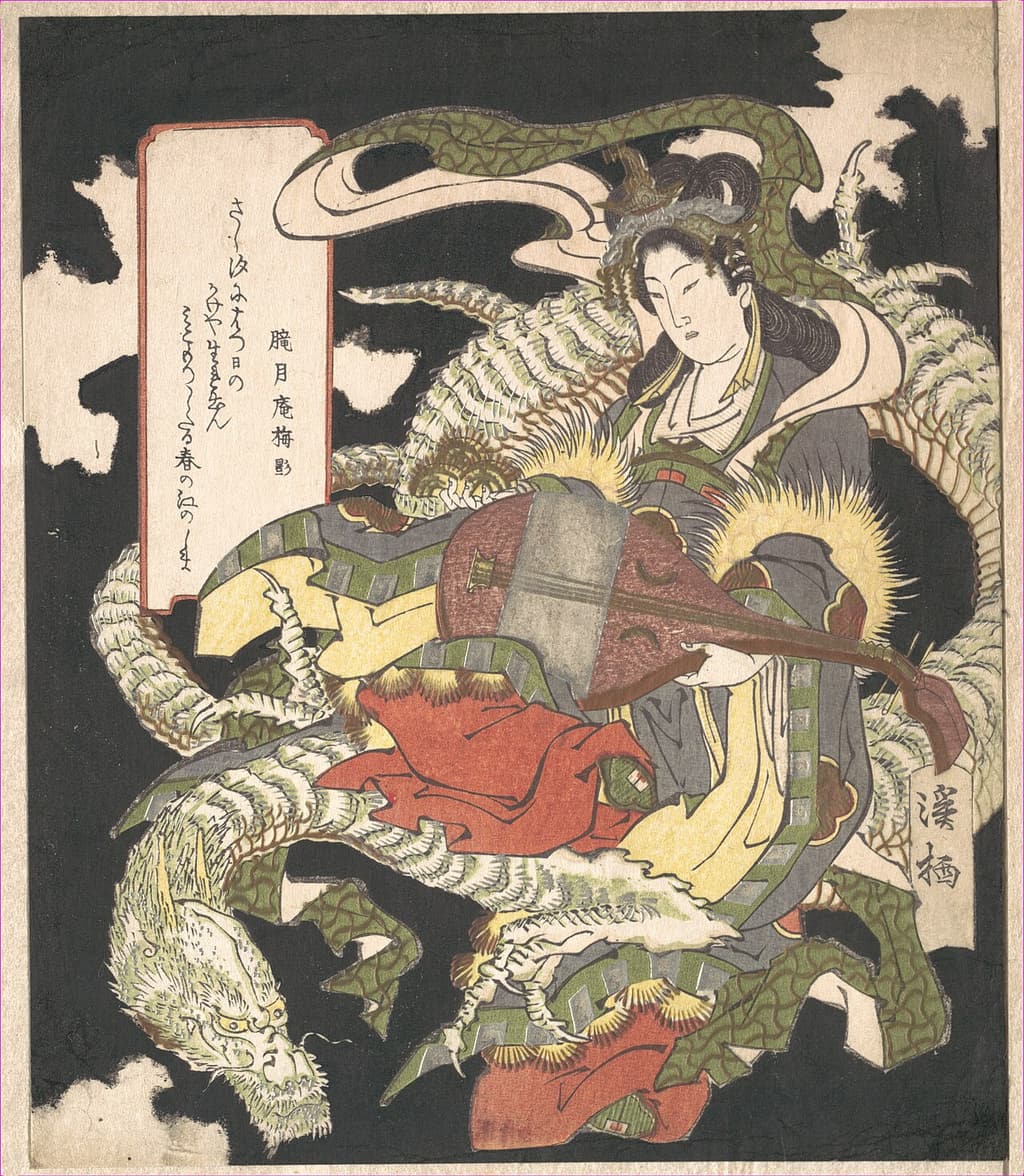
Find a small shrine on an island in a lake, or on a spit of sand reachable at low tide, or on a rock in a temple pond crossed by a red-railed bridge, and it will very often be hers. Benzaiten's shrines are on water with a consistency no other Japanese deity's are, and the reason is that she began, eight thousand kilometres away, as a river.
Sarasvatī, and the sutra that carried her
Sarasvatī is a Vedic river goddess who becomes, in classical Hinduism, the deity of speech, learning and music and the consort of Brahmā. Her route to Japan is documentary and datable: she appears in the Suvarṇaprabhāsa Sūtra, the Golden Light Sutra, which was translated into Chinese and reached Japan by the eighth century, where it was chanted for the protection of the state. In that text she promises eloquence and memory to those who preach the sutra, and she is given a hymn and a bathing rite.
Her Japanese name renders that promise. Written one way, Benzaiten means the deva of speech and talent; written another, which became the commoner spelling in the medieval period, it means the deva of speech and wealth — a single character swapped, and a goddess of eloquence acquires a portfolio in money. That respelling is the hinge of her Japanese career.
The biwa, and the arms she keeps losing
The Golden Light Sutra's Benzaiten has eight arms and carries weapons — bow, arrow, sword, axe, noose, wheel — and this martial form is preserved in some temples, notably in the eight-armed image tradition associated with Enoshima. But the form nearly everyone knows has two arms and a biwa, the pear-shaped Japanese lute, held across the body and played.
That substitution matched her to the instrument of Japanese professional musicianship. The biwa hōshi, blind itinerant lute-priests who recited the Heike Monogatari, were her people, and guilds of blind musicians held her as patron. She is still the deity that music students petition, and shrine plaques at her sites are covered in requests about auditions, examinations and stage nerves.
Three islands, five dragons, one snake
Her three most famous sites are all islands: Enoshima off the Shōnan coast near Kamakura, Chikubushima in Lake Biwa, and Itsukushima, the Miyajima of the great torii standing in the sea. Together they are conventionally called the three great Benzaiten of Japan, though other sites make the same claim.
The Enoshima origin legend, recorded in the eleventh-century Enoshima Engi, has a five-headed dragon terrorising the coast and devouring children until the island rises from the sea with the goddess on it; she refuses him, he repents, and she relents. Whether the outcome is marriage or submission varies with the telling. The dragon becomes a hill on the mainland at Koshigoe, which is pointed out today.
Her animal is the white snake, and this is where the syncretism gets dense. In the medieval period she was fused with Ugajin, an obscure and probably local deity depicted as a coiled white snake with the head of an old man, producing Uga-Benzaiten: the goddess crowned with a torii, and above the torii a small white serpent with a human face. It is one of the strangest images in Japanese religious art and it is on altars all over the country. Live white snakes kept at some of her shrines are treated as her manifestation, and shed snakeskin carried in a wallet is a standard money charm.
Money washed in a cave
At Zeniarai Benten in Kamakura, reached through a tunnel cut into a hillside, worshippers put coins and banknotes into a bamboo basket and rinse them in the spring inside the cave. The money is meant to be spent, not hoarded — the rinsing is understood to multiply what returns.
The shrine's founding story is dated to 1185 and attributed to a dream of Minamoto no Yoritomo, and it is the clearest illustration of what happened to Sarasvatī in Japan. The water is still central, exactly as it was for a Vedic river goddess. What is being done with it has changed completely.
At Itsukushima the water association took a different form again: the goddess enshrined there in the native register is Ichikishima-hime, one of the three Munakata sea goddesses produced in the exchange between Amaterasu and Susanoo, and Benzaiten was identified with her — partly because the names sound alike. A Buddhist deva and a chronicle kami merged over a pun and a shared address, and the 1868 separation forced Itsukushima to declare for the kami.
The only woman on the treasure ship
She is the sole female member of the Seven Lucky Gods, riding the treasure boat alongside Ebisu and Daikokuten, and in the New Year prints she is usually the one holding the lute while the others hold produce. Her inclusion is why a goddess of eloquence ended up on shop calendars.
Her modern presence is thick in games and anime — Onmyōji, Nioh, Noragami, gacha rosters generally — usually as an elegant lute-carrying figure with water and snake motifs, which is unusually faithful by the standards of pop-culture borrowing from Japanese religion. Enoshima itself is a heavily filmed location and appears constantly in anime set on the Shōnan coast, where the shrine tends to be background rather than subject.
Why do couples avoid visiting Enoshima together?
A widespread superstition holds that Benzaiten is jealous and will separate a couple who visit one of her island shrines as a pair. It is repeated at Enoshima, Chikubushima and Itsukushima alike, and it is not doctrine — priests dismiss it, and the shrines sell couple's charms. Its origin is probably the dragon legend, in which the goddess's own relationship with a suitor is unresolved and possibly coerced, combined with the ordinary folk logic that a beautiful unmarried goddess resents other people's happiness. It survives because it is a good story to tell someone on a bridge, and because Japanese superstition is generally comfortable holding a belief and not acting on it at the same time.
Is Benzaiten a kami or a Buddha?
Neither, strictly, and the answer matters for reading her shrines. She is a deva — a class of Indian divine being absorbed into Buddhism as a protector rather than an enlightened figure, which puts her below buddhas and bodhisattvas in the hierarchy and outside the Kojiki's roster of kami entirely. In medieval Japan that distinction was porous: she was enshrined at shrines, given kami identifications, and treated as a local deity, which is exactly what the fusion of the two religions permitted. When the government forced institutions to declare themselves in 1868, her sites split, and some of her images were destroyed or moved. Where you find her today — inside a temple hall, or behind a torii — is a record of which way that particular site jumped, and the tradition overview explains the separation that put her there.