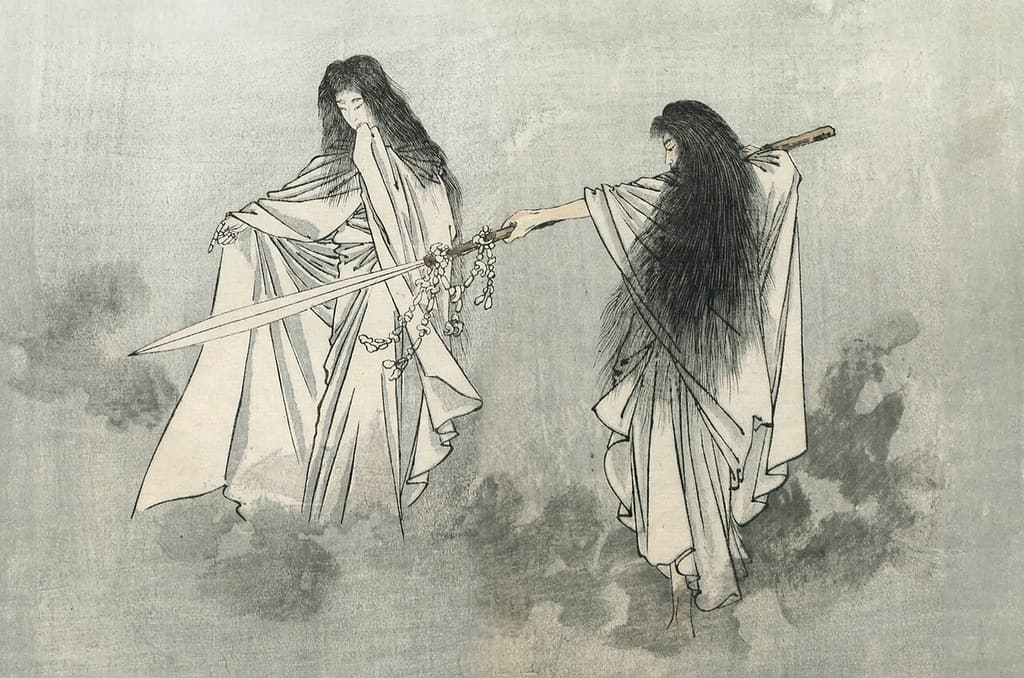
She is the only figure in Japanese myth who is both a creator of the world and its permanent adversary, and the transition between those two roles takes about four paragraphs. Before the fire she is a co-maker of islands and the mother of hundreds of kami. After it she is titled Yomotsu-Ōkami, the great deity of the land of the dead, and every human death is attributed to a promise she made in anger.
What she actually made
The catalogue is worth taking seriously, because English retellings tend to compress it into "they created Japan" and move on. Working with Izanagi, she bears the islands in a fixed sequence — Awaji first, then the double-named Iyo-no-futana with its four faces, then the islands of the inland sea and Kyushu with its four faces and Honshu last — and after the land she bears the furniture of the world: the kami of the house and the wind and the sea and the river mouths, of trees and of mountains, of moors and of mist between the valleys.
She is also the mother of the two agricultural kami named again and again in later shrine practice, and of the deity of the boundary between inside and outside. The Kojiki runs thirty-five kami in this stretch and expects you to read the list.
Death by childbirth, and the deities of a dying body
Her last child is fire, and bearing it burns her. What happens next is the strangest thing in the sequence: dying, she does not stop producing. Kami emerge from her vomit — a pair associated with metal and smelting. Kami emerge from her excrement — associated with clay. Kami emerge from her urine — associated with water and with the young growth of grain. A furnace, a mould, an irrigation channel and a harvest are being derived from a body in extremis, and the text presents it without comment.
Then she dies, and the sources tell you where she was buried: on Mount Hiba, on the border between the lands of Izumo and Hōki. That is a real place with real claimants today. The Nihon Shoki offers a rival grave at Arima in Kumano, where Hana-no-Iwaya — a cliff face, not a building — is treated as her tomb and decorated twice a year with an enormous rope hauled from the clifftop by hand. It is one of the oldest recorded sites of continuous worship in Japan, and it has no hall, because the rock is the shrine.
The rule she enforces
When her husband comes to fetch her, her first response is not refusal. She tells him he should have come sooner, because she has already eaten the food of that place — yomotsu-hegui, the hearth of Yomi — and is therefore of it. Then she says she will negotiate with the deities of Yomi, and asks him not to look at her while she does.
The condition matters more than the horror that follows. What binds her is not a sentence passed by a judge; there is no judge in Yomi and no reckoning of conduct. It is a rule of commensality: you belong to the household whose cooking fire you have shared. That is the same logic that operates in the Greek underworld with the pomegranate, and it is one of the few points where the two systems agree closely enough to be worth comparing (see underworlds compared).
Her fury when he lights his comb and looks is directed at the shaming — the Kojiki has her say he has put her to disgrace — and the pursuit she launches is a matter of honour, not appetite. She sends the hags, then the thunders on her body with an army, and at the end she comes herself, and finds a boulder in the way.
The bargain at the boundary
Across that rock they dissolve the marriage, and she makes the threat the tradition never forgets: she will strangle a thousand of the people of his country every day. His reply sets fifteen hundred births against it. The Kojiki then gives her a second name, Chishiki-no-Ōkami, "the great deity who pursues", alongside the title of the deity of Yomi.
Two things follow from this that are easy to miss. First, mortality here is a rate, not an event — the arrangement guarantees net population growth, which is a startlingly practical way to end a myth about grief. Second, she does not become evil. She becomes the deity in charge of an unpleasant department, which in a system with no devil is a different thing entirely.
The chronicle that would rather not discuss it
The Nihon Shoki's main narrative simply omits the journey to Yomi. In its principal account the couple deliberately produce the sun, the moon and the storm as parents, and the underworld sequence appears only among the alternative versions the compilers collected, marked as something one book says. Given that the Nihon Shoki was the formal chronicle, written in literary Chinese for a readership that included the continental courts, the demotion looks editorial: a foundational imperial ancestress with a rotting corpse and a homicidal grudge was not the version to lead with.
That leaves the Kojiki, in awkward hybrid script and aimed inward, carrying the story everyone now tells. Where a Japanese myth feels raw, it is usually because the Kojiki is the only one that kept it.
Kumano, and a goddess absorbed by a Buddha
In the medieval fusion of kami and buddhas, Izanami was identified with the deity of Kumano Nachi, one of the three great Kumano shrines in the mountains of the Kii peninsula, and through that identification with a bodhisattva — which put a goddess of decay at the head of one of the most heavily walked pilgrimage networks in the country. The Kumano Kodō routes, now a World Heritage listing, were trodden by retired emperors dozens of times each. The mountain landscape of Kumano was understood as a Pure Land you could reach on foot, and it is the same peninsula whose cliff the Nihon Shoki calls her grave.
The 1868 separation of the two religions unpicked the Buddhist layer from the shrines. The walking routes and the rock survived it.
The final boss problem
Persona 4 puts her at the end of the game as the entity behind the fog, which has made "Izanami" mean villain to a very large number of players; Persona 3's and 5's casts extend the pattern. Anime and manga tend to use the pair as doomed romance and stop at the moment of the forbidden look. Horror cinema and games raid the Yomi sequence for the hags and the maggots.
None of that is unreasonable, but it consistently drops the second half of the bargain. A tradition that explains death by having the goddess of death promise a thousand a day, and the god of life answer with fifteen hundred births, is not writing a villain. It is writing an equilibrium.
Why is a creator goddess also the deity of pollution?
Because in this system pollution is not moral failure — it is contact with the wrong side of a boundary, above all with death and decay. Izanami crosses that boundary while remaining a great kami, and the tradition's response is not to demonise her but to build elaborate machinery for handling the residue: rinsing, salt, the exclusion of mourners from shrine grounds, the wands of folded paper. Ise's priests have historically kept a strict distance from funerals for the same reason. The tradition overview explains why purity, rather than sin, is the axis the whole practice turns on.
Does anyone actually worship her today?
Yes, and more widely than the story would suggest. She is enshrined at Hana-no-Iwaya, at Kumano Nachi Taisha, at Iya Shrine in Shimane which claims proximity to the pass, at Taga Taisha alongside her husband, and in a great many local Izanagi-Izanami pairs where the couple are petitioned for marriage and safe childbirth. A goddess who died bearing a child is asked to protect women bearing children, which is grimly logical and entirely characteristic of how kami are approached.
What is the Even Pass of Yomi, and can you visit it?
Yomotsu-Hirasaka is described in the Kojiki as a slope, and the text then does something no Greek or Egyptian source does: it names its location on the map, calling it the Ifuya pass in the land of Izumo. Modern Higashi-Izumo in Shimane identifies a spot near Iya Shrine as the place, with a boulder standing in for the one that seals the road. Whether the Kojiki's compilers meant a real hillside or were anchoring a story to a familiar name is unanswerable, but the willingness to give the entrance to the underworld a province and a district is itself informative — this is a mythology whose geography is deliberately local. Yomi itself covers what the land beyond it is like, and the Japanese family tree shows which of her children the two chronicles credit to the marriage and which to the aftermath.