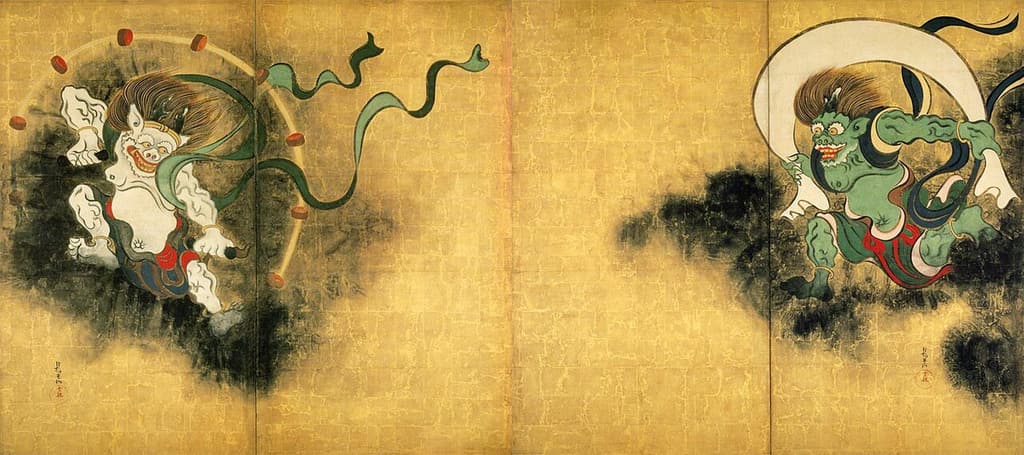
Japanese children are still told to cover their navels when thunder rolls, because the thunder god takes them. It is a joke that parents make in the same breath as closing the window, and it is also the most widely known thing about Raijin — a deity whose textual pedigree is thinner than his fame suggests.
Eight thunders on a corpse
The oldest thunder material in the chronicles is not a personality. When Izanagi lights his comb in the land of the dead, what he sees seated on the decaying body of Izanami are eight thunder deities, each named for the part it occupies: the great thunder on the head, the fire thunder on the chest, the black thunder on the belly, the cleaving thunder on the genitals, the young thunder on the left hand, the earth thunder on the right, the roaring thunder on the left foot, the coiled thunder on the right. They pursue him with an army when he runs.
That is thunder as an emanation of putrefaction — the noise of a body coming apart, distributed across it like a diagram. It has almost nothing in common with the drum-ringed demon of later art, and the Nihon Shoki adds a separate strand in which a strong man of the Kamo region is sent to seize the thunder on Mount Mimuro and brings it back writhing, which reads as a local legend rather than a national theology.
The figure now called Raijin, Raiden, Narukami or respectfully Kaminari-sama is a convergence of these threads with Buddhist iconography, and the join is convention rather than continuous textual descent. Anyone telling you the Edo painter's thunder god is the Kojiki's is skipping about eight centuries.
Sōtatsu's screens, and why he looks like that
The image everyone carries — a muscular, wild-haired figure with a ring of drums arched behind his shoulders, striking them with mallets, mouth open — is fixed above all by one object: Tawaraya Sōtatsu's pair of folding screens, Fūjin Raijin-zu, painted in the early seventeenth century and kept at Kennin-ji in Kyoto. It is a National Treasure and the most copied composition in Japanese art. Ogata Kōrin repainted it a century later; Sakai Hōitsu repainted Kōrin's; the sequence of homages runs into the present day on posters, T-shirts and sake labels.
Sōtatsu did not invent the figures. Thunder and wind deities flank Kannon in the twelfth-century sculptural group at Sanjūsangen-dō in Kyoto, and comparable pairs appear in earlier Buddhist hell and rain imagery. What Sōtatsu did was strip the pair out of a crowded religious context, put them on gold leaf at the outer edges of two screens with nothing between them, and let the composition carry the storm.
He is red or reddish in most renderings; Fūjin is green or blue. The drums usually number three, but painters vary it, and a good copy is often identifiable by the count.
The Thunder Gate
The most-photographed gate in Tokyo is properly called Fūraijinmon — the gate of the wind and thunder gods — at Sensō-ji in Asakusa. Almost everyone calls it Kaminarimon after the character on the enormous red lantern. The thunder god stands in the left niche as you approach, the wind god in the right, and the pairing is the same one Sōtatsu painted.
The gate that stands there now is not old. The original burned repeatedly, was lost in 1865, and was left as a gap for ninety-five years until Matsushita Kōnosuke, the founder of the electronics firm behind the Panasonic brand, funded its reconstruction in 1960 after praying at the temple over an illness. The lantern carries his company's name on the base, which most visitors never look down far enough to see.
The thunder animal, and the man who became lightning
Two associated traditions are worth separating out.
The raijū, thunder beast, is a creature said to accompany the thunder — variously a badger-like animal, a wolf, or a lump of blue-white fire — that falls with the strike and claws at trees and at people. Edo-period naturalists collected accounts of it, and one recurring detail is that it sleeps in human navels, which is where the navel warning comes from. The threat that the thunder god steals bellies is a compression of the beast's habits onto the god.
Separately, and historically far more consequential, is Sugawara no Michizane. A brilliant scholar-official exiled by court rivals, he died in Kyushu in 903; a sequence of deaths, fires and calamities followed, culminating in a lightning strike on the palace's Seiryōden hall in 930 that killed courtiers in front of the emperor. The court concluded that his angry spirit was striking them, granted him posthumous rank, and enshrined him. He is now Tenjin, the deity of scholarship, petitioned by millions of students at Kitano Tenmangū and Dazaifu Tenmangū before examinations. A wronged bureaucrat became lightning and then became the patron of homework, and no other thunder tradition on this site takes that route.
Mortal Kombat, Ghibli and the drum ring
Western audiences most often meet the name through Mortal Kombat's Raiden, a hat-wearing thunder god whose design owes more to a Chinese-influenced fighting-game aesthetic than to Kennin-ji; the Metal Gear Raiden is a further borrowing from that borrowing. In Japanese media the Sōtatsu silhouette is used directly and constantly — the demon-drummer shape is instantly readable, so it turns up as boss design, festival float, taiko troupe logo and beer branding.
Ghibli's Pom Poko and Spirited Away both use the visual grammar the screens established, and any anime storm sequence with a ring of drums behind a figure is quoting the same painting. When you recognise it, you are recognising a seventeenth-century artwork, not an ancient god.
Is Raijin an oni?
He is drawn as one, and that is a genuine iconographic statement rather than sloppiness. Horns, fangs, a loincloth and a muscular red body are the standard vocabulary for oni, and Buddhist art assigned that body to figures who inflict force under divine authority — hell wardens, guardian kings, weather deities. Being drawn as a demon does not make him malevolent; it marks him as a power you do not negotiate with. Shinto shrines that enshrine thunder kami, notably the Kamo shrines in Kyoto, depict nothing of the kind, because a kami in shrine practice generally has no image at all.
Do people pray to the thunder god for rain?
Historically, yes, and it is the practical core of the cult. Thunder in an agricultural society arriving in the rainy season is the sound of a rice crop being made, and the word kaminari is usually derived from kami no ari or a related phrase connecting the noise directly to divine presence. There is also a well-attested folk observation, long predating its explanation, that lightning makes rice grow — which is why one word for a lightning flash, inazuma, is literally "rice's wife". Atmospheric nitrogen fixed by a discharge does in fact fertilise a paddy. The farmers were right about the effect and wrong about the mechanism, which is a fair summary of a great deal of weather religion.