Why does a Japanese demon have horns and wear a tiger skin? Not for the reason most people assume. It is a compass reading.
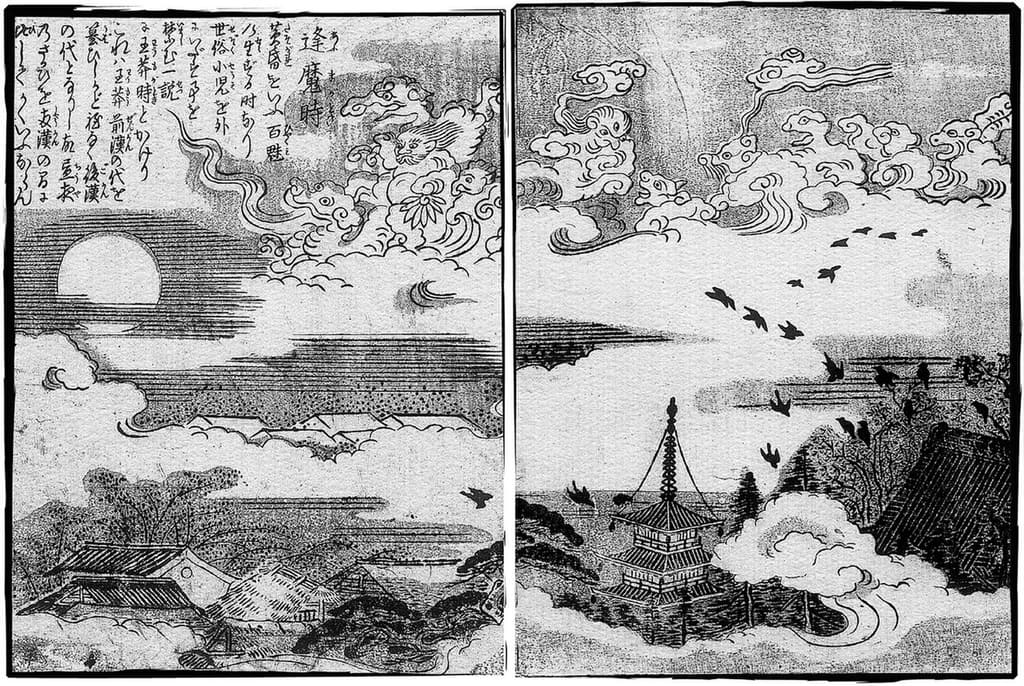
The old Japanese system borrowed the Chinese duodecimal cycle to name directions as well as hours, and the north-east — the unlucky quarter, the kimon or demon gate through which malign influence enters — falls at the boundary between the sign of the ox and the sign of the tiger. A being that comes from that direction is therefore drawn with the ox's horns and the tiger's hide, and it wears its loincloth in stripes. The iconography is a diagram of a bearing.
The consequences were architectural. Kyoto was laid out with Enryaku-ji on Mount Hiei guarding its north-eastern approach; Edo had Kan'ei-ji at Ueno doing the same job for the shogun's castle. Traditional houses avoid placing a door, a well or a hearth on the north-east corner, and builders still take the rule seriously enough for it to affect Japanese floor plans today.
A word that meant "hidden"
Before it meant an ogre, oni appears to have meant something closer to a concealed or invisible power — the character used for it was read in ways connected to on, hiding — and in the earliest usage it covers unseen malevolent forces generally: the cause of a plague, a death in the night, a possession.
The visible demon comes later, and it comes largely from Buddhism. Hell paintings imported from China and elaborated in Japan gave enormous currency to horned, muscular, club-wielding wardens who boil and dismember the damned, and the ox-headed and horse-headed guardians of the Buddhist hells supplied ready-made bodies. Once the hells were being painted for lay audiences, everyone knew what an oni looked like.
Colour became conventional: red and blue are the standard pair, with green, black and yellow appearing in sets that some traditions map onto the defilements of Buddhist psychology — anger, greed and the rest. The iron studded club, kanabō, is fixed early, and the idiom oni ni kanabō, "an oni with an iron club", still means an already-strong thing made stronger.
The gate of Rashōmon, and the ogre of Ōe
Medieval literature gives them two famous outings, both involving the warrior Watanabe no Tsuna.
At the ruined Rashōmon gate at the southern end of Kyoto, Tsuna is attacked by an oni; he severs its arm and takes it home, where it is kept in a sealed box. Some nights later his aged aunt visits, asks to see the famous arm, seizes it and reverts to the demon before flying off. The Noh play Rashōmon and the play Ibaraki stage it, and it is one of the tightest horror plots in the repertoire.
Shuten-dōji, the drunkard boy, is the greatest of all oni: leader of a band on Mount Ōe outside Kyoto, abductor of noblewomen from the capital, defeated when Minamoto no Raikō and his retainers arrive disguised as mountain ascetics, present him with poisoned sake, and take his head — which, severed, flies up and bites at Raikō's helmet. The story runs through picture-scrolls, Noh, kabuki and an enormous amount of modern manga.
Beans, every February
The one thing every Japanese person does with an oni happens at Setsubun, the day before the start of spring in the old calendar, in early February. Roasted soybeans are thrown out of the door and around the house with the shout oni wa soto, fuku wa uchi — demons out, fortune in. A family member, or at a temple a celebrity or a sumo wrestler, wears an oni mask and is pelted.
Two details keep it from being merely quaint. Eating one bean for each year of your age is part of the observance. And a handful of places invert the shout — Kinpusen-ji in Yoshino, a Shugendō centre, calls the demons in, on the grounds that even oni should have somewhere to go; some households named Oni or Watanabe skip the ritual, the latter because a Watanabe already defeated one and the family need not bother. A ritual with attested regional dissent is a living one.
Ancestors, victims, and the woman who becomes one
Not every oni is born a monster. A recurring and much darker strand has human beings turn into them through the intensity of their own emotions — above all jealousy and grief.
The Noh play Kanawa and the legend of Hashihime, the bridge maiden of Uji, has a betrayed woman perform a rite at Kifune Shrine, wade into the river, wear an iron trivet on her head with candles burning on its legs, and become a demon. The Noh mask hannya, with its horns, gold eyes and grief-shaped mouth, is designed to be read as a woman in the act of that transformation rather than as a monster: at certain angles it looks enraged, at others it looks like weeping. It is one of the great achievements of Japanese theatrical design and it is now stamped on hoodies worldwide.
That strand also produces yamauba-type figures and connects the oni to the vengeful ghost tradition, which follows different rules again.
Demon Slayer, Ogre Battle and the mask on the wall
Demon Slayer — Kimetsu no Yaiba — has done more to globalise the word than anything before it, and it is worth being clear that its demons are a modern invention keeping only the name and a general appetite: they are sunlight-averse blood-drinkers with regeneration, which is a vampire specification, not an oni one. Onmyōji, Nioh, Ōkami and the Megami Tensei line all field more traditional versions. Dragon Ball's afterlife bureaucrats in horns and Hawaiian shirts are a joke about hell wardens that has outlived most of its audience's knowledge of the reference.
The hannya mask has escaped Japanese culture entirely and now circulates as a tattoo and streetwear motif on its own, generally without the play attached.
Are oni evil, or just dangerous?
They are the closest thing this tradition has to genuinely malevolent beings, which is worth stating plainly because so much of Japanese religion resists the category. A kami can blight or bless depending on treatment; a fox can marry into a family; a kappa can be bargained with. An oni, in most of its appearances, is simply an enemy — it eats people, it abducts, it torments, and the correct response is force. But even here the boundaries leak: oni serve as gate guardians and protective figures on roof tiles, appear as the enforcement arm of a just hell rather than as rebels against it, and in a handful of local traditions are the beneficent founding spirits of a village. The Japanese word does more work than the English "demon", and it does not carry the same theology behind it.
Do oni have anything to do with the thunder god's appearance?
They share a body, and the sharing is deliberate. Buddhist art assigned the horned, fanged, loincloth-wearing physique to any figure whose function was overwhelming force applied under authority, which is why Raijin is painted as one, why the guardian kings at temple gates are built along similar lines, and why hell wardens and weather deities look like cousins. The body signals a mode of action rather than a moral status. Reading every horned figure in Japanese art as a demon is the mistake this convention invites, and it is worth resisting: the muscular red thing on the gate may be keeping you out or keeping something else out, and the picture alone will not tell you which.