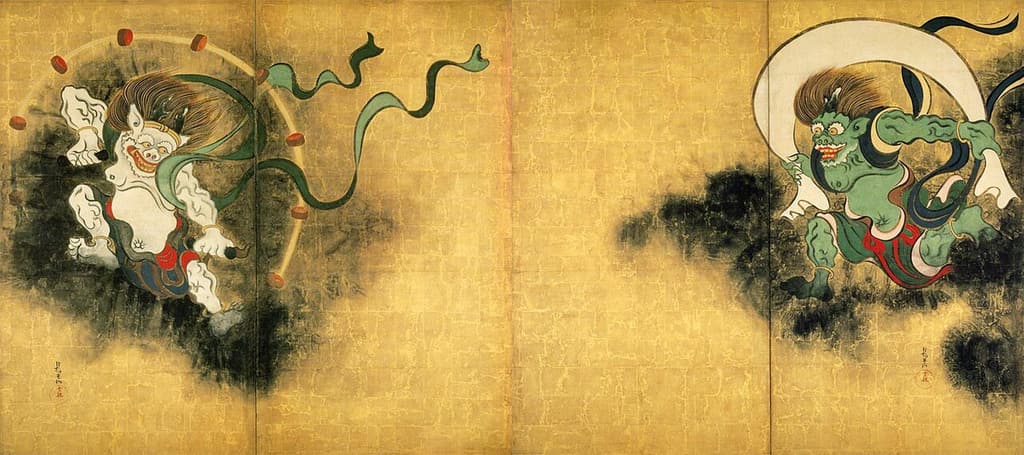
The bag slung across the wind god's shoulders may be the longest-travelled object in religious art. The argument, made most influentially by art historians tracing Buddhist iconography backwards along the Silk Road, is that it descends from the billowing cloak held over the head of Greek wind personifications, carried east through the Hellenistic sculpture of Gandhara in what is now Pakistan and Afghanistan, absorbed into Buddhist imagery as an attribute of the Indian wind deity Vāyu, and arriving in Japan as a closed sack of air. If that chain holds, the wind is being depicted in Kyoto with a device invented on the Aegean.
It is a strong case built on a real sequence of surviving images, and it is not universally accepted. The intermediate stages are patchy, and a cloak becoming a bag is a large change to attribute to transmission rather than to independent invention. Treat it as the best available account rather than a settled fact.
Futen, and the Buddhist import
His formal Buddhist name in Japan is Fūten, the deva of wind, one of the directional guardians of the ten class absorbed from Indian cosmology through Chinese Buddhist translation. That is his documented route into the country: he arrives as scripture and sculpture, not as a kami of the chronicles. Calling him a Shinto god without qualification collapses a real distinction, and the Nihon Shoki's own wind material belongs to different deities entirely.
His standard depiction gives him green or blue-green skin, wild streaming hair, a small number of clawed toes and fingers — often four, against the thunder god's three, a convention painters use to distinguish them at a glance — and the bag held open at both ends above his shoulders.
The kami who actually get prayed to for wind
The native wind deities are Shinatsuhiko and Shinatobe, born in the chronicles when Izanami breathes away the morning mist, and they are enshrined at Ise in two subsidiary shrines known as the wind palaces. Until the late thirteenth century these were minor establishments concerned with agricultural weather.
Then, in 1274 and again in 1281, Mongol invasion fleets were broken up by storms off Kyushu. The court had ordered nationwide prayers, and the Ise wind shrines claimed the result. Both were promoted to higher rank, and the storms acquired the name kamikaze, divine wind — a phrase that then sat quietly in the historical record for six and a half centuries before being applied, in 1944, to pilots flown into ships. That later use is what most non-Japanese readers now hear in the word, and it has largely obscured the thirteenth-century typhoons that named it.
There are also kaze-no-kami rites across rural Japan aimed specifically at keeping typhoons off the rice at harvest, and a separate folk usage in which a wind kami is blamed for illness — the ordinary Japanese word for catching a cold, kaze o hiku, is written with the character for wind.
The pair, and why he is always on the left of the picture
He is almost never depicted alone. From the twelfth-century sculptural ensemble at Sanjūsangen-dō to Tawaraya Sōtatsu's seventeenth-century screens to the niches of the great gate at Sensō-ji in Asakusa, wind and thunder come as a set, and the composition places the wind at the viewer's right and the thunder god at the left — meaning that on a two-screen pair, the wind occupies the right-hand screen and the two figures lean inward across an empty gold centre.
The pairing is functional rather than genealogical. They are not brothers in any text; they are the two halves of a storm, given bodies so that a storm can be addressed. That is characteristic of how Buddhist protective imagery works, and it is why they have no myths together and no family tree entry — the Japanese family tree has no place for either of them, because they did not arrive through the chronicles.
Where the design ended up
The green demon with the sack has become one of Japan's most portable visual exports. He appears as a boss and a summon across Nioh, Ōkami, Onmyōji and a long tail of mobile games, usually alongside his thunder counterpart and usually as a pure elemental. Sports teams, sake brands, tattoo flash and festival floats all use the silhouette. Final Fantasy has run wind summons under related names for decades.
The reliable loss in adaptation is the bag's function. In the art it is not a weapon that shoots wind; it is a container, held open, from which wind is being let out in a controlled stream — the god is not throwing a gale so much as administering one. Games almost always redraw it as a cannon.
Was there ever a wind god in the Kojiki with a personality?
No, and the absence is informative. Shinatsuhiko and Shinatobe are named, credited with an origin in a divine breath, and given nothing to do — no dialogue, no quarrel, no offspring of consequence. Japanese myth in its chronicle form is heavily invested in genealogy and in the transfer of authority, and weather deities are poor material for either. Wind became a figure with a face only when Buddhist art brought a ready-made body for it from the continent, which is why the vivid version of this deity is an import and the indigenous version is a name on a list. The tradition overview explains why the chronicles are shaped that way.
Why do the wind god and thunder god have different numbers of fingers?
It is a workshop convention rather than a doctrine, and it is not applied consistently enough to date a painting on its own — but where it is used, the wind god carries four digits on each hand and foot and the thunder god three, and the numbers have been read as referring to the compass directions in one case and to the divisions of the sky in the other. Copyists preserved the difference partly because it makes a pair of figures with similar bodies instantly distinguishable at a distance, which matters on a folding screen designed to be seen across a room. As with much iconographic detail in Japanese Buddhist art, the practical reason and the symbolic explanation coexist without either cancelling the other.