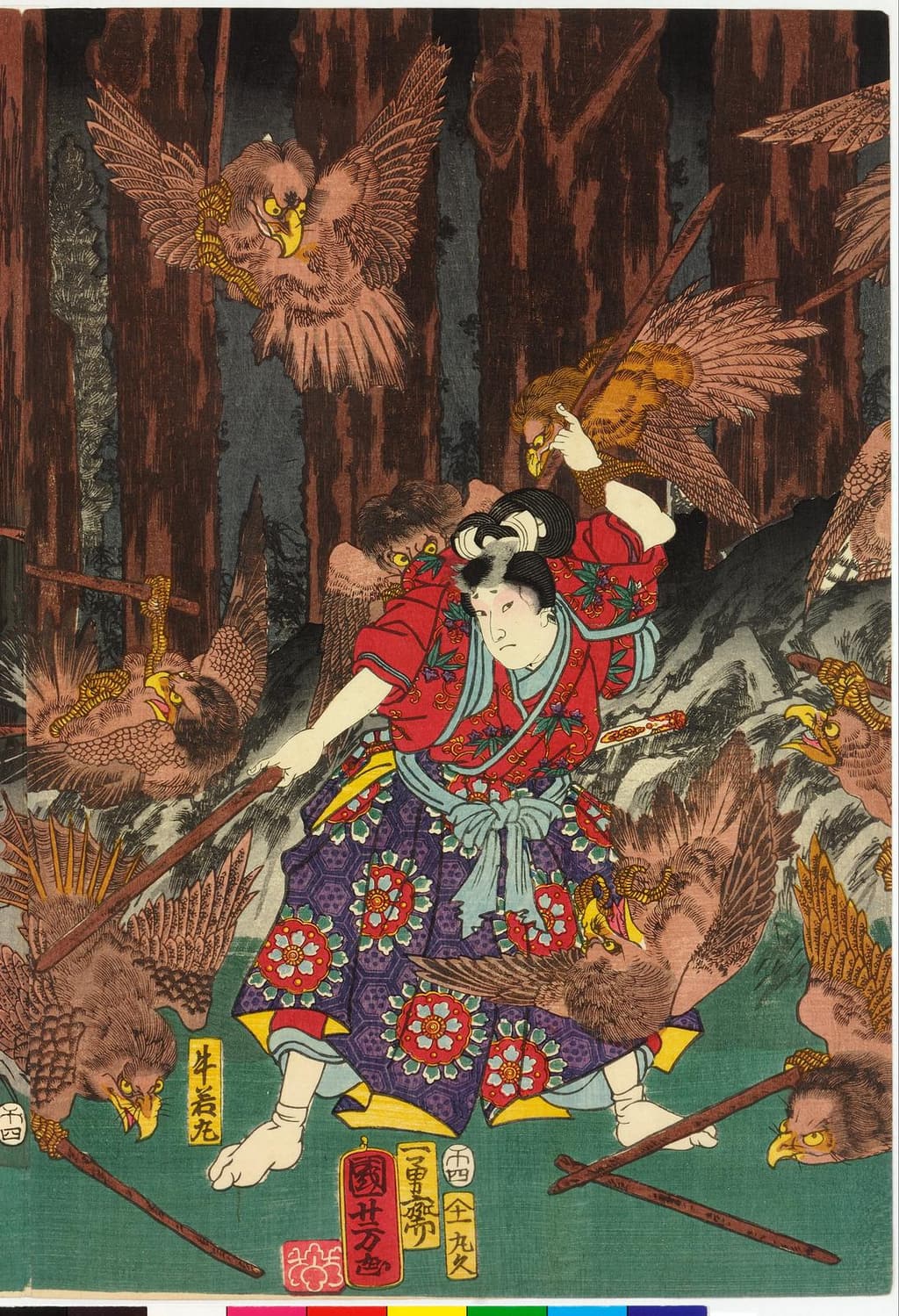
The word's first appearance in a Japanese text is not about a goblin at all. The Nihon Shoki records that in 637 a great star crossed the sky from east to west with a noise like thunder, and that a Buddhist priest returned from China said it was not a falling star but the barking of the tengu — the celestial dog, a Chinese omen creature whose name was written with the characters for heaven and dog.
Nothing that followed in Japan kept the dog. The creature that inherited the name became a bird, then a mountain ascetic, then a swordmaster, and the trajectory of those changes is the most legible case in Japanese folklore of a supernatural type being remade to fit whatever the age was anxious about.
Bird-demons who prey on arrogant monks
By the Konjaku Monogatarishū in the twelfth century, the tengu is a bird-formed being of the mountains whose speciality is corrupting Buddhist clergy. It possesses monks, tempts them into displays of miraculous power, appears as a buddha in a false vision to be worshipped by the credulous, and drags the vain into a realm of its own.
That realm is doctrinally specific. Medieval Buddhist writing developed the idea of the tengu-dō, a destination for those who practised assiduously but with pride — outside the standard six paths of rebirth, populated by monks who were spiritually powerful and morally ruined. The illustrated Tengu Zōshi scrolls of 1296 satirise the great temples of the day by drawing their eminent clergy as tengu, and the joke lands because everyone understood the accusation.
This is a monster that exists to make a point about religious institutions, and it is why tengu are so often shown in monastic robes.
Two faces
Two body-types coexist and both remain current:
- Karasu-tengu, the crow tengu: a beaked, feathered, winged figure, sometimes with human hands and clawed feet. This is the older form.
- Hanataka-tengu or daitengu, the great tengu: red-faced, human, with an enormous nose, wearing the small black cap and pom-pommed sash of a yamabushi mountain ascetic, carrying a feather fan and walking on single-toothed geta.
The long-nosed version develops later and overlaps heavily with the face of Sarutahiko, the crossroads kami, to the point that the two are visually indistinguishable in festival masks. The feather fan, hauchiwa, raises winds. The one-toothed clog is an ascetic's balance training worn as an identifier.
Kurama, and the swordsman's teacher
The turn from demon to teacher happens through one legend. Minamoto no Yoshitsune — the Genpei war's brilliant, doomed commander — was as a boy called Ushiwakamaru and was placed in the temple on Mount Kurama, north of Kyoto. The tradition is that he slipped out at night to be trained in swordsmanship by Sōjōbō, the great tengu of the mountain, which is why he could later defeat the giant monk Benkei on a bridge and fight the way he did.
The story is not in the Heike Monogatari, which is the near-contemporary account of the war. It develops in the later Gikeiki and is fixed for good by the Noh play Kurama Tengu, in which the tengu is a sympathetic and rather sad figure who takes pity on a lonely child. Kurama-dera sells tengu everything today, and the mountain's tengu is the best-known individual of the type.
Once tengu could teach, they could also protect. Mountain communities and yamabushi practitioners treated them as guardians of particular peaks — Mount Takao near Tokyo, Mount Kurama, Mount Haguro, Mount Daisen — and their supposed abductions of children, kamikakushi, became explanations for disappearances in wooded country rather than acts of pure malice.
Pride, and how you can tell
The defining tengu vice is arrogance, and Japanese preserves it as an idiom: tengu ni naru, "to become a tengu", means to get above yourself. A boastful person is said to have a long nose. This is the rare case where a folklore creature has been fully absorbed into ordinary speech as a moral term.
The associated warnings are practical. Do not cut trees on a tengu's mountain. Do not laugh loudly in the forest at night. If a stone falls beside you on a path with no one above, that is tengu-tsubute, a tengu throwing it. If you hear a tree being felled at night and find no stump in the morning, that is tengu-daoshi, the sound without the act — a real and well-attested acoustic folk belief in Japanese mountain villages.
Yamabushi, and who the tengu actually resembled
The costume is the giveaway. Tengu dress exactly like practitioners of Shugendō, the mountain ascetic tradition that mixed Buddhism, Daoist elements and kami worship, whose members walked circuits of sacred peaks, performed austerities under waterfalls, and were credited with healing and exorcism. They lived outside the great temples, answered to nobody, and were regarded by the settled clergy with a mixture of respect and suspicion.
A supernatural being that lives on a mountain, dresses as a yamabushi, has real power, is contemptuous of established monks and is dangerous to the proud is not a coincidence. Whether tengu imagery caricatured the mountain ascetics or the ascetics adopted a resonant image is argued both ways, and the two are probably not separable.
Wings, masks and boss fights
The design is a staple. Nioh, Ōkami, Sekiro-adjacent titles, Onmyōji, Yo-kai Watch, Naruto, Demon Slayer — which gives a mentor a tengu mask, a neat reference to the Kurama role — and Ghibli crowd scenes all field tengu, usually as either an aerial swordsman or a mask. Pokémon's Shiftry and a long line of long-nosed goblin designs descend from the same source.
The mask is now more common than the creature. It hangs in bars, appears on festival stalls, leads processions, and is a standard piece of Japanese visual shorthand for mischief and for the mountains — which means a great many people recognise a tengu without knowing it was ever a bird, still less a comet.
Are tengu demons or gods?
The category refuses to settle, and that refusal is the honest answer rather than an evasion. In Buddhist tale literature they are unambiguously a hazard — beings of a bad destination who obstruct enlightenment. In mountain shrine practice they are enshrined, given offerings, and asked for protection, with several shrines and temples treating a named tengu as the resident spirit of the peak. Some are given the honorific of a kami; others are exorcised. A tradition without a hard line between deity and monster can hold both positions at once, and the tengu illustrates that better than any other being in Japanese belief, more so even than the oni, whose role is at least consistently adversarial.
Which parts of the tengu are genuinely medieval and which are Edo inventions?
The bird form, the monastic satire, the tengu realm and the abduction beliefs are securely medieval and textually attested. The long-nosed red-faced figure with fan and clogs consolidates in the Edo period, when the woodblock print trade and Toriyama Sekien's illustrated catalogues fixed the appearance of the whole yōkai repertoire and, in a number of documented cases, invented creatures outright. The tengu was not invented — it has six centuries of prior record — but its look is early modern, and much of the sub-typology that circulates today, including elaborate hierarchies of named great tengu governing particular mountains, comes from Edo popular literature rather than from religion. Treating an Edo print as evidence of ancient belief is the standard trap with Japanese monsters, and the tradition overview sets out where the line falls.