The spider she is named after is real, common, and currently colonising the American south-east. Trichonephila clavata — the jorō spider — is a golden orb-weaver with yellow and blue-black banding, a body a few centimetres long and a web that can span a footpath, and it is one of the most conspicuous animals in a Japanese garden in autumn. It reached Georgia around 2014 and has been spreading north ever since, which means a growing number of people are meeting the monster's namesake without knowing there is a monster.
Two ways to write the name
The ordinary spelling of the spider's name uses characters read jorō in the sense of a courtesan, giving something like "courtesan spider" — a reference to the striking colouring rather than to anything sinister.
The monster's name is often written differently, with characters meaning roughly "entangling newlywed" or "binding bride". Which spelling came first is unsettled, and Edo writers used both, sometimes in the same volume. The double writing is a compact statement of what the creature is: a beautiful thing that ties you up.
Four hundred years, then a woman
The rule attached to her belongs to a wider class of Japanese belief in which any object or animal that survives long enough acquires a spirit and the power to change shape. For the jorōgumo the threshold is usually given as four hundred years — at which point the spider can take the form of a woman, generally young and generally accomplished.
The standard plot follows. She appears in a ruined house, or by a river, or at a waterfall. In one widely repeated version she is playing the biwa, and while her guest listens to the music she binds him in silk. In others she takes a man as husband and consumes him over time, or entertains travellers who are never seen again. Fire-breathing spider-children appear in some Edo tellings, which is a detail modern retellings drop.
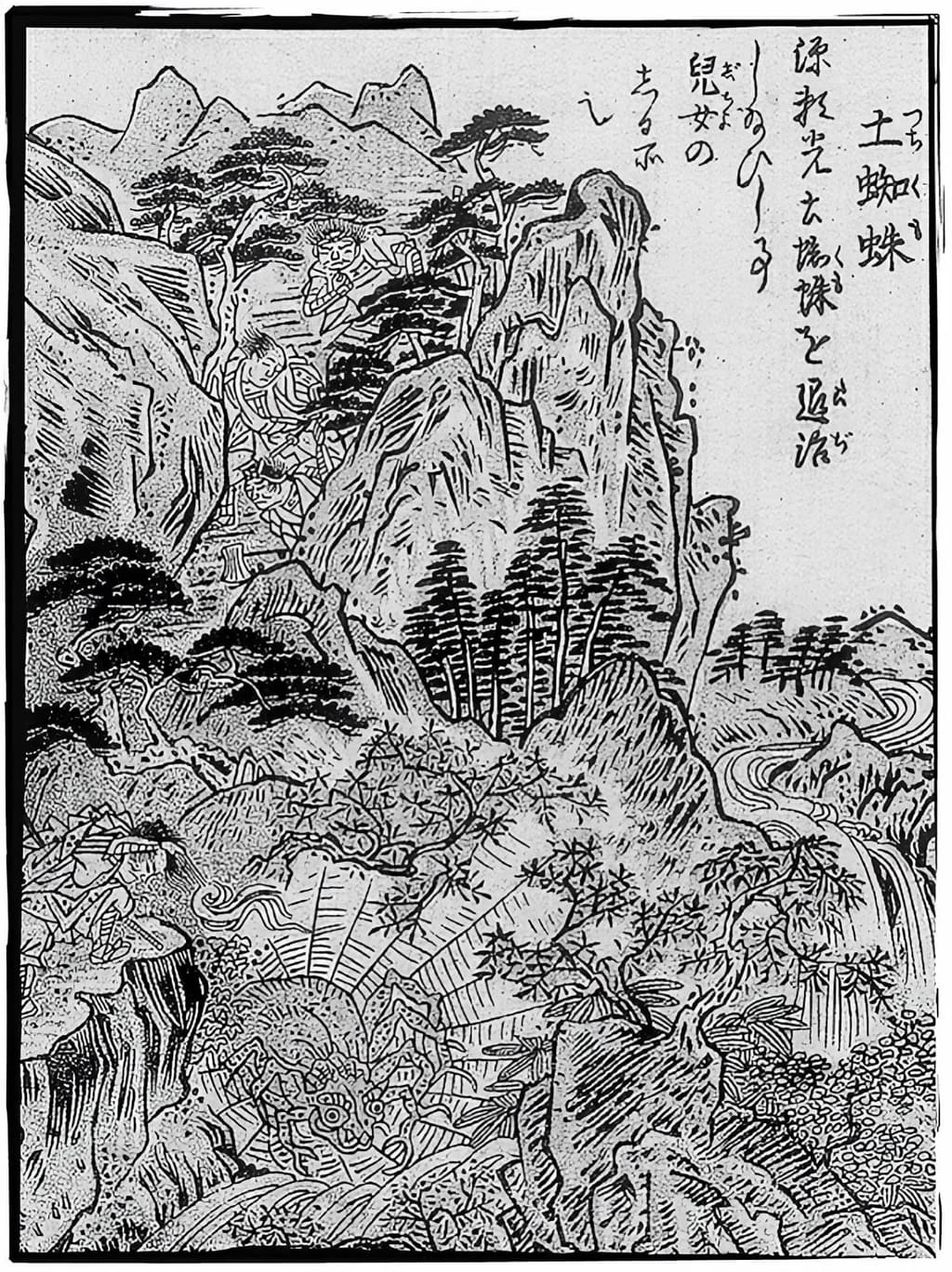
The Taihei Hyakumonogatari of 1732 and other Edo collections of the hundred-tales tradition carry her, and the Konjaku-era literature has related spider material — the twelfth-century tale of the hero Minamoto no Raikō fighting a monstrous earth spider, the tsuchigumo, is older and separate but has fed into the same imaginative pool. The tsuchigumo is worth distinguishing carefully: it originates in the chronicles as a contemptuous term for people who resisted the early Yamato state, was rendered as a monster later, and is not a seductress.
Jōren Falls
The best-known regional legend is attached to a specific waterfall in the Izu peninsula. At Jōren Falls, a woodcutter resting by the pool has his ankle wrapped in a thread; he transfers it quietly to a tree stump, which is dragged into the water and destroyed. A voice from the pool tells him to say nothing.
He keeps the secret for years, then breaks it while drunk — and, in the version most often told, walks into the falls and does not come out. A second Izu variant has a man who visits the pool obsessively, is warned off, and is finally taken.
Local versions add a name-and-word taboo: the visitor must not repeat what he has been told, or must not say her name. At Kashikobuchi in Sendai, a related pool legend produced a practice of saying kashikoi, kashikoi — "clever one, clever one" — at the water's edge to placate the spider, and a marker there still records it.
Silk, binding and the shape of the fear
It is worth being direct about what this figure is made of. A creature that is admired for its beauty, that produces a thread, that binds a man while he is enjoying himself and consumes him at leisure, in a period whose licensed pleasure quarters were a major economic institution and a major source of moral anxiety, is not an obscure symbol. The courtesan reading is built into the spelling of the name.
The silk association runs the other way as well. Sericulture was a defining Japanese industry, its labour overwhelmingly female, and thread as a female product with the power to bind is a persistent motif in Japanese story — the Kojiki's own tale of an unseen night visitor identified by a thread sewn to his robe, and the many fabric-and-recognition folktales, all live in the same territory.
Waterfalls, boss fights and Spider-Verse
She is a staple of the yōkai roster in games: Nioh, Onmyōji, Ōkami, Yo-kai Watch, Muramasa and a long list of gacha titles field her, generally as a woman above and a spider below, in a cavern or by water. Naruto and other shōnen series field spider-women who are clearly her descendants. Western media has picked her up too — she appears by name in urban-fantasy fiction and, most visibly, as a character concept in recent animated superhero work — usually with the courtesan reading intact and the waterfall dropped.
The consistent modern change is to give her a face and a motive. In the Edo sources she is a mechanism: something that lives in the pool, that reaches out, and that is defeated by not talking. The tales are about the man's discretion and its failure far more than about her.
Is she a yōkai or a ghost?
A yōkai, and specifically one of the tsukumogami-adjacent class of things that transform by outliving their natural span. That places her in a different category from the vengeful dead: she has no grievance, no unfinished business and no former human life. She was a spider, she got old, and she acquired capabilities. That is a distinctively Japanese proposition — the idea that duration alone confers spiritual power, applied to animals, to tools, to trees and to stones — and it is why so many Japanese monsters are old versions of ordinary things rather than beings from elsewhere. The tanuki and the fox belong to the same logic, with the same escalation over time.
Why do so many of her stories hinge on keeping a secret?
Because the taboo is the plot's engine, and it recurs across the Japanese supernatural far beyond spiders — the snow woman's condition, the crane wife's closed door, the fox wife's exposure, the fisherman's forbidden casket. In each the supernatural party grants something on terms, and the human party fails the terms, usually through ordinary weakness rather than malice: drink, curiosity, loneliness, the urge to tell. What distinguishes the jorōgumo variants is that the secret is not about her identity but about the encounter itself, which makes the offence a breach of confidence rather than a discovery. The reward for silence, in most versions, is simply being allowed to go on living near the water, which is a very modest bargain to fail.