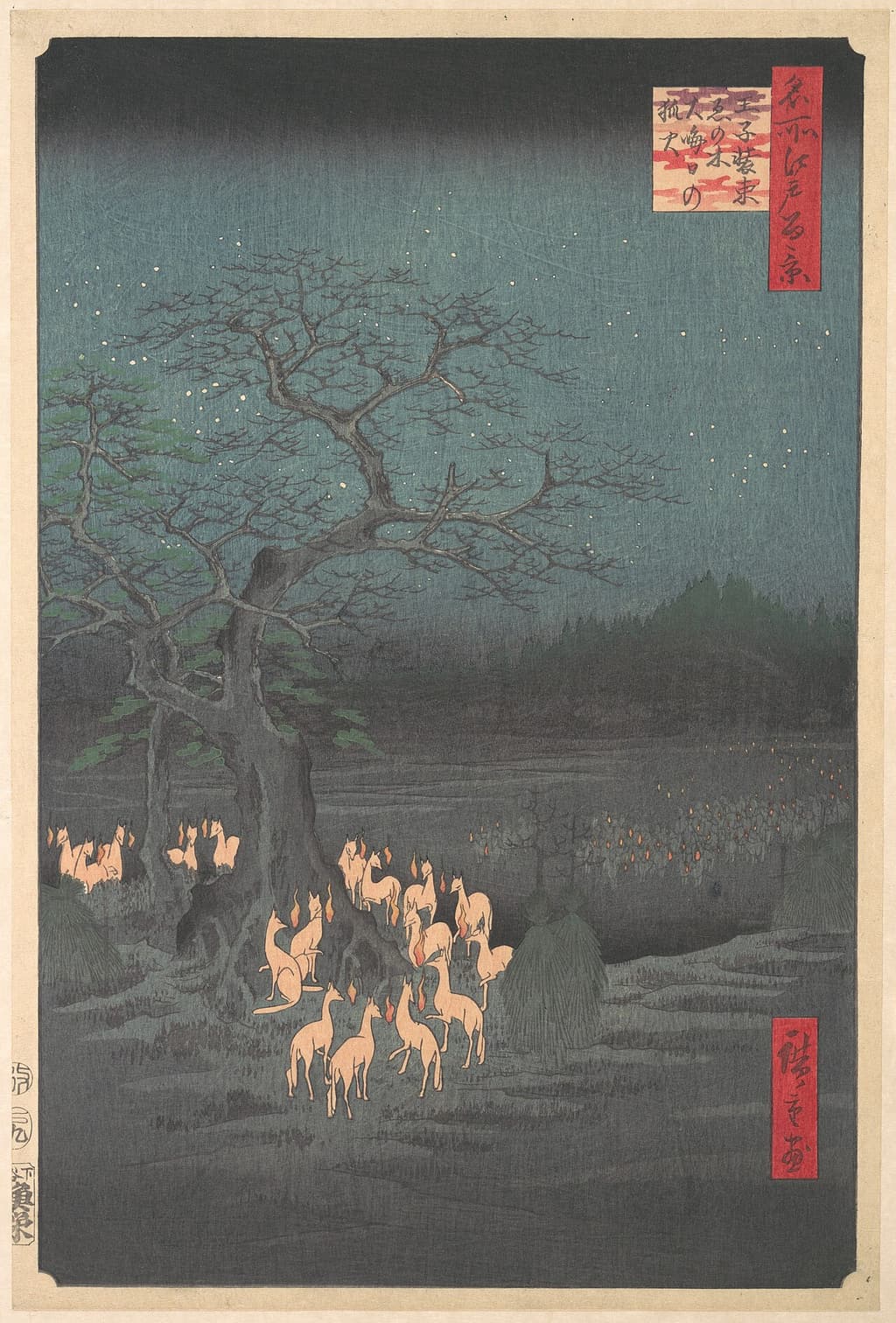
Fox possession was a live medical category in Japan into the twentieth century. Kitsunetsuki — a condition in which a fox was understood to have entered a person, typically a woman, through the fingernails or the breast, producing a changed voice, cravings for fried tofu and red beans, and speech in the fox's own person — appears in medical writing, in police records, and in the case notes of Japan's first generation of Western-trained psychiatrists, who spent a good deal of the Meiji period arguing it out of existence. Shimane and the San'in coast had a further refinement: entire households were said to keep foxes, and the accusation was serious enough to affect marriages and property well into living memory.
No other creature in Japanese folklore carries that kind of documented social weight, and it is the reason the fox is not simply a folktale animal.
The oldest fox story is a marriage
The Nihon Ryōiki, an early ninth-century Buddhist tale collection, has a man of Mino province meet a woman on a moor, marry her, and father a son. Their dog, born the same day, hates her; one day it corners her and she reverts to a fox and flees over a fence. He calls after her that since they have a child between them, she should come back and sleep with him whenever she likes — and she does, returning each night and leaving each morning.
The collection then derives her name from the invitation: ki-tsu-ne, "come and sleep". Etymologists regard this as a pun rather than a derivation, but it is the earliest attested Japanese fox story and it is already fully formed — the fox-wife, the recognition, the marriage that survives the exposure. Later versions, above all the Kuzunoha legend in which a fox-wife's departure produces the great diviner Abe no Seimei, keep the shape and add a farewell poem written on a screen.
Note what the oldest version does not contain: no tails, no malice, no possession. Those accumulate later.
Tails, and the century count
The rule that a fox grows an additional tail per century, up to nine, and turns white or gold when it reaches the ninth, is late and comes from Chinese material. The nine-tailed fox is Chinese first — the huli jing of the classics, an omen creature that becomes a seductress — and the Korean kumiho is a parallel development, not the same being. These three are relatives with real differences: the Korean version is generally more purely predatory, the Chinese version has an older and more ambiguous omen role, and the Japanese version is the only one of the three with a major institutional religious role.
Japanese tradition also distinguishes the zenko, the good fox associated with shrines, from the nogitsune or yako, the wild field fox that deceives and possesses. That division does a great deal of quiet work: it lets a shrine keep foxes as sacred without endorsing the ones that make people ill.
Not the same as Inari's foxes
The white foxes flanking the gate of an Inari shrine are messengers, not the deity, and not folklore foxes either. They are invisible attendants, and their statues carry the granary key or one of its companion emblems in the mouth. Conflating them with the shapeshifter of the tales is the single commonest error in English writing on this subject, and it happens because the animal is the same and the offerings — fried tofu above all — overlap.
The overlap is not accidental, though. Once a deity of the rice harvest had foxes as messengers, and once foxes were already the animal that lived at the edge of the paddy and was believed to shapeshift, the two bodies of belief fed each other for a thousand years. Toyokawa Inari, a Zen temple, houses the Buddhist deity Dakiniten on a white fox, which folds a third tradition in on top.
The stone that split
Tamamo-no-Mae is the great villain of the tradition: a beautiful courtier in the service of the retired emperor Toba in the twelfth century, unmasked by a diviner as a nine-tailed fox, hunted down on the moor at Nasu, and transformed at her death into the Sesshō-seki, the killing stone, which poisoned anything that approached it. Volcanic gas seeps at the site provide the mechanism.
In March 2022 the stone split in two. The break was reported worldwide, largely by people delighted by the idea that a demon had been released, and Japanese officials pointed out that cracks had been visible for years and water had frozen in them. The local response was to hold a ceremony. Very little else from Japanese folklore has travelled that far in recent years — the clearest comparison is the Amabie, the plague-warding sea spirit that went viral worldwide in 2020 and ended up on Japanese health-ministry material.
Sunshowers and the fox's wedding
Rain falling while the sun shines is called kitsune no yomeiri, the fox's wedding. In some regions the procession of lights seen at night on a hillside is given the same name, and there are rural traditions of staging a mock fox wedding as a local festival — Kudamatsu and Niigata among them.
Other fox properties worth naming: the hoshi no tama, a white ball a fox carries and which can be taken as leverage over it; the leaf placed on the head to effect a transformation; the ability to produce illusory buildings and banquets; and the persistent detail that a transformed fox is given away by its shadow, its reflection, or a dog.
Nine tails, everywhere
Naruto's Kurama is probably the single most influential fox in modern global culture, and it is a demon sealed in a person — which, whatever else it is, is a straight import of kitsunetsuki. Pokémon's Vulpix and Ninetales encode the tail-counting rule; Ōkami's Ninetails is the killing-stone fox; Onmyōji and Nioh field both fox-wives and Tamamo; Spirited Away does not use foxes but runs on the same logic of names, contracts and being seen for what you are. Teen Wolf and Western urban fantasy have imported the kitsune wholesale, usually via the nine-tailed version.
The distinctive Japanese material that tends not to survive the journey is the marriage. A fox that seduces and destroys is a stock supernatural threat anywhere; a fox that marries a farmer, raises his child, is exposed, and is asked to keep coming back is a specifically Japanese proposition, and it is the oldest thing in the file.
Did people really believe in fox possession recently enough to matter?
Yes, and the documentation is unusually good. Shimane's fox-owning households are described in detail by Lafcadio Hearn in the 1890s and were still a live social problem in the mid-twentieth century, when local authorities and newspapers addressed the discrimination directly. Japan's early psychiatric establishment, led by Kure Shūzō, treated kitsunetsuki as a diagnosis to be reclassified rather than a superstition to be laughed at, and cases appear in hospital records. Exorcisms at Inari temples were, and in a limited way still are, performed. This is not a folklore artefact; it is a belief system with a legal, medical and social footprint within four generations.
Why foxes, specifically?
Because of where the animal lived. The Japanese red fox is a real, common presence at exactly the boundary that matters in this religion — the edge of the cultivated paddy, the margin between the village and the mountain, the place where rice stores and rodents and human habitation meet. It is nocturnal, it appears and vanishes, its eyes reflect light, and it audibly screams. An animal with those habits at that boundary attracts stories in most cultures; what Japan did differently was to give it an institutional role in the country's most numerous shrine network, which locked the belief into the landscape rather than leaving it in the tales. The shapeshifter survey sets the fox beside the tanuki, which occupies the same margin with a completely different temperament.