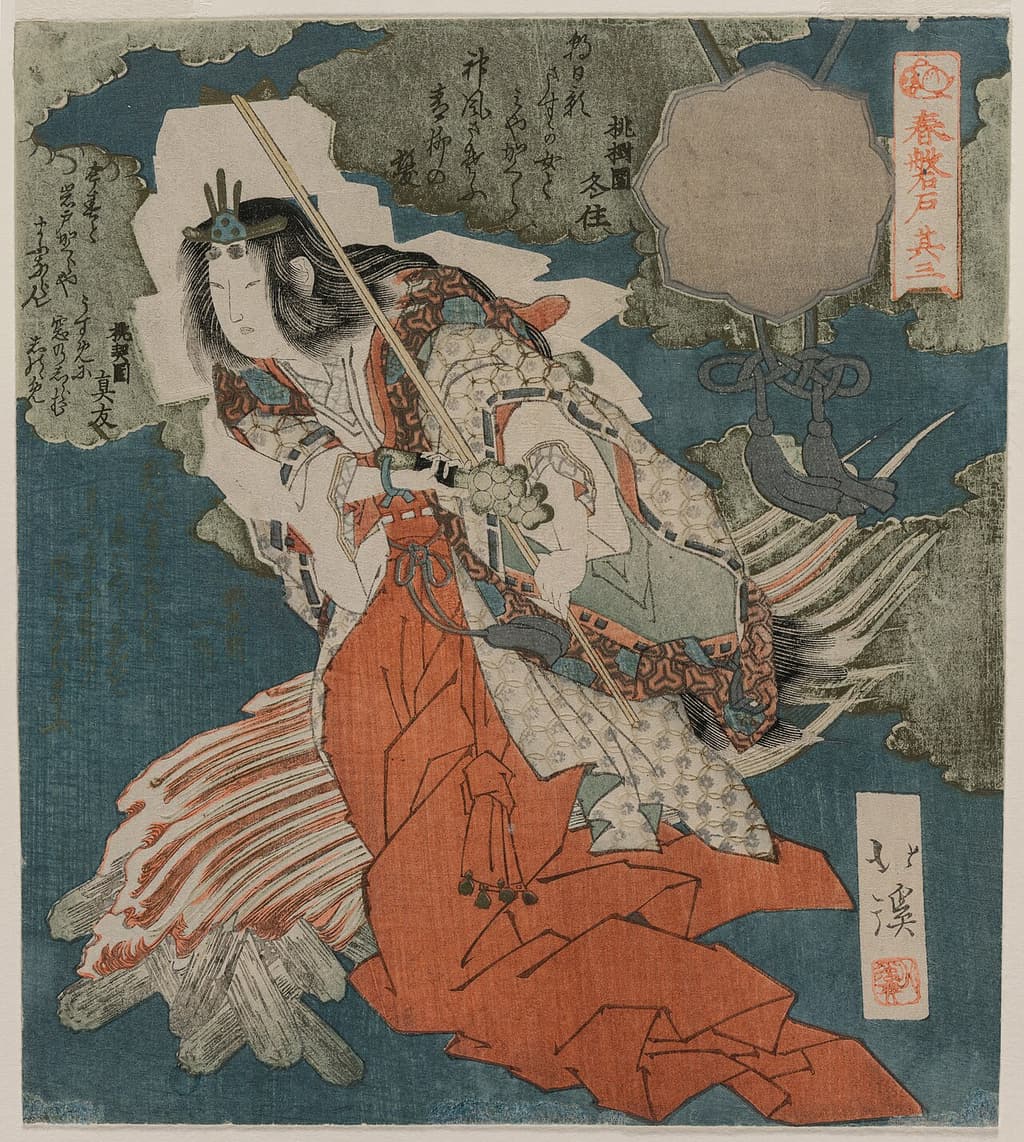
The world is dark, the sun has locked herself in a cave, and eight hundred myriad deities are standing about in a dry riverbed with no plan. What ends the crisis is a woman turning over a tub, stamping on it until it booms like a drum, binding up her sleeves with vine and pulling her nipple-cords and her skirt-string loose while she dances, until the assembled gods laugh so loudly that heaven shakes.
Japanese sacred performance begins here, and it begins as a dirty joke that works.
What she actually does at the cave
The Kojiki is specific about her equipment, and the specifics are ritual rather than theatrical: club-moss from the heavenly mountain worn as a sash, a headdress of spindle-tree, bundled bamboo grass held in the hands. She becomes kamugakari — possessed, seized by divinity — and the exposure follows from the possession rather than being a performance choice.
When Amaterasu cracks the door to ask why anyone is laughing in the dark, it is Uzume who answers, and the answer is a lie: there is a deity here greater than you. The mirror is angled forward at that moment so the sun sees her own light and takes it for the rival. Uzume improvises the deception that gets the door open.
The Nihon Shoki keeps the scene with variations, and its account of what she wore and did is somewhat more restrained. Both versions agree that the crisis is resolved by laughter, and that a goddess talks her way through the gap.
The Sarume, and a name that means monkey
She is named as the ancestress of the Sarume-no-kimi, a hereditary corporation of court ritualists — women who performed sacred dance and mediumship in the palace, attested in the eighth-century record as a real institution with a real office. Myth here is doing genealogy for a professional guild, which is exactly what it does for the imperial house a few chapters later.
The name Sarume means "monkey woman", and the Kojiki explains it by her encounter with Sarutahiko: when the heavenly party descends and finds an enormous kami blocking the crossroads, it is Uzume who is sent, on the reasoning that she alone can outface anyone. She bares her breast, drops her skirt-cord and laughs at him, and demands to know who he is; he answers politely that he has come to guide them. She is subsequently ordered to escort him home and to take his name, and her descendants take it with her.
Two things are worth noticing. First, her method is identical in both scenes — confront an immovable divine obstacle by making it absurd. Second, the guild's name derives from a man's name, which is unusual enough that commentators have argued about whether the etymology is real or reverse-engineered from the syllable saru.
Kagura, and the claim about theatre
Kagura — kami-entertainment — is the family of shrine dances performed across Japan, from formal court versions to the all-night village programmes of Iwami in Shimane and the mountain rites of Takachiho in Kyushu, where the cave episode is danced every night of the year for visitors and over several nights in winter for the community. Uzume's dance is treated as its origin.
The stronger claim, repeated in a great many books, is that Japanese theatre as such descends from it — that Noh and kabuki trace back to a goddess on a tub. That is a traditional genealogy rather than a documented lineage. Noh's actual formation in the fourteenth century out of sarugaku and dengaku, and kabuki's out of a woman named Izumo no Okuni dancing in a Kyoto riverbed around 1603, are historically traceable and do not need a mythological ancestor. What is true is that Japanese performance has consistently understood itself as beginning with an obscene comic dance performed for gods, and has said so.
Izumo no Okuni's own story, incidentally, rhymes with Uzume's closely enough that the connection may not be accidental: a woman, a riverbed, a crowd, and a performance that was funny before it was respectable.
Otafuku, and the face on the mask
The round-cheeked, small-eyed, smiling female mask called Otafuku or Okame — sold at festivals, hung in kitchens, worn in comic dances — is widely identified with her. The identification is folk rather than textual and the mask type has its own separate history in kyōgen comedy, but it has stuck firmly enough that Otafuku is now the face most Japanese people would put to the name.
She appears with the mask at Setsubun in February, in the ritual where beans are thrown at oni and, in some temple performances, an Otafuku figure appears to restore order — comedy and demons handled by the same performer, which is a fair description of her original job.
A second, smaller tradition credits her with the exclamation of ara, omoshiroshi at the moment the light returned, and derives from it a word that now means "interesting" and once meant, literally, "the faces are bright". Etymologists regard this as folk etymology, and it is repeated in shrine literature anyway.
Comedy, possession and the modern stage
She turns up in games and anime as a dancer or a support character — Ōkami stages her cave dance directly, and Onmyōji-style rosters recruit her as a performer with charm-based abilities. Her scene is also, unavoidably, the thing every anime "everyone laughs and the crisis lifts" beat descends from, whether or not the writers know it.
Where adaptations struggle is with the strip. Modern retellings for general audiences almost always soften it to a funny dance, and the softening removes the mechanism: it is not amusement that the other deities feel but shock tipping into hilarity, and it is the volume of that laughter, not its warmth, that makes a sun goddess curious enough to open a door. A goddess who resolves a cosmic emergency by being deliberately outrageous is a rarer figure than a goddess who is merely cheerful.
Is her dance really about possession rather than seduction?
The text supports possession, and this is the most common misreading of her. The Kojiki says she became divinely seized before it describes what happened to her clothing, and the props she carries — bound moss, bamboo grass, an overturned tub struck as a drum — are the standard toolkit of Japanese shamanic practice as it is attested elsewhere, not stage costume. The exposure of the body in that frame belongs to a wide class of ritual acts, found in several cultures, in which display drives off malignancy or provokes obligatory laughter. Reading it as flirtation imports a category the scene does not have; the audience is a crowd of gods with a practical problem, not an admirer.
Why is the guild she founded made up of women?
Because mediumship in early Japan was substantially a female profession, and the palace institutionalised it. Alongside the Sarume, the court maintained the mikannagi diviners and, at Ise, an imperial princess serving as the sun kami's own representative; regional traditions of blind female mediums, the itako of the north-east among them, persisted into the twentieth century. The chronicles were compiled during and immediately after reigns of ruling empresses, and the pattern of women as the channel through which kami speak is consistent enough across the record to be structural rather than incidental. The tradition overview covers how much of Japanese practice is conducted by people rather than by texts.