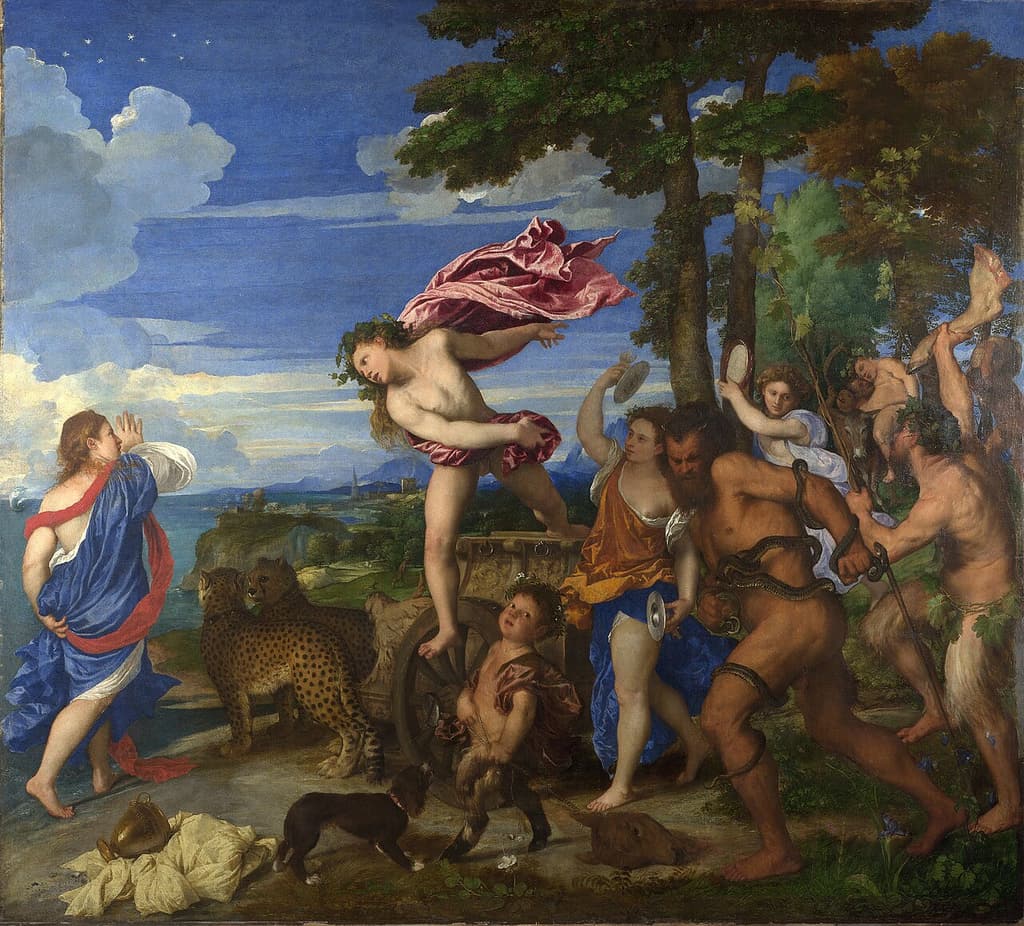
A young god walks into the city where he was born, in the body of a soft-looking foreign man with long hair, and asks to be recognised. The king says no. Two hours later the king's mother is standing in the palace courtyard holding her son's head and telling her father what a fine hunter she has been.
Euripides wrote Bacchae in Macedonia at the end of his life. It was produced in Athens after his death, around 405 BCE, and took first prize — the only one he won posthumously. It is the most formally perfect Greek tragedy that survives and the least comfortable.
The grievance
Dionysus's mother was Semele, daughter of Cadmus who founded Thebes. She was pregnant by Zeus and was destroyed by his lightning when she asked to see him undisguised; the unborn child was sewn into his father's thigh and carried to term. Her three sisters put out a different story: that she had slept with some man, blamed a god to cover it, and been killed for the blasphemy. The family has been repeating that version for twenty years, and the smouldering ruin of Semele's tomb is still in the middle of the courtyard.
So the god comes home with a specific complaint. He has already driven the women of Thebes — his aunts among them — out of their houses and onto the slopes of Mount Cithaeron, dressed in fawnskins and carrying wands, in a state that the play never lets you call either ecstasy or illness.
The king who cannot see it
Pentheus, Semele's nephew, has just inherited the throne and is young enough to be frightened of looking weak. His diagnosis of what is happening on the mountain is entirely sexual: the women are drunk, they are meeting men in the woods, and it will stop when he has them in irons.
Euripides gives him one superbly awkward scene before the trouble starts. The blind prophet Teiresias and old Cadmus, the founder himself, come on stage in fawnskins with ivy in their hair, two elderly men dressed for a rite they can barely walk to, and Pentheus is disgusted. Teiresias's argument for going is not faith but prudence and civic sense: the god is real, the honour costs nothing, and a king who fights this will lose. It is a thoroughly Greek defence of religion — pragmatic, unmystical, and completely correct.
Pentheus arrests the stranger anyway. What follows is a sequence of quiet impossibilities: the bull he ties up in the stable is not the man; the palace shakes and the fire on Semele's tomb flares; the prisoner walks out of the building unhurried and asks whether he was missed.
What the herdsman saw
A messenger comes down from Cithaeron, and his speech is the hinge of the play.
He found the women asleep in good order — not drunk, not with men. They woke, tied their hair, fastened their fawnskins, and suckled the young of wild animals. One struck the rock with her wand and water came; another put hers in the ground and wine welled up; they scratched the earth and got milk, and honey ran from the ivy on their staffs.
Then the herdsmen tried to ambush them, and it went the other way. Unarmed women pulled full-grown cattle apart with their hands, ripped ribs out of heifers, and went through two villages carrying fire in their hair that did not burn them. Iron did not draw blood on them. They came back to the springs and washed and were as they had been.
The messenger's closing line to the king is the play's whole argument in miniature: whoever this god is, take him into the city, because he is powerful, and because they say he gave men wine.
The dressing
Then Dionysus does something crueller than any of it. He offers Pentheus what Pentheus actually wants — to watch.
The king agrees to go up the mountain, and agrees to go in disguise, and the god dresses him: long linen dress, a wig, a wand, a fawnskin. And in the middle of it Pentheus's mind begins to go. He asks whether he looks like his mother or his aunt. He fusses about a fallen curl. Then he looks at his guide and says he sees two suns and two cities, and that the stranger seems to have horns and to be leading him as a bull.
They go out. And the god, alone on stage, drops the courtesy entirely and tells the audience exactly what he is going to do.
Cithaeron
The second messenger's speech is short. Dionysus bent a pine tree to the ground and set Pentheus in the top and let it up again, and then made him visible to every woman on the mountain. They tore the tree out by the roots.
Agave got to him first. He pulled his wig off and touched her cheek and told her who he was, and she did not see him — she saw a lion. She took hold of his left arm and put her foot against his ribs and pulled it out of the socket, and her sisters helped with the rest. She came down the mountain with his head fixed on her wand, in triumph, expecting to be praised.
Cadmus, who has been up there gathering what could be found of his grandson in a cloth, has to bring her out of it, and he does it slowly, by asking her ordinary questions: where are you, whom did you marry, whose son is that. The manuscript is damaged at exactly this point — the great recognition and the lament over the body are largely lost — and modern editions patch fragments of it from a Byzantine Christian play that quarried Euripides for verse.
Dionysus appears above the ruin, no longer disguised, and disposes of the survivors without pity: Agave into exile, Cadmus and his wife Harmonia turned into serpents and sent to lead a barbarian army. Cadmus's protest — that gods should not resemble men in their tempers — gets the reply that Zeus approved all of this long ago.
The god was never foreign
Euripides stages Dionysus as a new arrival from Lydia, an eastern intruder demanding admission to Greece. For a long time scholars took that at face value and dated his arrival in Greek religion to the archaic period.
Linear B tablets have made that untenable. The name appears in Mycenaean Greek at Pylos and at Khania on Crete, centuries before Homer. He is as old as any Olympian. The play's foreignness is a dramatic device — an argument about what a city does with the parts of itself it will not acknowledge — not a piece of religious history.
What Athenians were watching
They were watching a play about their own theatre's patron, performed at his festival, in a theatre next to his sanctuary, by actors wearing masks in a form of worship. The subject of Bacchae is the danger of refusing to participate in a communal rite, staged inside a communal rite. Nothing in Greek drama is more self-aware.
What Euripides thought is genuinely disputed and has been for a century. One reading, associated with E. R. Dodds's commentary, takes the play as a study of a real psychological force that punishes repression regardless of anyone's morals — the god is neither just nor unjust, simply a fact of human nature. Another sees late-life piety, a dramatist notorious for scepticism finally submitting. A third sees an unsparing indictment of a god who behaves like a vindictive adolescent, with the audience invited to side with the wrecked old man at the end. The text supports all three, which is why it is still staged.
The maenads themselves are a further problem. Real Greek women did hold biennial mountain rites for Dionysus at Delphi and elsewhere, and inscriptions record official thiasoi with appointed leaders. Whether anything resembling the tearing apart of live animals ever occurred, or whether it was a permanent piece of literary imagination about what women do when unsupervised, is not settled by the evidence.
Since
The play went quiet for centuries and came back hard in the twentieth. Nietzsche built half his aesthetics on the opposition between this god and Apollo, though he read remarkably little of the actual tragedy into it. The Performance Group's Dionysus in 69 turned it into participatory nudity in a New York garage. Wole Soyinka rewrote it in 1973 as a slave revolt, with the god's rites belonging to the enslaved and the king representing the state that criminalises them, and ended on communion rather than horror. Donna Tartt's The Secret History is a novel about students who read this play too closely and try it.
The Homeric Hymn to Dionysus gives a much lighter version of the same lesson: pirates seize a beautiful young man off a beach, the ropes will not hold him, wine runs through the ship, a vine climbs the mast, a bear appears amidships, and the crew go over the side and surface as dolphins. Same god, same rule — you do not get to decide he is not there — with the corpses left out.
Points worth separating
Is Pentheus's death a sparagmos, and was that a real rite? Sparagmos, the tearing apart of a living body, and omophagia, eating it raw, are attested in literature and in a few later ritual regulations, but the archaeological and epigraphic record for classical Greece gives no clear case. Treat it as something Greeks believed about the god's worship rather than something demonstrably done.
Why is Thebes always the city where this happens? Athenian tragedy uses Thebes as the place where the unthinkable is set — incest, fratricide, mothers killing sons. It was a real and hostile neighbour, and putting the worst stories a day's march away rather than at home was both safer and more pointed.
Does Agave appear in earlier versions? The dismemberment of Pentheus by his mother is older than Euripides — Aeschylus wrote a Pentheus, now lost, and the scene appears on vases well before 405 BCE. What is Euripides' own is the dressing scene and the recognition, which is to say the two parts nobody can forget.
Why does Dionysus look effeminate? Because Pentheus says so, and because the god's early images are bearded and adult while the classical stage version is young and soft. The play makes the king's contempt for that appearance the first symptom of his blindness, and then puts him in a dress.
Read on at the Greek tradition hub, the family tree that ties Cadmus's descendants together, or the story of another Theban house in Oedipus's Thebes.