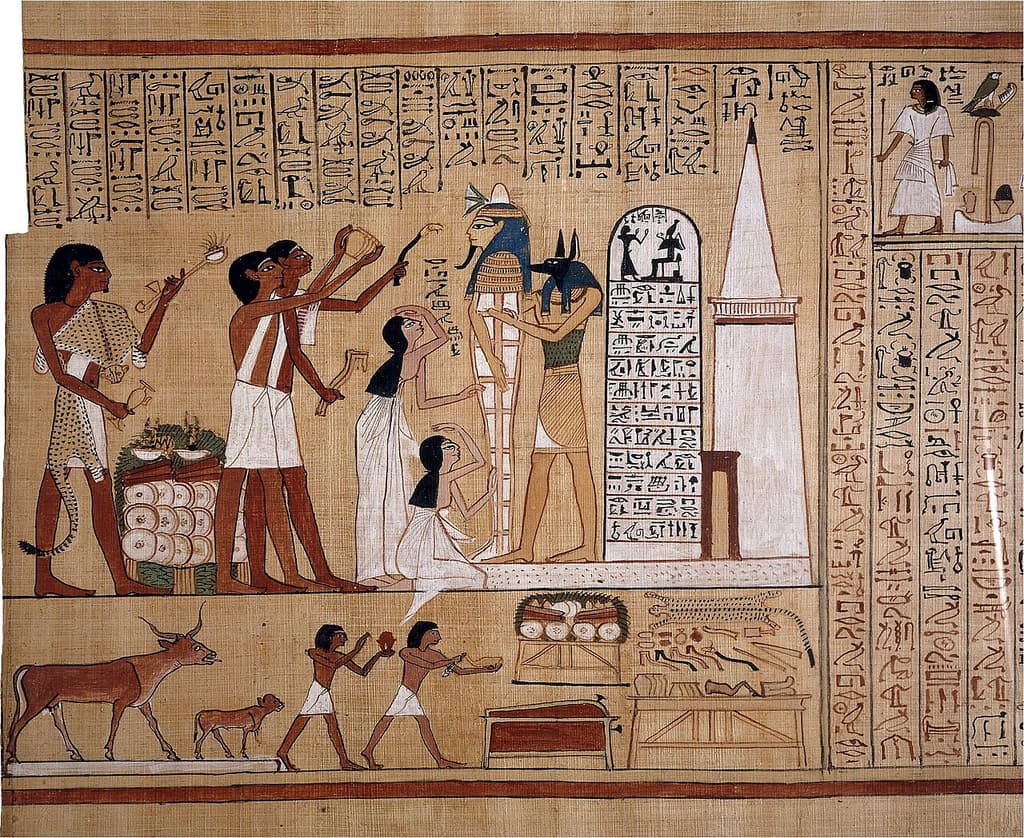
This is the most famous story Egypt ever told, and Egypt never told it. Not in full, not in order, not once in three thousand years of temple walls, coffins and papyri. The continuous narrative everyone knows — the banquet, the chest, the fourteen pieces, the missing phallus — comes from a Greek philosopher writing in the second century CE, in Greek, for a Greek priestess, using Greek divine names.
That does not make it false. It makes it a source with a shape, and the honest way to handle it is to tell it properly and then say, item by item, what the Egyptian evidence actually supports.
Plutarch's version, told through
Five days that did not exist. The sky-goddess conceived by the earth-god, and the sun cursed her so that she could not give birth in any month of any year. The god of writing then gambled with the moon, won a seventieth part of each of its lights, and made five extra days out of the winnings — days belonging to no month, which is why the Egyptian year has 365. On those days were born, in order, Osiris, the elder Horus, Set (who tore his own way out of his mother's side), Isis, and Nephthys. At Osiris's birth a voice announced that the lord of all had come into the world.
A good king and a plot. Osiris took the throne and lifted the Egyptians out of squalor: he gave them grain, showed them how to make wine and beer, gave them laws, taught them the honouring of the gods. Then he went abroad to do the same for the rest of the world, and carried it by persuasion, argument and music rather than by armies. Isis governed in his absence and watched Set, who wanted the throne and had seventy-two men and a foreign queen behind him.
The chest. Set had Osiris's measurements taken in secret and commissioned a chest of that exact size, beautifully made, and brought it into a banquet. He offered it, playfully, to whoever it fitted. Everyone climbed in and out. Osiris lay down in it, and the conspirators were on the lid before he could sit up: nails driven, molten lead poured into the seams, the whole thing carried to the river and put out to sea. Plutarch even gives the date — the seventeenth of the month of Athyr — with the tidy precision of a man who has read a temple calendar.
The wandering. Isis cut off a lock of hair, put on mourning, and went looking. Children by the riverside had seen where the chest went. On the way she learned that Osiris had lain with her sister Nephthys by mistake and that the child of it had been exposed for fear of Set; she tracked the baby down with dogs and raised him, and he became her guardian and guide — Anubis.
Byblos. The chest had drifted to the Phoenician coast and lodged in a bush, which grew into a tree that closed round it, and the king of Byblos cut that tree and set it up as a pillar in his hall. Isis went there, sat by a well, made friends with the queen's women by braiding their hair and leaving an extraordinary scent on them, and was taken on as nurse to the royal infant. She fed him by giving him her finger; at night she burned away the mortal parts of him while she flew round the pillar in the shape of a swallow, keening. The queen walked in on this, screamed, and by screaming cost her son immortality. Isis asked for the pillar, cut the chest out of it, and left the wood wrapped in linen as a relic that Plutarch says was still venerated in his day.
Fourteen pieces. She hid the chest in the marshes. Set, out hunting by moonlight, found it, recognised what was inside, and cut the body into fourteen parts which he scattered. Isis went after them in a boat of papyrus — Plutarch adds that this is why crocodiles will not touch a papyrus boat — and buried each piece where she found it, which is why so many places in Egypt claimed the tomb of Osiris. Only one part was never recovered: the phallus, thrown into the river and eaten by three species of fish, which Egyptians accordingly would not eat. Isis made a replacement and consecrated it.
The son. Osiris came back from the land of the dead to train Horus for the fight, and tested him with two questions: what is the finest thing a man can do, and which animal is most use in war. Horus answered that the finest thing is to avenge a wronged father and mother, and that the most useful animal is the horse, not the lion — because a lion is what you want when you need rescuing, and a horse is what you want when the enemy is running. His father approved of the second answer more than the first.
The war ran for days. Horus won. Set was handed over in chains to Isis, and she let him go, and Horus tore the crown off his mother's head in fury; the god of writing gave her a horned headdress instead. Set then sued, alleging that Horus was a bastard, and lost the case.
What Egypt actually attests
Now the audit. Egyptian sources are full of this story's consequences and almost silent about its events, because writing down the killing of a god was not something Egyptian religious decorum permitted. Allusion was allowed. Narration was not.
Solidly Egyptian, from the Old Kingdom onwards. The Pyramid Texts, carved inside royal tombs from around 2350 BCE, refer over and over to Osiris being struck down by his brother, to his body lying on the riverbank at a place called Nedit, to Isis and Nephthys finding him and mourning over him as two birds of prey, and to Isis conceiving Horus from the dead body. The murder is assumed on every side and never described.
Solidly Egyptian. Drowning. The oldest strand has Osiris go into the water and be recovered from it; drowned people had a special sacred status in Egypt for exactly this reason. The chest and the sea voyage are not part of that.
Solidly Egyptian. Dismemberment and the scattering of relics. Temple and funerary texts, and especially the late geographical papyri, list which part of Osiris rests in which nome. But the totals in those lists vary from place to place and never settle on fourteen. Plutarch's fourteen is the number of days the moon takes to wane, and he says so himself — it is a Greek interpretation attached to a genuine Egyptian practice.
Solidly Egyptian. The revival and the conception. The Great Hymn to Osiris on an Eighteenth-Dynasty stela now in the Louvre gives the search, Isis making wind with her wings, the raising of her husband's inertness far enough to get an heir, and the vindication of Horus before the tribunal — and it, too, steps around the murder.
Egyptian in substance, disputed in detail. The lost phallus. There is genuine Egyptian material about the member and about fish, and local fish taboos are real; the specific list of three species is Plutarch's contribution.
Almost certainly not Egyptian. The Byblos episode. Egypt had a deep and ancient relationship with Byblos — cedar, ships, a goddess there whom Egyptians identified with Hathor and later with Isis — so the setting is not arbitrary. But the plot of that episode, in which a disguised goddess in mourning takes service as a nurse, secretly burns the mortality out of a royal child in the fire, and is interrupted by the horrified mother, is the Demeter-and-Demophoon scene from the Greek hymn sung at Eleusis, with the names changed. Plutarch knew that hymn intimately. Whatever happened at Byblos, this is a Greek story sitting inside an Egyptian one.
What Egypt did with it instead of narrating it
Rather than telling the story, Egypt performed it and grew it.
At Abydos, an annual procession enacted the god's death, the attack on his barque, the mourning and the triumphant return; a Twelfth-Dynasty official named Ikhernofret left an inscription describing his role in organising it, which is our best evidence for what it looked like from the inside.
In the month of Khoiak, priests made Osiris beds — mummy-shaped trays of Nile silt sown with barley, watered, and kept in the dark until they sprouted. A god who is killed, buried and comes up green is not a metaphor here; he is a germination test, done annually, with the result visible.
And the djed pillar, understood as the god's backbone, was raised upright in a ritual attended by the king. The verb is the point: the sign for stability is a spine being stood back up.
Disputes worth knowing
Is Osiris a "dying and rising god"? James Frazer built a whole comparative category out of him, alongside Tammuz, Adonis and Attis, and it dominated popular writing for a century. Specialists have taken it apart since. Osiris does not return to the world of the living. He revives sufficiently to father an heir and then rules the dead permanently, which is a different proposition from resurrection — the succession passes to his son precisely because the father does not come back.
How much did Plutarch invent? Probably very little outright, and a great deal by selection and arrangement. He had Egyptian informants, he had access to Alexandrian scholarship, and much of his detail checks out against material he could not have known independently. What he did was impose narrative order on a body of allusion, and interpret the result philosophically — his own reading is that Osiris is the moist, generative principle and Set the arid and destructive one, which is Greek natural philosophy, not Egyptian theology.
Was Set always the villain? No, and this is the biggest distortion the Plutarch-shaped version produces. For most of Egyptian history Set is a necessary and honoured god — the one who stands in the sun's boat and kills Apep every night, a god of the desert and of foreign lands, the patron of Ramesside kings who were named after him. The reduction of Set to a straightforward evil brother is late, and it hardens under Persian and Greek rule.
Common questions about the story
Why does Isis let Set go? Plutarch is genuinely puzzled by it and offers no explanation. Within an Egyptian frame it makes more sense: Set is her brother, the family is a single unit, and the aim of the process is the correct transfer of an office rather than the destruction of a relative — which is precisely how the tribunal case resolves it.
Why so many tombs of Osiris? Because burying a piece where you found it distributes the relic, and every nome that had one had a claim. Abydos won the competition and became the pilgrimage centre; Plutarch also records the alternative explanation that Isis made replicas and gave one to each district so that Set would never know which was real.
Does the fourteenth piece ever turn up? No. It is the one irreducible loss in the story, and it is what makes Horus's conception a feat of magic rather than an ordinary act. Isis is a magician before she is anything else, and this is the demonstration.
What is the seventeenth of Athyr? A real date in the Egyptian civil calendar, in the season when the inundation was going down and land was reappearing. Plutarch's date-keeping is one of the strongest signs that he had access to genuine liturgical information.
Why did Egyptians not write it down plainly? Because words were held to act. Writing the killing of a god in full, with the killer named and the method described, risked accomplishing it. The same instinct mutilates hieroglyphs of dangerous animals inside tombs.
Continue with Osiris, Isis, Set, Nephthys and Anubis; the lawsuit that follows at the contendings of Horus and Seth; the courtroom of the dead at the weighing of the heart. The tradition is mapped at the Egyptian hub and the Egyptian family tree.