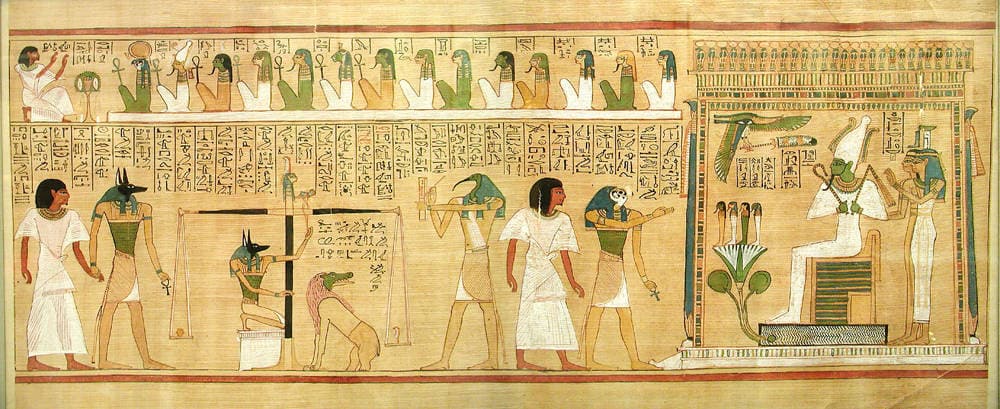
The scene is on more Egyptian papyri than any other, and it is not a myth in the usual sense — it has no plot and no protagonist except you. A room, a balance, a clerk, a monster, and a very long list of things you are required to state you have not done. It is the oldest fully worked-out account in the world of a person being individually assessed after death, and it survives in enough copies that we can watch ordinary people prepare for it.
Coming into the hall
The dead person arrives at a double doorway and enters what the texts call the Hall of the Two Truths.
The first thing that happens is not an examination. It is a greeting, and the deceased has to get it right. He addresses Osiris by title, states that he has come to see the god's beauty, and then — before anyone asks him anything — begins the declaration.
The declaration
This is the passage usually called the negative confession, which is a poor name and should be retired. Nothing is confessed. It is a declaration of innocence, delivered in the first person, and it comes in two parts.
The first part is addressed to Osiris directly, as a long run of denials. A representative stretch of it, and these are the actual items:
- I have not done wrong.
- I have not robbed.
- I have not been rapacious.
- I have not stolen.
- I have not killed people.
- I have not damaged the grain-measure.
- I have not stolen the property of a god.
- I have not told lies.
- I have not snatched away food.
- I have not been sullen.
- I have not committed adultery.
- I have not made anyone weep.
- I have not eaten my heart — meaning, roughly, I have not let anger or grief master me.
- I have not eavesdropped.
- I have not multiplied words in speaking.
- I have disputed only about my own property.
- I have not been quarrelsome.
- I have not been hot-tempered.
- I have not been deaf to words of truth.
- I have not reviled the king.
- I have not fouled the water.
- I have not raised my voice.
- I have not cursed a god.
- I have not been boastful.
- I have not held back water at its season.
- I have not dammed a flowing channel.
- I have not extinguished a fire at its proper moment.
- I have not neglected the days of meat offerings.
- I have not driven away the cattle of the god's estate.
- I have not stopped a god in his procession.
The list is worth reading slowly, because it does something that ought to be surprising. It does not distinguish between moral offences and ritual ones. Murder sits in the same list as neglecting an offering date; adultery sits beside interfering with irrigation; sulking is an item. To an Egyptian, maat — order, rightness, the correct running of things — covered the canal, the calendar and the character equally, and there was no separate compartment for ethics.
The second part is stranger and more frightening. Forty-two divine assessors sit around the hall, each with a name and a home town, and the dead person addresses every single one of them individually, by name, denying one specific offence to each. Their names are not comforting: Bone-breaker from Herakleopolis. Blood-eater from the slaughter-block. Swallower of Shadows. Eater of Entrails from the House of Thirty. Hot-foot who came out of the dusk. Pale One from Heliopolis. He who acts as he wishes.
Knowing the names is the point. Egyptian magical logic held that a being you can name accurately is a being you can address, and a being you can address cannot simply act on you. The list is not a memory test set by the gods; it is armament carried by the dead.
The balance
Then the heart is weighed.
The scene is standardised in the illustrated papyri and everyone has seen a version of it. The great balance stands in the middle. In one pan is the heart of the deceased — the organ deliberately left inside the body during mummification, because it was where thought, memory, character and conscience were held. In the other is a single ostrich feather, the emblem of Maat, or sometimes a small seated figure of the goddess herself.
Anubis crouches at the base with a hand on the plumb-bob, adjusting the balance and reading it. Thoth stands beside it with a scribe's palette and a reed pen, writing down the outcome — because a verdict that is not recorded has not happened.
And to one side sits Ammit, assembled out of the three animals Egyptians feared most: a crocodile's head, the forequarters of a lion, the hindquarters of a hippopotamus. She is not a torturer. She has one function, and she performs it once.
If the heart balances, Horus takes the dead person by the hand and leads him to Osiris, enthroned with Isis and Nephthys behind him and the four sons of Horus standing on a lotus in front. He is announced as maa-kheru — true of voice, vindicated, the same term used of a man who has won a lawsuit — and he goes out into the Field of Reeds to farm land that is always fertile.
If the heart does not balance, Ammit eats it, and the person ceases to exist. This is the sharpest difference between Egyptian judgement and the afterlives that came later in the Mediterranean. There is no hell. There is no eternal punishment, no torment, no purgation. There is annihilation — the second death — and for a culture that had invested everything in continuing to exist, that was the worst outcome imaginable.
The scarab, and the honest problem it exposes
Here is the detail that makes the whole system human.
Mummified bodies routinely carry a large stone scarab over the heart, and inscribed on the underside of it is a spell — number 30B in the modern numbering of the Book of the Dead. It is addressed by the dead person to his own heart. And what it asks for is this: do not stand up as a witness against me. Do not oppose me before the keeper of the balance. Do not tell against me in the presence of the tribunal.
So the same man who recites forty-two denials also arrives carrying an amulet whose specific purpose is to stop his heart from contradicting them.
Egyptians clearly did not think the outcome was a foregone conclusion, and they also clearly did not intend to leave it to chance. The system is a court and the dead are lawyered up. That coexistence of genuine moral seriousness and frank procedural insurance is characteristic, and flattening it in either direction — into a sincere moral test or into cynical magic — misrepresents it.
Where the text comes from
The declaration and the judgement scene together make up spell 125 of the collection Egyptians called the Book of Coming Forth by Day and modern scholarship calls the Book of the Dead.
It is a New Kingdom composition in its developed form, from around 1550 BCE onward, but the idea behind it is much older. Middle Kingdom coffin texts already speak of a tribunal, and the Instruction addressed to King Merikare warns that the judges of the dead are not lenient and that a man's conduct is piled beside him. The balance and the feather are the New Kingdom's contribution — the moment an abstract reckoning became a picture.
The books themselves were commercial products, and the market is visible in the objects. Rich commissions like the papyrus made for the scribe Ani around 1250 BCE are superbly drawn, generously spaced and beautifully coloured. Cheaper ones are cramped, error-strewn, and sometimes bought pre-written with blank gaps for the customer's name to be filled in later. Occasionally the gaps were never filled.
The thing that never appears
In the entire surviving corpus of illustrated judgement scenes — thousands of them, across a thousand years — the balance is always level, or tipping the right way. Ammit is always waiting and never eating.
That is not because Egyptians thought failure impossible. It is because the papyrus was the equipment. Depicting your own vindication was part of accomplishing it, and no one commissioned a picture of themselves being destroyed.
Reading the ethics honestly
Two things are frequently over-claimed about spell 125 and both should be handled with care.
It is not a moral code. It is a script for a specific occasion. Nothing in Egypt required anyone to live by the list; the list exists to be recited at the door. Egyptian ethical instruction proper lives in a different genre — the wisdom texts and instructions — and those are longer, more practical and much less absolute.
It is not an ancestor of the Ten Commandments. The resemblance of a few items is real and the connection is unproven, and the differences are larger than the overlaps: there is no covenant, no single deity issuing the list, no prohibition on images, and a great deal of material about canals, offerings and processions that has no counterpart. Assertions of direct descent are made confidently in popular writing and cautiously or not at all by Egyptologists.
Questions that come up
Why the heart and not the head? Because Egyptians located thought, judgement, memory and will in the heart. The brain was removed during embalming and discarded; the heart was left in place, or if it had to be removed, replaced. The organ on the scales is the seat of the person.
Why is the counterweight a feather? Because a feather is the hieroglyph for maat, and because the balance is a real object Egyptians used every day for weighing gold and grain. The image says the person's character is being measured against the standard by which everything else in Egypt was measured.
Does anyone speak for the accused? Thoth records and, in some versions, announces the result favourably; Horus escorts. But nobody argues the case. The declaration is a self-representation, which is why getting the wording right mattered enough to pay a scribe for.
Do the forty-two assessors correspond to the nomes of Egypt? The number is close to the count of administrative districts, and the assessors carry town names, so the connection is very likely and often stated. It is not proved, and the lists of names vary between manuscripts.
Is this a myth at all? Not in the sense of a story about the gods. It is a procedure — closer to a liturgy or a legal script than to the murder of Osiris. What makes it belong here is that it is the destination of everything else in Egyptian religion: the whole apparatus of embalming, tomb, offering and spell exists to get one person into that room in a fit state to speak.
Continue with Maat, Anubis, Thoth, Ammit, the Duat the hall stands in, and the Field of Reeds beyond it. Wider context at the Egyptian hub and among underworld guardians.