Everyone carries a mental picture of these gods, and almost nobody knows where their picture came from. Ask what Thor looks like, or Medusa, or a kitsune, and the image that arrives is dated, located and commercially motivated — it was made by a particular workshop for a particular buyer, and it is evidence of something, but rarely of what people assume.
Images are not illustrations of myth. They are independent witnesses, with their own budgets, formats and audiences, and they frequently disagree with the texts. Learning what each medium can and cannot support is as useful as learning to date a manuscript.
Attic pottery: export goods that outvote the poets
The largest body of Greek mythological imagery is painted on tableware. Black-figure and then red-figure pots were produced in quantity in Athens from roughly the seventh century BCE, signed sometimes by potter and painter, and sold across the Mediterranean — a very large share of the surviving masterpieces come out of Etruscan tombs, because Etruria was the export market and Etruscans buried the good crockery.
That commercial reality is the key to using them. Subject choice reflects what sold, not what was believed most fervently, and the wedding scenes, athletic scenes and drinking-party scenes crowd the divine ones. But the pots have one enormous advantage over the poems: there are tens of thousands of them, they are closely datable by style, and they show episodes that no surviving literature records at all. Where a sixth-century vase depicts a version of a story that contradicts the standard literary account, that is not an error by the painter. It is direct evidence of a variant the books lost.
They also date changes. Early Medusa is a frontal grotesque — tusks, staring eyes, a face that functions as a protective device rather than a portrait — and the beautiful, pitiable Medusa arrives centuries later. You can watch the transformation happen across the pottery record, which is why an argument about her that rests only on literature is only half-informed.
Roman walls, and the masterpieces they are copies of
Roman domestic wall painting survives in bulk for one grim reason: two towns were buried in 79 CE and their interiors preserved intact. What was recovered is a dated cross-section of what prosperous Romans wanted to look at over breakfast.
Much of it adapts Greek panel painting — celebrated works on wood, by named Greek masters, all of which are lost. The frescoes are therefore our nearest access to a whole vanished art form, at one remove, filtered through the taste of provincial Italian decorators and their clients. That is genuinely valuable and genuinely treacherous: a mythological scene on a dining-room wall tells you what a wealthy household in Campania found decorative in a particular decade, and only indirectly what anybody thought about the god in it.
The Roman gods come to us visually through this domestic filter far more than through cult statues, most of which are gone.
Carved stone in the north, where the captions are missing
Scandinavian and insular carving is the opposite situation: very few images, enormously important, and almost none of them labelled.
The Gotland picture stones run for centuries and show ships, riders, women offering horns to arriving warriors, and a horse that appears to have more legs than it should. The Ramsund rock carving in Sweden, from around 1030, is a rare case of near-certainty — it lays out the Sigurd story in a sequence any reader of the poem recognises instantly: the sword thrust from below, the roasting heart, the thumb in the mouth, the birds, the smith. Carvings like it are how we know such narratives were in circulation generations before any manuscript recorded them.
The stones are also where the tidy pagan-versus-Christian story falls apart. Carvings in England and the Isle of Man from the conversion period put unmistakably Norse apocalyptic imagery next to Christian scenes on the same monument, commissioned by the same people. Whatever was going on in those communities, it was not a clean replacement of one belief by another.
The caution is real, though. Identifying a figure with eight legs as Sleipnir is reasonable; identifying a woman with a horn as a valkyrie is an inference from later texts, and a horn is just a horn. A large amount of what is confidently captioned in books is interpretation inherited from nineteenth-century antiquarians.
Edo prints, which often invented what they depict
Japanese woodblock printing gives this field its most seductive images and its sharpest trap. Full-colour printing arrived in the 1760s, and by the nineteenth century Edo publishers were producing warrior prints, ghost prints and monster prints at industrial scale for a mass urban market — cheap, fashionable, competitive, and brilliant.
The trap is that these prints are frequently the origin of the traditional appearance rather than a record of it. Illustrated compendia of supernatural creatures published from the 1770s onwards fixed the look of beings that had circulated as vague regional rumours, standardised local variants into one canonical form, and in a number of cases simply invented creatures that later generations received as ancient folklore. The long-nosed red-faced mountain being everyone recognises is a late crystallisation of a much older and much stranger tradition, as the tengu page sets out; the kappa's standard equipment was flattened out of genuine regional variety by printed encyclopaedias.
So a nineteenth-century print is superb evidence about the nineteenth century and must be handled with care as evidence about anything earlier. The Japanese pages here date the image as carefully as the story.
Painting across a religious border
The illustration of Indian epic includes one of the more remarkable commissions in art history: a Mughal emperor's workshop producing a lavishly illustrated Persian translation of the Mahabharata in the 1580s, with Muslim and Hindu painters working together on it. It was a deliberate cultural project by a court interested in what its subjects believed, and the resulting pictures show Sanskrit narrative in Persianate visual language — architecture, faces and landscape conventions from one tradition applied to the material of another.
The hill-state workshops of the following century took the visual treatment of Krishna somewhere else again, with a devotional intensity and a colour sense that belong to their own region and moment. Neither body of painting is a neutral window onto the epic. Both are arguments about how it should be felt, made centuries after the text and for particular patrons.
What Victorian artists put in your head
A great deal of the mental furniture is not ancient at all. Nineteenth-century academic painting and book illustration gave the English-speaking world its default images of the classical and Norse worlds: a blond, muscular Thor swinging a hammer through a mass of trolls in a celebrated Swedish canvas of 1872; the rippling, gauzy nymphs of late Victorian salon painting; the spindly, uncanny fairy-tale line of Edwardian illustrated editions of the Ring operas.
Opera itself is responsible for one of the most persistent visual errors in popular history, courtesy of a costume designer working for the first Bayreuth festival in 1876 — the pop-culture ledger has the details. None of this is worthless: it is magnificent art and it is honest evidence about the century that produced it. It is simply not evidence about Iceland or Athens.
Why the images on this site are all public domain
Two reasons, one practical and one editorial.
The practical one is that the ancient and early-modern works themselves — the vases, the frescoes, the prints, the manuscripts — are long out of copyright, and major museums have made high-resolution photographs of their public-domain holdings freely available under open licences. Some of the largest collections in the world now release such images with no restrictions at all. There is a genuine legal argument about whether a faithful photograph of a flat public-domain painting attracts any new copyright; a United States court decided in 1999 that it does not, and the European Union legislated in the same direction in 2019, while the position remains contested in some jurisdictions. Using material from institutions that have explicitly opened their collections avoids the whole question.
The editorial reason matters more. A modern illustration of a god is somebody's interpretation, made now, and putting it on the page would silently overwrite the historical record with a contemporary imagining — exactly the process this article is about. An image made in the culture that told the story is a source. An image made last year is decoration pretending to be one.
Questions about using images as evidence
How do specialists identify a figure with no inscription?
By attribute, context and repetition. A figure recurring across many objects with the same distinguishing gear — an animal companion, a specific weapon, a particular headdress — can be identified with reasonable confidence, especially where a labelled example exists somewhere in the corpus to anchor it. Single unlabelled objects are much weaker evidence, and honest catalogues say "probably" a great deal more often than popular books do.
Are ancient artists ever demonstrably wrong about their own myths?
They are frequently different, which is not the same thing, and the difference is usually the interesting part. Painters worked from what they had heard, adapted scenes to the shape of the object, and compressed or combined episodes to fit a frieze. The correct move when an image contradicts a text is to treat both as testimony rather than to correct one against the other.
Why are Egyptian and Mesopotamian images so much harder to read?
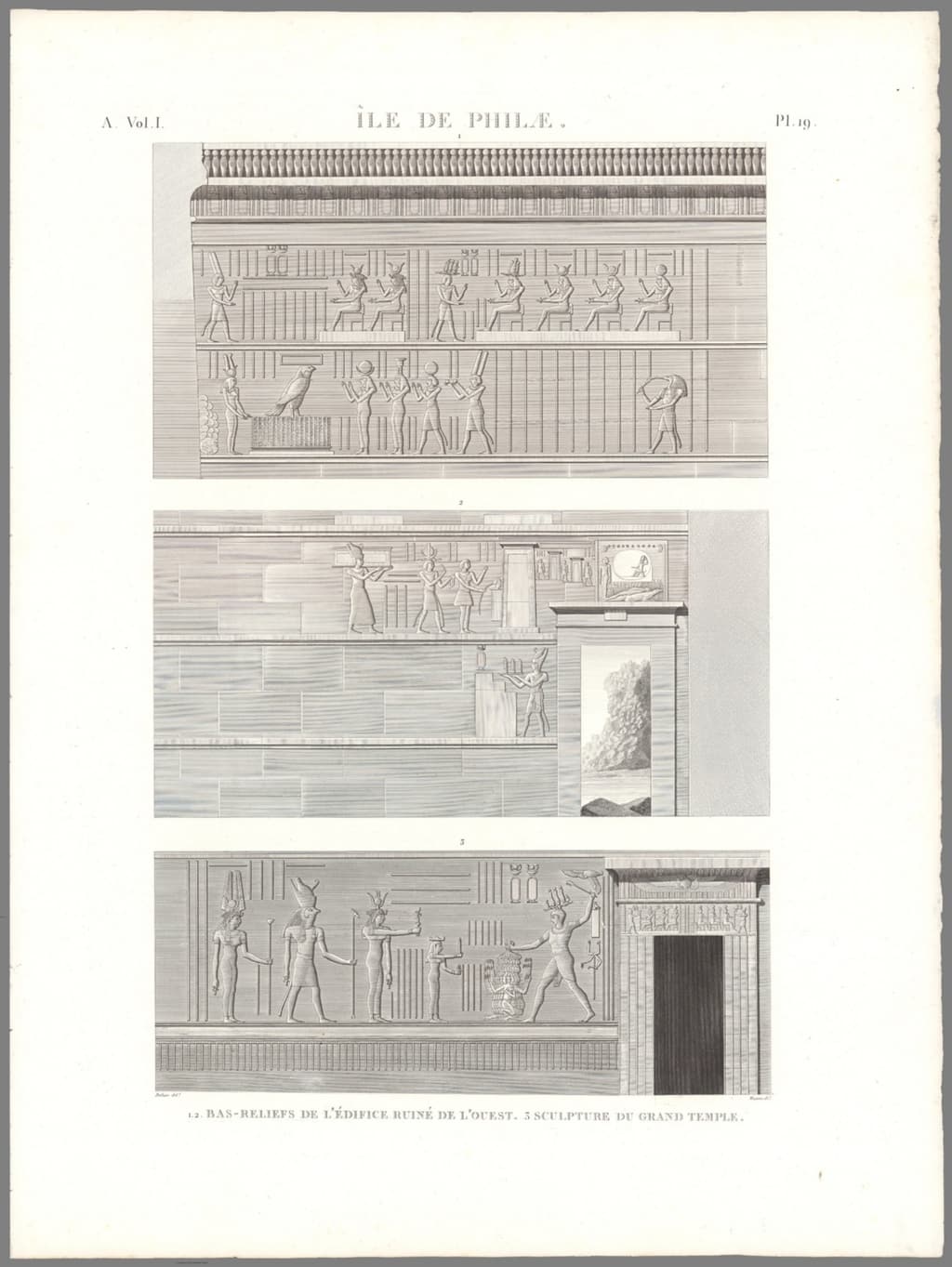
Because their functions differ from ours. Egyptian tomb imagery is equipment: it does something for the dead person and is composed to be effective rather than descriptive. Mesopotamian cylinder seals are tiny, mass-produced, and full of scenes whose identification with named narratives has been proposed, disputed and withdrawn repeatedly over a century of scholarship. Both traditions reward the same discipline as the texts — ask what the object was for.
Does this site ever use a reconstruction drawing?
Only where a reconstruction is itself a documented historical artefact — a nineteenth-century excavation drawing, say, published with its assumptions visible — and it is labelled as what it is. A modern speculative rendering of a lost temple or a vanished statue looks like knowledge and is not, and it would undercut the one thing every page here is trying to keep clear: the line between what survives and what we would like to have.