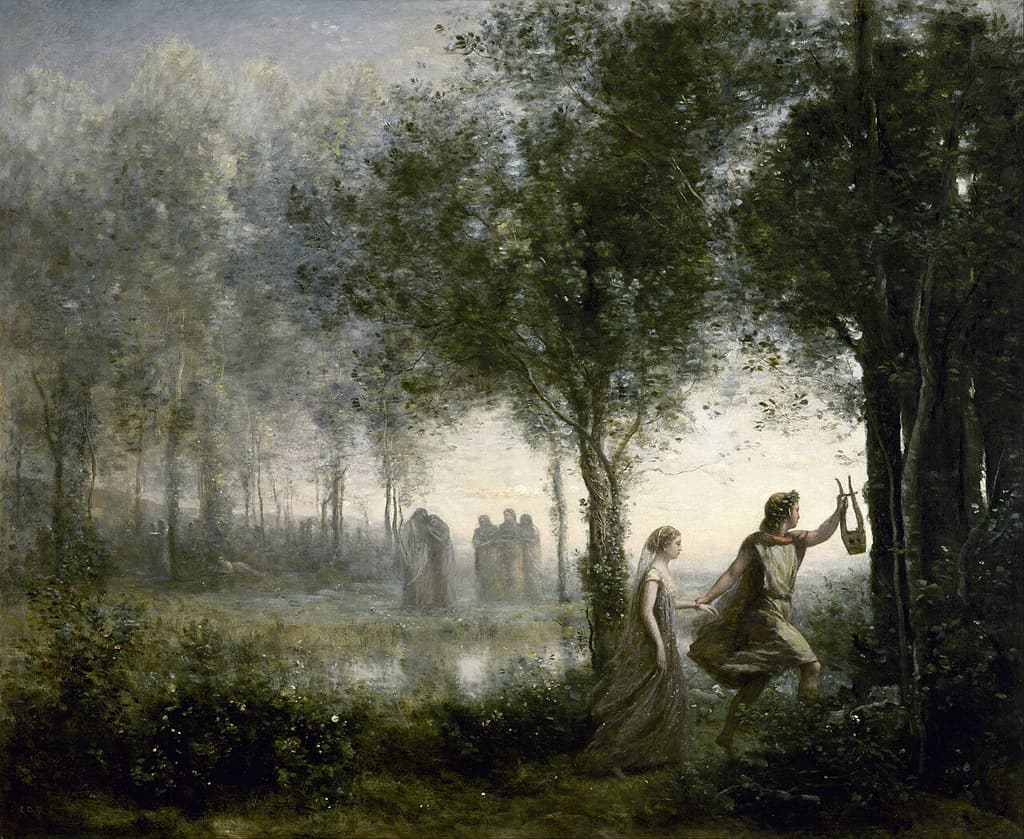
Everyone knows how this one ends. He gets her, he is told not to look back, he looks back, he loses her. It is possibly the most compact tragedy in European culture and it has been set to music more often than any other classical story.
It may also be about two thousand years younger than the story it belongs to. The looking back — the failure — cannot be shown in any surviving text before Virgil, writing in the 30s BCE. What came before that is patchier and stranger, and in at least one version he never had a chance at all.
The version that won
Orpheus sang so well that rivers changed course, trees pulled up their roots to follow him, and stones came downhill to listen. He married a woman named Eurydice. On their wedding day, or shortly after, she stepped on a snake in long grass and died.
He went down after her, and this is the part where every later composer earns their fee: he did not fight anything. He played. Charon ferried him across without payment. Cerberus lay down. In Ovid's account the damned stop mid-punishment — Tantalus stops reaching, Ixion's wheel halts, Sisyphus sits down on his rock — and the Furies weep for the first time in their existence. He came before the thrones and made his case in a short, brilliantly judged speech: I am not here to sightsee, I am not here to chain the dog, my wife stepped on a snake; and if you refuse me, keep us both, because I am not going back alone. Then, the line that does the work: you two, of all beings, were joined by love.
Persephone could hardly say otherwise. Hades agreed, with one condition attached, which Virgil calls a law and Ovid calls a pact: she follows behind, and he does not turn round until both of them are out under the sky.
They came up the long dark slope in silence. And a step or two from the top — Virgil says he was overcome, forgetful, unable to hold out; Ovid says he was afraid she was failing and hungry to see her — he turned. She was drawn backwards. She said one word, and it was his name, and he could not hear it.
He tried to cross again and Charon refused him. He sat on the bank for seven days without food, and then went back up into Thrace and would not touch another woman for the rest of his short life.
What the older evidence actually supports
Orpheus is old. Ibycus, in the sixth century BCE, already refers to him as famous, and by the fifth he is a stock figure of Thracian song, a member of the Argo's crew, and the name attached to a body of religious poetry. A relief known from Roman copies, thought to reproduce a Greek original of about 420 BCE, shows Orpheus, Eurydice and Hermes standing together in a moment of quiet parting — but a relief cannot tell you whose fault it was, and scholars have read that image both ways for a century.
Two things are genuinely uncertain:
- Her name. The earliest surviving reference to the wife by name calls her Agriope, not Eurydice, in a Hellenistic poem by Hermesianax. Eurydice is not securely attested until the first century BCE. Something happened to the name in transmission, and nobody knows what.
- The outcome. Euripides, in Alcestis, has the chorus wish for the tongue of Orpheus so as to charm the powers below and bring a wife back — which reads as though it worked. Hermesianax's summary appears to describe a successful retrieval. There is no unambiguous pre-Virgilian statement that Orpheus failed.
That is a substantial gap between what the tradition is assumed to say and what it can be shown to say. It is entirely possible that the backward glance is Virgil's own contribution — or that it belonged to a version we have lost and he chose to follow. Either position is defensible; the confident assertion that the failure is "the ancient story" is not.
Plato's third version, which nobody films
In the Symposium, Phaedrus offers the story as a moral example, and he is contemptuous. The gods, he says, sent Orpheus away with a phantom of his wife rather than the woman herself, because he came to the underworld alive and soft, using cleverness rather than courage. He was a musician; he did not dare to die for love, as Alcestis did. So they cheated him, and later arranged for him to be killed by women.
This is a genuinely different story, not a variant detail. There is no condition, no walk up, no glance. Orpheus is a coward who was fobbed off with an illusion. Phaedrus is speaking in character in a dialogue and may be adapting for the sake of argument, but the version is there in a fourth-century BCE text, and it predates every account of the backward glance.
Virgil's frame, which Ovid demolished
The Orpheus story does not stand alone in the Georgics. It sits at the end of a poem about bee-keeping, inside another story. Aristaeus, a herdsman, has lost his bees; he wrestles the shape-changing sea-god Proteus to find out why; and Proteus tells him the bees died because he pursued Eurydice through the grass on the day she trod on the snake, and Orpheus's grief and the anger of the nymphs have fallen on him. Aristaeus makes restitution by sacrificing cattle, and new swarms rise from the carcasses.
So in the oldest full version we have, the love story is a piece of evidence in someone else's compensation case, and the point of the poem is that the natural order can be repaired by correct ritual — which is precisely what Orpheus could not do.
Ovid, a generation later, threw the frame away. In Metamorphoses 10 he gives Orpheus the descent, the speech and the loss, and then hands him the whole of book 10 as a singer, so that the stories of Pygmalion, Adonis and Hyacinthus are all sung by a grieving widower — and then opens book 11 by killing him. Ovid's Orpheus is a poet whose subject is loss; Virgil's is a man who broke a rule.
Torn apart, and still singing
The Thracian women killed him. Why depends on the source: because he refused them, because he had turned Thracian men toward loving boys, because he neglected Dionysus in favour of Apollo and the sun. They could not do it while he was singing — their shouting had to drown him out first. They tore him to pieces and threw the head and the lyre into the river Hebrus, and both floated, still sounding, all the way to the sea and across to Lesbos.
That is not a decorative ending. The head was said to have gone on prophesying at a shrine on Lesbos until Apollo shut it up; Lesbos was the island that produced Sappho and Alcaeus and the whole tradition of Greek lyric to the lyre, and the story is quite openly an origin myth for its poetry. The lyre went into the sky as the constellation Lyra.
Orpheus the religious figure, who is a separate problem
Attached to his name in antiquity was a body of poetry and a set of practices modern scholars call Orphism: a theogony in which Dionysus is dismembered by the Titans and humanity is made from their ashes, and therefore carries both guilt and a divine fragment; dietary rules, chiefly no meat and no beans; and a promise of a better fate after death.
This is not merely a hypothesis about lost books. Thin gold leaves have been dug out of graves at Hipponion, Petelia, Thurii and a scatter of other sites across southern Italy, Thessaly and Crete, the earliest of them fifth-century. What is scratched on them is travel advice for a dead person: which water to walk past, which to ask for by name, what to say when challenged below. They read like a phrasebook for a journey. Whether the people buried with them would have called themselves followers of Orpheus is argued, but the connection between the singer who went down and came back and a movement selling directions for the same trip is not a modern invention.
Why it will not stop being staged
Opera essentially begins here. Peri's Euridice in 1600 and Monteverdi's L'Orfeo in 1607 are among the first operas to survive, and both chose this subject because it is a story in which singing is the plot. Gluck's 1762 version reunites the couple and was criticised for it in his own century. Offenbach turned it into a can-can. Cocteau relocated it to postwar Paris with a radio in a car broadcasting nonsense verse; Black Orpheus set it in a Rio carnival; Rilke wrote the definitive modern poem about the walk up, in which Eurydice does not want to come; Anaïs Mitchell's Hadestown made the underworld an industrial company town and ran for years on Broadway.
Every one of these keeps the glance. It is too good to give up, whoever invented it.
Questions worth asking about this one
Is there any physical trace of Orphic practice? Yes, and it is unusually good evidence for an ancient mystery movement: the gold funerary tablets, plus the Derveni papyrus — a scorched scroll pulled out of a fourth-century BCE Macedonian pyre, carrying a philosophical commentary on an Orphic theogony. Europe has nothing older in manuscript, and it survives only because the fire did an incomplete job.
Was Orpheus considered a real person? By most Greeks, yes — a Thracian singer of the generation before the Trojan War, older than Homer. Herodotus discusses "Orphic" rites as an established practice. Aristotle, unusually, is reported to have doubted that any such man ever existed.
Why Thrace? Thrace was, to Athenians, the barbarian north — the region of Dionysiac excess and of an alien kind of religious specialist. Placing the greatest of singers there makes him permanently semi-foreign, which suits a figure whose expertise is crossing boundaries.
Does any version let him keep her? Not in a surviving classical narrative. Gluck's librettist Calzabigi supplied the happy ending in 1762 for theatrical reasons, and it has been quietly resented ever since.
Related: the Argo's voyage, on which Orpheus rowed and out-sang the Sirens; the Muses, one of whom was his mother; and the Greek tradition at large.