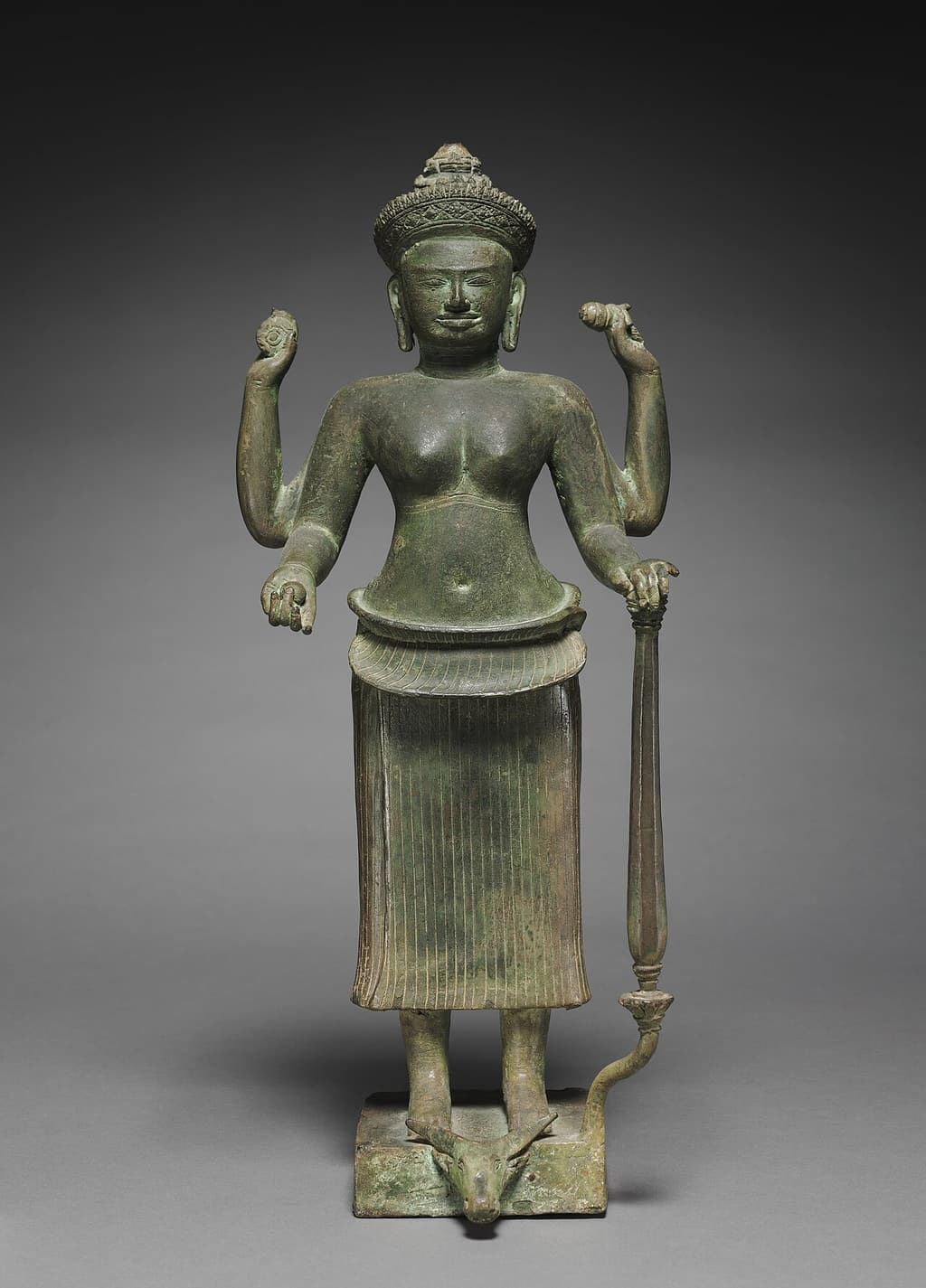
The gods do not send a champion. They cannot; they have already lost. What they do instead is stand together and pour their anger out of their own bodies until it fuses into a mountain of fire, and out of the fire comes a woman none of them has met. Then each of them hands her the weapon he personally cannot beat the enemy with, and steps back.
That is the founding scene of goddess-centred Hinduism, and it is set out with the precision of an inventory.
Losing heaven
Mahishasura had defeated the gods in a war that ran a hundred years, taken Indra's place, and assumed the offices of the sun, the moon, the wind, the fire and the lord of the dead. The gods were expelled from their own heaven and were walking on the earth like ordinary displaced people.
They went to Brahma, and Brahma took them to Shiva and Vishnu, and the whole story was told out loud in front of them.
The making
What happened then is described physically. Vishnu's face darkened with anger and a great light came out of it. The same happened to Shiva, and to Brahma, and to Indra, and then to every deity in the assembly — and the lights did not disperse. They combined, and grew, and stood there as a blazing mass filling the quarters of the sky, and then took the form of a woman.
The Devi Mahatmya itemises which god supplied which part of her, and the list is not decoration: it is a legal statement that she is the composite and total power of the entire pantheon.
- Her face from the light of Shiva.
- Her arms from Vishnu.
- Her hair from Yama, the lord of the dead.
- Her breasts from the moon; her waist from Indra.
- Her thighs and legs from Varuna; her hips from the earth; her feet from Brahma.
- Her toes from the sun, her fingers from the Vasus, her nose from Kubera.
- Her teeth from the lord of creatures; her three eyes from fire; her eyebrows from the twin physicians of the gods; her ears from the wind.
Then the arming, which is done the same way — not manufactured for her but drawn out of the gods' own equipment, each producing a duplicate of what he carries.
Shiva pulled a trident from his trident. Vishnu drew a discus from his discus. Varuna gave a conch, and a noose. Fire gave a spear. The wind gave a bow and two inexhaustible quivers. Indra produced a thunderbolt from his thunderbolt, and a bell from the neck of his elephant. Yama gave a staff, Brahma a rosary and a water pot. The sun poured his rays into the pores of her skin. Time gave a sword and a shining shield. The ocean gave garments, a necklace, a crest jewel, earrings and armlets. The divine architect gave an axe and armour that could not be cut. The mountain gave her jewels — and a lion to ride.
Then she laughed, and the sound went on and on, and the sky would not hold it, and the earth shook, and the demon army heard it and came.
The battle
She fought the generals first, and the Devi Mahatmya names them one after another as they die — Chikshura the great commander, Chamara riding his elephant, Udagra, Mahahanu, Asiloman, Baskala, Ugravirya, and armies behind them in numbers the text gives in tens of thousands.
The lion is not a mount in these passages. It goes through the demon ranks the way fire goes through dry grass, killing on its own account while she is occupied elsewhere.
Then Mahishasura himself, and this is where the story becomes what it is: he changes shape four times, and each change is an attempt to escape the fight rather than win it.
He came in his buffalo form and scattered troops with his horns and his hooves and the wind of his lashing tail. She threw her noose over him — and the buffalo was gone and there was a lion in the noose.
She struck at the lion's head, and the lion was gone and there was a man with a sword and a shield.
She loosed arrows at the man, and the man was gone and there was a great elephant, which took hold of her lion with its trunk and began to drag it.
She cut off the trunk, and the elephant was gone and he was a buffalo again, tearing up mountains and throwing them.
Then she drank from the cup she carried, and her eyes went red, and she laughed at him. He was still boasting when she leapt down, put a foot on his neck, and drove the trident into him.
He tried, at the last, to come out of the buffalo's mouth in his own form. She got the great sword to him while he was half emerged, and took his head off there, and the gods stood on the field and praised her.
The text this comes from
What is retold above is the middle episode of the Devi Mahatmya. The same work circulates under two other names, the Chandi and the seven-hundred verses of the goddess, and the second of those is a count: it runs to roughly that many verses and sits as a self-contained unit inside the Markandeya Purana. Its usual dating is the fifth or sixth century CE.
It is the foundational text of Shakta Hinduism, and its claim is stated rather than implied: the goddess is not the consort of a great god, nor his energy on loan, but the ultimate reality herself, from whom the gods derive their power and to whom they return it when they are beaten.
The work has a frame that is easy to skip and worth knowing. A king who has lost his kingdom and a merchant who has been robbed and thrown out by his own family meet in a forest hermitage, both unable to stop caring about the people who ruined them, and a sage tells them three stories about the goddess to explain why. The three episodes — the demons Madhu and Kaitabha, Mahishasura, and Shumbha and Nishumbha with the blood-multiplying Raktabija — are answers to two men's specific misery, not free-standing myths.
Other Puranas tell the Mahishasura story too, with different emphases, and the Devi Bhagavata gives him a birth: son of a demon and a she-buffalo, protected by a boon that ruled out death at the hands of any male, mortal or divine. The gap in that wording is why the answer had to be a goddess, and it is the same structural trick that repeatedly organises Puranic narrative — an exhaustive-looking immunity with one unexamined gap in it.
Where it lives now
The Devi Mahatmya is not a text people read about. It is recited, in full, during Navaratri, the nine nights of the goddess, twice a year.
In Bengal, Assam, Odisha and increasingly far beyond, the autumn festival is Durga Puja: clay images built up on straw and bamboo armatures by hereditary artisan families in Kolkata's Kumartuli quarter, installed in temporary pavilions that have become a competitive art form in their own right, worshipped for days, and then carried to the river and immersed. UNESCO added it to its list of intangible cultural heritage in 2021. In Mysuru the same goddess, as Chamundeshwari on the hill above the city, is the reason for one of India's largest processions.
There is also a radio programme. Since the 1930s, All India Radio in Kolkata has broadcast a Bengali devotional montage of the goddess's descent in the small hours of the morning that opens the festival period, and generations of listeners have got up in the dark to hear the same recording. It is one of the most durable pieces of religious broadcasting anywhere.
The image of the killing — the goddess with many arms, the lion, the trident going in, the demon emerging from the severed buffalo neck — is among the most-carved subjects in Indian art. The seventh-century Pallava relief at Mamallapuram, where she rides forward on the lion against a huge buffalo-headed figure retreating with his club, is the version most often reproduced, and its two names in the scholarly literature reflect an old disagreement about the cave it sits in.
Reading it honestly
It is a theological argument, not just a battle. The composite creation is the whole point: the gods' power does not defeat the demon while it is distributed among them and works when it is unified in her. Shakta readings take that literally — the many gods are aspects, she is the substance.
The shape-shifting is the theme. Mahishasura does not fight her; he keeps becoming something else, and she keeps finding him. A demon whose only strategy is escape, killed at the moment he emerges from one form into another, is a fairly precise image of what the text says the goddess does to delusion.
The gods do not fight. After the making, they contribute nothing. They watch, and at the end they praise her. Very few narratives in world religion demote their own established pantheon quite this comprehensively inside a single episode.
And Mahishasura is not universally a villain. Some communities in eastern and central India — including groups who take their name from the asuras — hold traditions in which he is an ancestor and a wronged king, and commemorate him rather than his killing. Those observances, and the argument about absorption and displacement that surrounds them, belong to Durga's own page rather than to the retelling of the text; they are real, they are contested, and they are not settled here.
Questions worth answering
Is Durga the same as Parvati? Depends who is answering. Much of northern practice treats Durga as a form of Parvati, Shiva's wife, and Bengali Durga Puja explicitly celebrates a married daughter's annual visit home with her children. Shakta theology as the Devi Mahatmya states it does not subordinate her to anyone; she is prior. Both are held sincerely and the question is not neutral.
Where does Kali come in? Not in this episode. She emerges from the goddess's forehead in the third one, when Raktabija's blood is producing a new demon from every drop that touches the ground, and she solves it by drinking the blood before it lands.
Why the wine? The text has her drink before the final assault and her eyes redden. Devotional commentary reads it as the intoxication of battle-fury; ritual practice in some Shakta traditions includes offerings that non-Shakta Hindus do not make. It is one of several places where this text is closer to Tantric practice than to mainstream Puranic devotion.
How many arms does she have? The text does not fix a number, and images vary from four to eighteen. The arms are a way of showing that she is holding every god's weapon at once, which is the argument the creation scene made.
Is Mysuru named after him? The city's name derives from a form meaning the town of the buffalo demon, and the goddess who killed him is its patron on the hill above. Both the demon and his killer are commemorated in the same place, which is more common in Indian religious geography than outsiders expect.
Continue with Durga, Kali, Parvati, Lakshmi and Saraswati; the other great Puranic origin dispute at how Ganesha got his head; and the Hindu tradition hub.