The poem does not begin with the war, or the storm, or the monsters. It begins in a house on a small island, with a young man who has never met his father watching a hundred and eight men eat his inheritance and being unable to say anything about it. Homer withholds his hero for four books and then, when he finally produces him, produces him crying on a beach. Almost everything people know about the Odyssey — the cyclops, the sirens, the whirlpool — is packed into four books in the middle, and it is all narrated by Odysseus himself, at a dinner party, to strangers, by a man the poem has just spent a book establishing as the best liar alive.
Ithaca first: a household in occupation
Twenty years after he sailed for Troy, the men of the islands have decided he is dead and are courting his wife. They live in his hall, kill his livestock daily, and treat his son Telemachus as furniture. Penelope has held them off for three years with the shroud she wove for old Laertes and unpicked each night, and they have found her out.
Athena comes to the door disguised as a family friend, and what she does is not magic but advice: call an assembly, say it aloud in public, then go and ask the men who came home from Troy what they know. Telemachus sails to Pylos and then to Sparta, where he finds Menelaus and Helen hosting a wedding, comfortably married, telling stories about the war in front of each other. Helen slips a drug into the wine that stops grief. It is one of the eeriest domestic scenes in Greek literature, and it exists to show a boy what a restored household looks like.
Book 5: the man himself, seven years in
He is on Calypso's island and has been for seven years, sleeping with a goddess who has offered to make him immortal, and spending his days on the shore looking at the sea and weeping. That is how Homer introduces the cleverest man in the world.
Hermes arrives with an order. Calypso is furious — she names, at length, the male gods who are allowed mortal lovers when goddesses are not — and complies. Odysseus builds a raft, sails eighteen days, and is wrecked by Poseidon within sight of land. A sea nymph gives him a veil to keep him up. He crawls ashore naked, buries himself in a heap of dead leaves, and sleeps.
He is found by a girl doing laundry. Nausicaa, princess of the Phaeacians, has come down to the river with the palace washing because Athena gave her a dream about her wedding clothes, and she deals with a naked stranger emerging from a bush with more composure than anyone else in the poem manages all year. Her people are sailors of an almost magical competence; her father Alcinous feeds him, and at the feast the bard sings about the wooden horse, and the guest covers his face and cries, and is asked who he is.
The stories he tells about himself
Books 9 to 12 are the traveller's own account, and their status is worth holding in mind: nobody corroborates any of it.
He raided the Cicerones and lost men because his crew would not leave when he said. He touched at the country of the lotus-eaters and had to drag men back to the ships weeping. Then the cave.
The cyclops episode is the finest thing in the poem and the most damaging thing Odysseus ever does. He goes into Polyphemus's cave uninvited, with twelve men, out of curiosity, and asks for a guest-gift. The cyclops's reply — that his kind do not fear Zeus — establishes him as the perfect anti-host, and he eats six of the men. Odysseus gets him drunk, tells him his name is Nobody, and drives a sharpened olive stake into his single eye; the other cyclopes, hearing screams and being told Nobody is killing him, go back to bed. The men escape strapped under the bellies of the sheep. And then, safely offshore, Odysseus shouts his real name and his father's name and his address back at the blinded giant, because he cannot bear to have done it anonymously. Polyphemus prays to his father Poseidon, and now the god has something to curse.
After that: Aeolus, who gives him all the contrary winds tied in an oxhide bag, and a crew who open it in sight of the smoke of Ithaca because they think it is treasure. The Laestrygonians, cannibal giants who sink eleven of his twelve ships with rocks in a narrow harbour. Circe on Aeaea, who turns the scouting party into pigs and is defeated by a herb Hermes supplies, and with whom he then stays a year, until his men have to remind him that they have a home.
The dead, and the last of the crew
Circe sends him to the edge of the world to consult a dead prophet. He digs a trench, pours blood into it, and the dead come to drink.
Teiresias tells him the route home and something else, less often quoted: that even after Ithaca he must take an oar inland until he meets people who mistake it for a winnowing fan, and there make sacrifice, and that death will come to him from the sea, gently, in old age. Then his mother comes — he did not know she was dead — and he tries three times to hold her and closes on nothing. Agamemnon describes being murdered at his own homecoming dinner and warns him not to trust any woman. Achilles, offered congratulations on being a king among the dead, replies that he would rather be a hired labourer on a poor man's farm than rule all the corpses in the world. Ajax will not speak to him at all, and walks off into the dark, and that silence is the single best-judged effect in Homer.
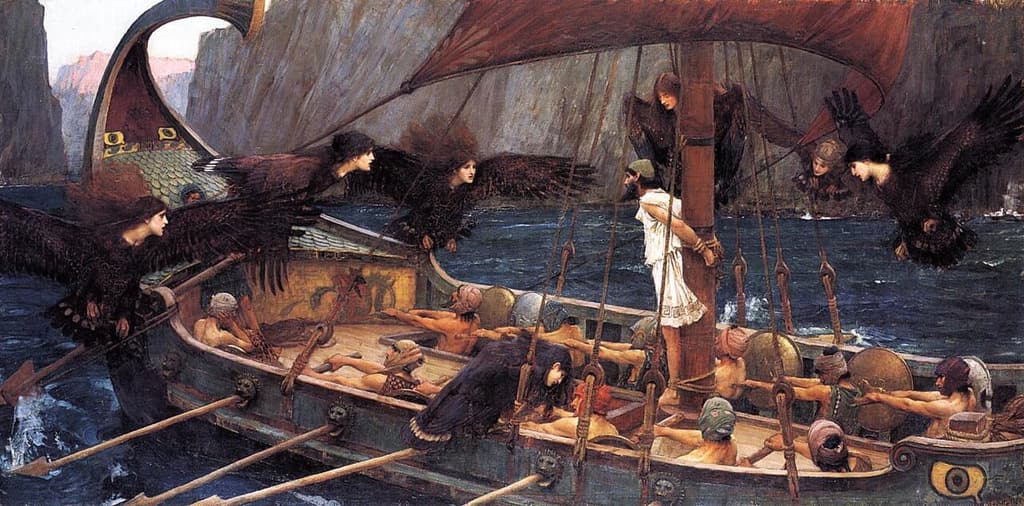
Then the passage back: the Sirens, whose promise is not beauty but knowledge — they offer to tell him everything that happened at Troy — heard with his crew's ears plugged and himself lashed to the mast. Scylla and the whirlpool, where he obeys Circe's instruction to sail close to the six-headed thing and lose six men rather than lose the ship, and does not warn the crew. And finally Thrinacia, where the cattle of Helios graze and where his starving men, while he sleeps, slaughter them. The hides crawl. The spitted meat lows on the fire. Zeus breaks the ship with a thunderbolt, and Odysseus alone survives, clinging to the keel, and drifts to Calypso — which is where the flashback closes and the poem's present resumes.
The half of the poem nobody summarises
The Phaeacians put him ashore on Ithaca asleep, and the second half — half the whole poem — is a slow domestic thriller. Athena disguises him as an old beggar. He goes first to his swineherd Eumaeus, who does not know him and treats him well, which is the standard the poem is measuring everyone against. He reveals himself to his son in a hut. He walks into his own hall and is insulted, kicked, and hit with a footstool.
The old dog Argos, lying on a dung heap, lifts his head and knows him, and dies. It takes four lines.
His old nurse Eurycleia washes his feet and finds the boar-scar on his thigh and nearly says his name aloud, and he takes her by the throat until she is quiet. Penelope, who may or may not have worked out who he is — scholars have argued this for a century and Homer refuses to settle it — announces a contest: the bow that only her husband could string, and an arrow through the sockets of twelve axe-heads.
The beggar wins it, and turns, and shoots the loudest of the suitors through the throat as he lifts his cup. What follows is a massacre in a locked room, with his son and two herdsmen beside him, and it does not read as a triumph. Afterwards the twelve maids who slept with the suitors are made to carry out the bodies and clean the floor, and then hanged in a row in the yard.
Penelope's test is the last and cleverest thing in the book. She orders the bed moved out of the chamber, and he objects that it cannot be moved, because he built it himself around a living olive trunk rooted in the floor. Only two people alive know that. She lets go.
The families of the dead come for him the next morning, and the poem ends with a goddess stopping a blood feud in a field, rather abruptly, in a passage that ancient scholars themselves suspected was not original.
How this text reached us, and what is argued about it
The Odyssey was composed in performance before it was written — probably in the late eighth or seventh century BCE, in a tradition of oral hexameter poetry whose workings were reconstructed in the 1930s by Milman Parry and Albert Lord, partly by recording living epic singers in the Balkans. That is why the poem is full of repeated phrases and set scenes: they are the working equipment of a singer composing at speed.
Live disputes worth knowing about:
- One poet or two. The Iliad and Odyssey differ in vocabulary, outlook and technique, and the ancient scholars who thought them by different hands were called the Separatists. The question is still open and probably unanswerable.
- The ending. Book 24 — the second visit to the dead, the recognition scene with Laertes, the aborted feud — was athetised by Aristarchus and Aristophanes of Byzantium, who held the poem ends at the marriage bed. Most modern editors keep it and defend its design.
- The geography. Attempts to map the wanderings onto real Mediterranean coasts began in antiquity and have never stopped. Eratosthenes' verdict is the one to remember: you will find the route of Odysseus's wanderings when you find the cobbler who stitched the bag of the winds.
- Samuel Butler's proposal that the poem was composed by a young Sicilian woman is not accepted by anyone, but his observation that the domestic interiors are described with far more interest than the battles is worth more than his conclusion.
Why hospitality is the real subject
Every stop is a test of the same institution. The cyclops eats his guests. The Laestrygonians eat his guests. Circe drugs them. Calypso keeps her guest for seven years, which is its own kind of violation. The Phaeacians do it perfectly — feed the stranger, do not ask his name until he has eaten, send him home loaded with gifts — and are punished by Poseidon for it anyway. And the suitors, back on Ithaca, are guests who will not leave.
For an audience of Greek islanders whose survival depended on being taken in by strangers at the far end of a voyage, this was not a theme. It was the law, told as adventure.
Its very long afterlife
Dante puts Ulysses in the eighth circle of hell as a counsellor of fraud and invents a final voyage for him past the Pillars of Hercules to his death — an ending Homer never wrote and which has been irresistible ever since. Tennyson took that restlessness and made it Victorian. Cavafy told readers the destination was never the point. Joyce mapped every episode onto one day in Dublin in 1904 and turned Odysseus into an advertising canvasser, which remains the most audacious thing ever done with a classical text. Margaret Atwood gave the twelve hanged maids their own voices. The Coen brothers set it in Depression-era Mississippi.
And the Telegony, a lost epic of the Cycle, supplied the sequel nobody wants: Telegonus, Odysseus's son by Circe, comes looking for his father, does not recognise him, and kills him with a spear tipped with a stingray's barb — death out of the sea, gently, as promised.
Details worth checking
How many men came home with him? None. He leaves Troy with twelve ships; eleven are destroyed by the Laestrygonians, and the last crew is killed by Zeus for eating the sun's cattle. He arrives on Ithaca alone, asleep, in a borrowed boat.
Is Penelope's recognition scene meant to be ambiguous? The poem gives her the bed trick after she has already had several chances to acknowledge him, and it never states what she believed and when. Ancient and modern readers both split, and the ambiguity looks deliberate: she is the only character who out-manoeuvres him.
What is the winnowing-fan errand for? Teiresias's instruction sends Odysseus to a people who have never seen the sea, to plant an oar and sacrifice to the god who has hunted him — a formal reconciliation with Poseidon carried out at the furthest possible point from his own element. Homer never narrates it, and the omission is one of the reasons later poets kept writing sequels.
Was there really a bag of winds? As a story motif, wind tied up in a bag is attested across a wide range of northern and Mediterranean sailors' folklore. Homer's version is the earliest surviving literary instance, and the detail that ruins it — the crew opening it out of greed within sight of home — is exactly the sort of thing this poem does to its hero.
Continue to the trick that ended the war, or to the Greek tradition as a whole.